Health · Ireland
Temple Street Children's Hospital
- Client
- Children's Health Ireland at Temple Street
- Architect
- O'Connell Mahon Architects
- Location
- Temple Street, Dublin 1
- Completed
- 2019–2020
- Sector
- Health
- Scope
- Bilingual Irish and English signage throughout the outpatient department · Colour-banded level directories for the renal and neurology floors · Room identification panels with illustrated motif fields · Reception and level identification · Door-mounted roundels for consulting and treatment rooms · Manufacture and installation
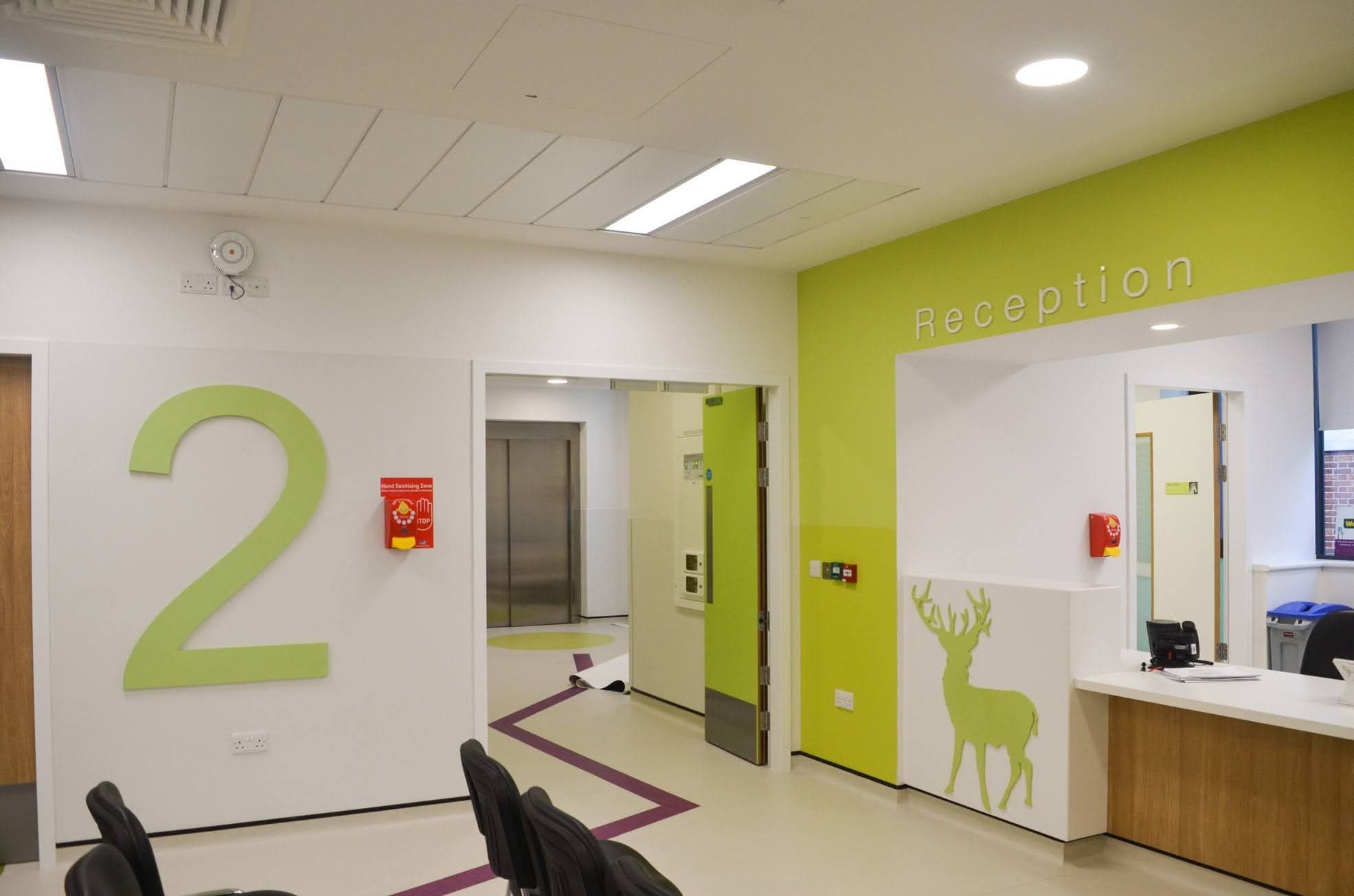
The outpatient department at Temple Street runs renal and neurological clinics across two levels of a three-storey extension raised above the original single-storey OPD. The signage has to explain that building to readers who are, for the most part, children.
Extension area
Storeys
Outpatient levels signed
Languages
The outpatient department at Temple Street sits in a three-storey extension raised above the single-storey OPD that was already there, with the emergency department below it and a protected structure at ground level. Renal and neurological clinics occupy two of those levels. Someone arriving at the door is looking for a building that is almost entirely above them.
Three, two, zero
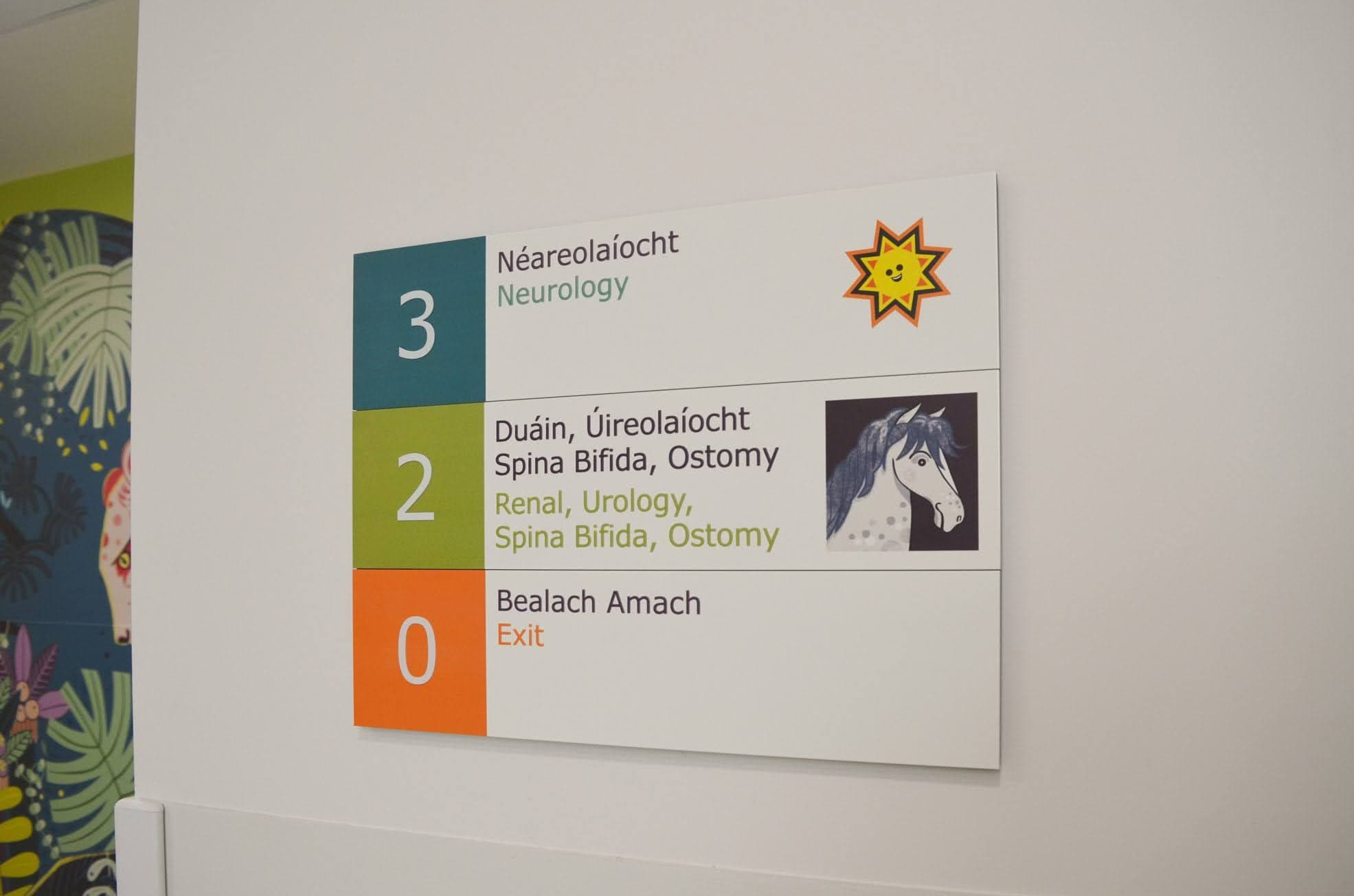
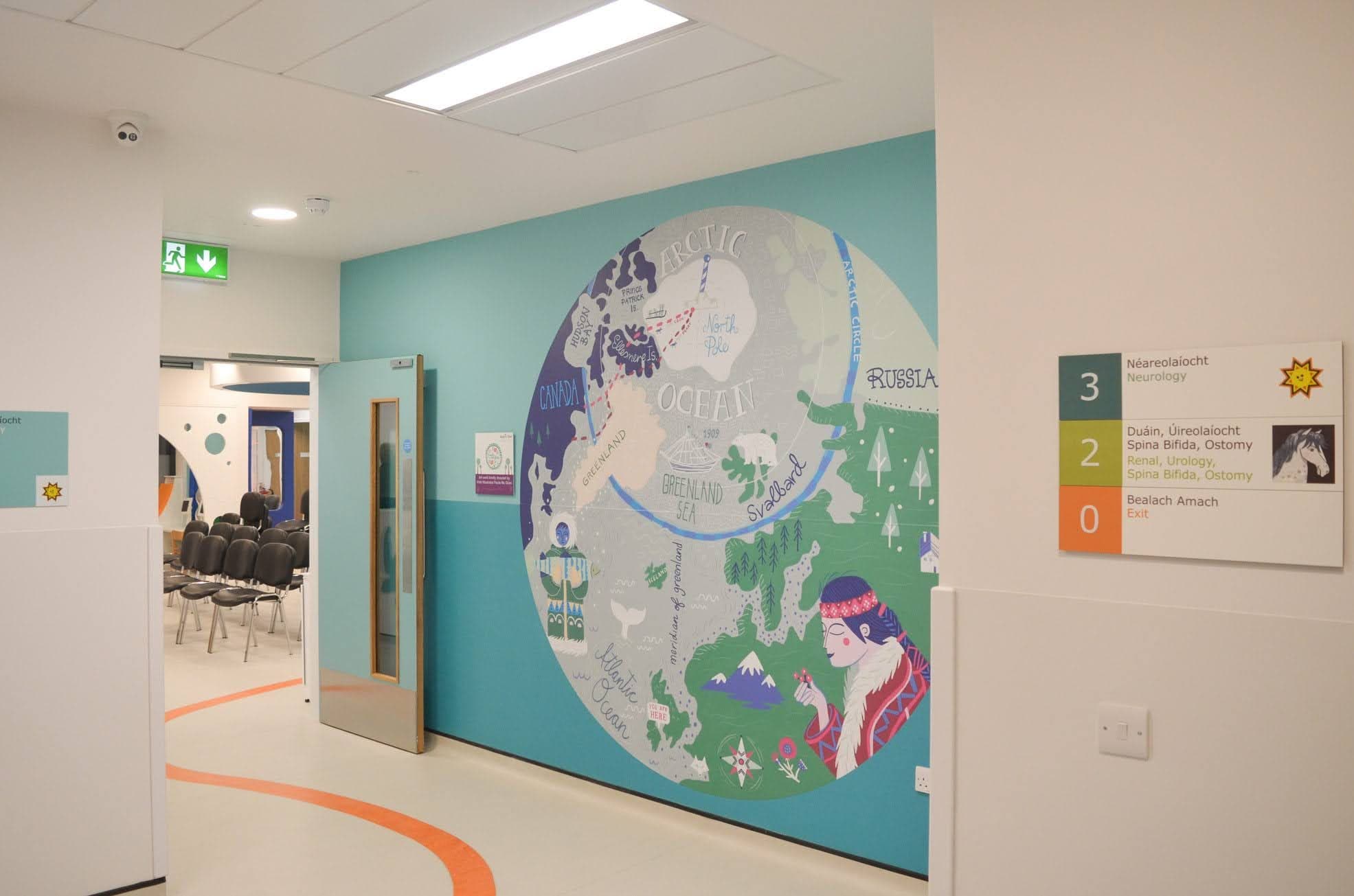
The level directory lists 3 for Néareolaíocht, 2 for Duáin, Úireolaíocht, Spina Bifida, Ostomy, and 0 for Bealach Amach. There is no 1. The first floor is an interstitial plantroom, and a directory that offered it would send a family to a door they cannot open. Each level takes a colour, dark teal, olive or orange, set as a band behind the numeral and repeated in the English line beneath the Irish, so a floor can be recognised before a word of it is read.
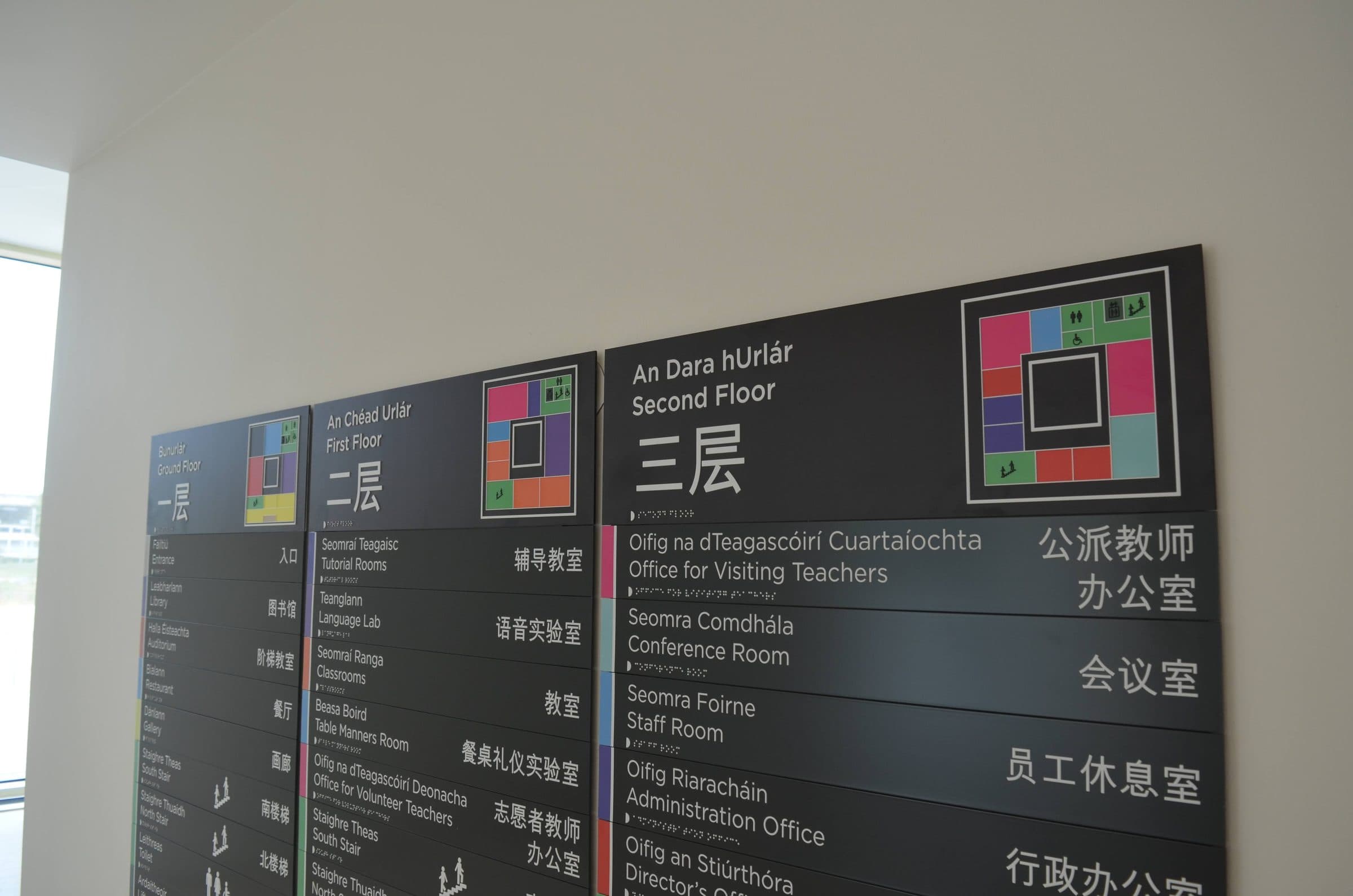
Irish first, then English
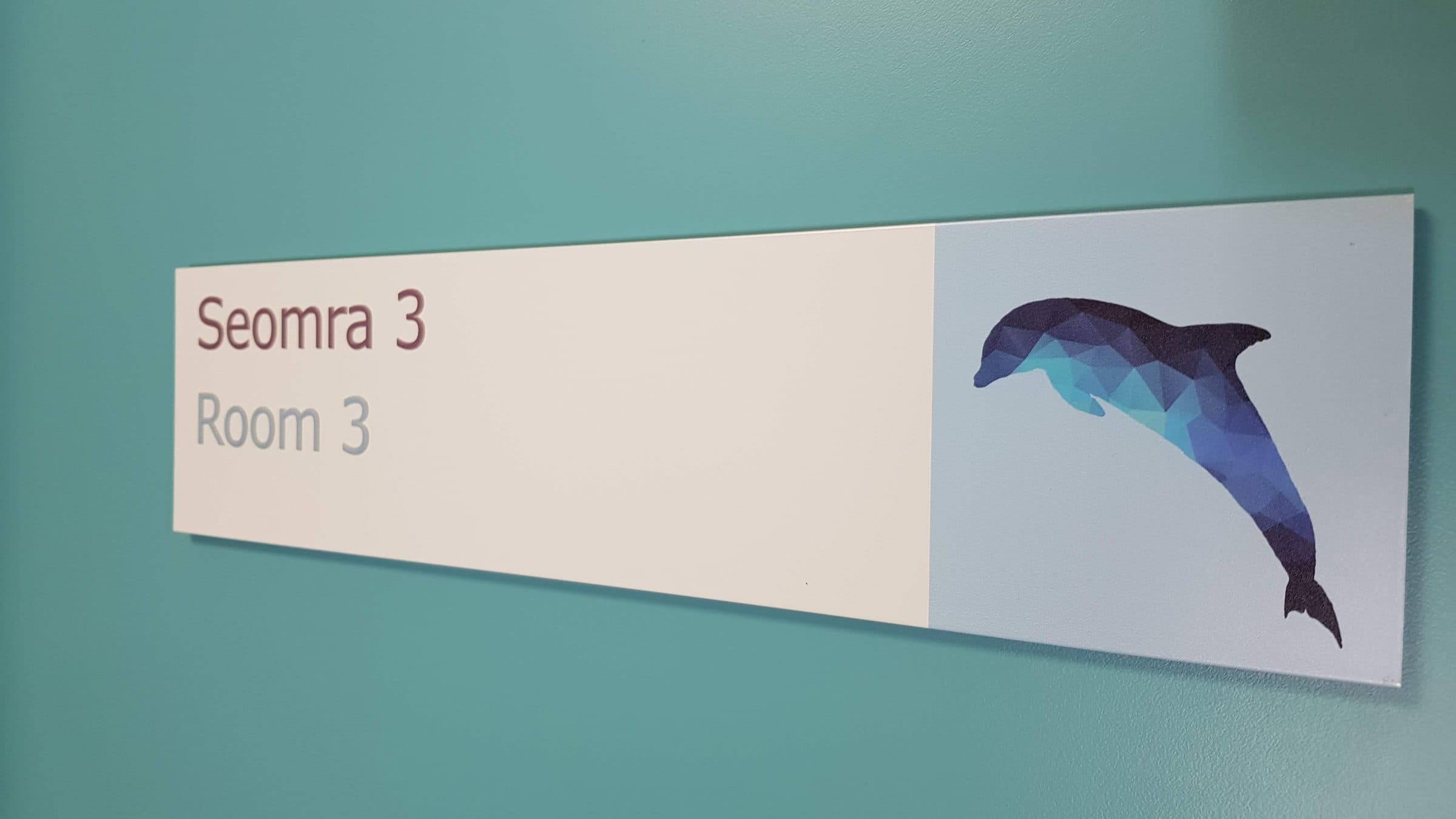
Irish public bodies sign in both languages under the Official Languages Act 2003, with the Irish placed first and no less prominent than the English. Every panel in the department holds to it, down to the smallest: Seomra 3 above Room 3, the Irish in warm maroon, the English in grey directly below. Keeping one convention across directories, room numbers and exits is what stops a bilingual system reading as two systems competing for the same wall.
A child who cannot yet read Néareolaíocht can still find the level with the sun on it.
The motif does the work the words cannot
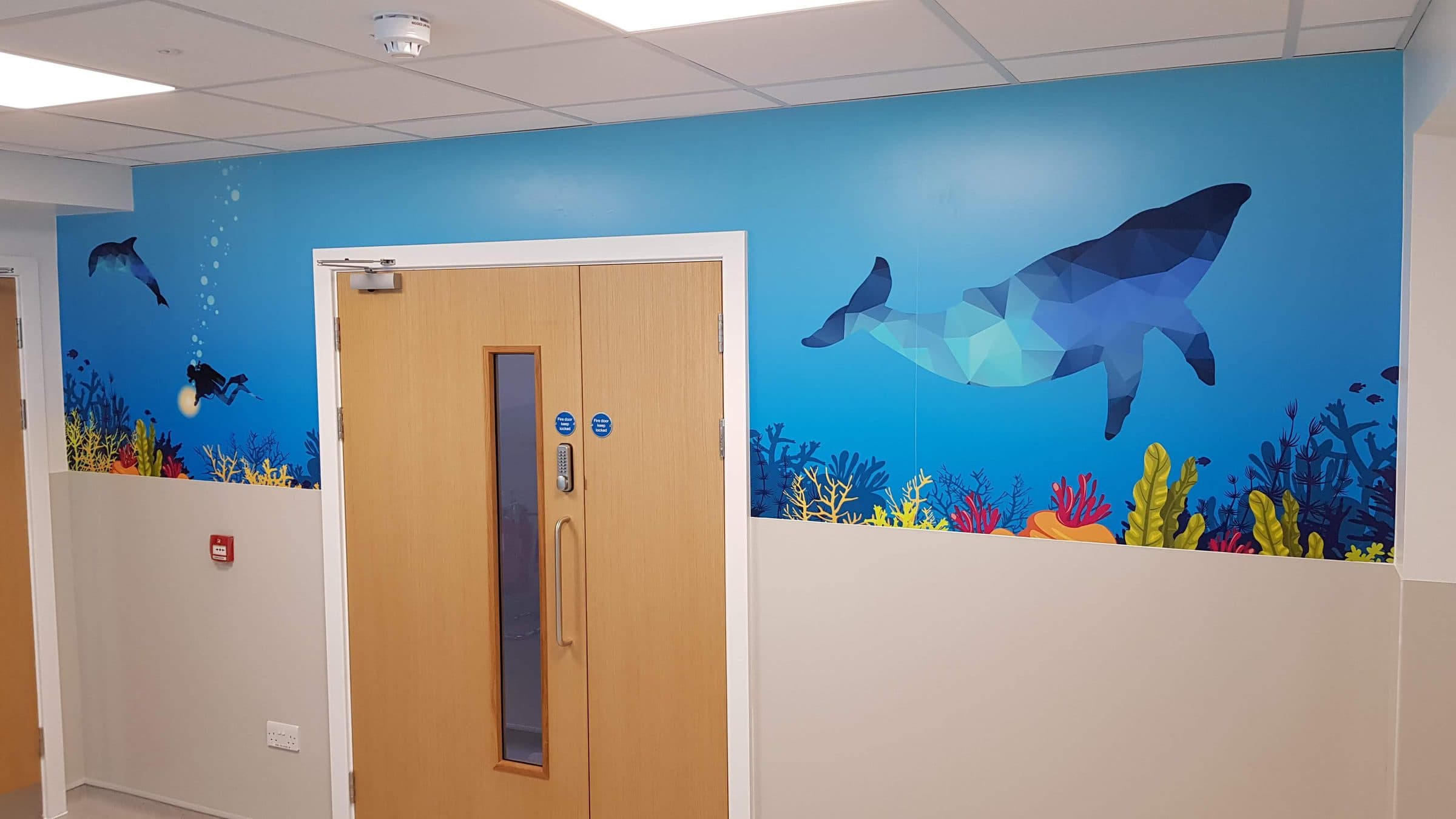
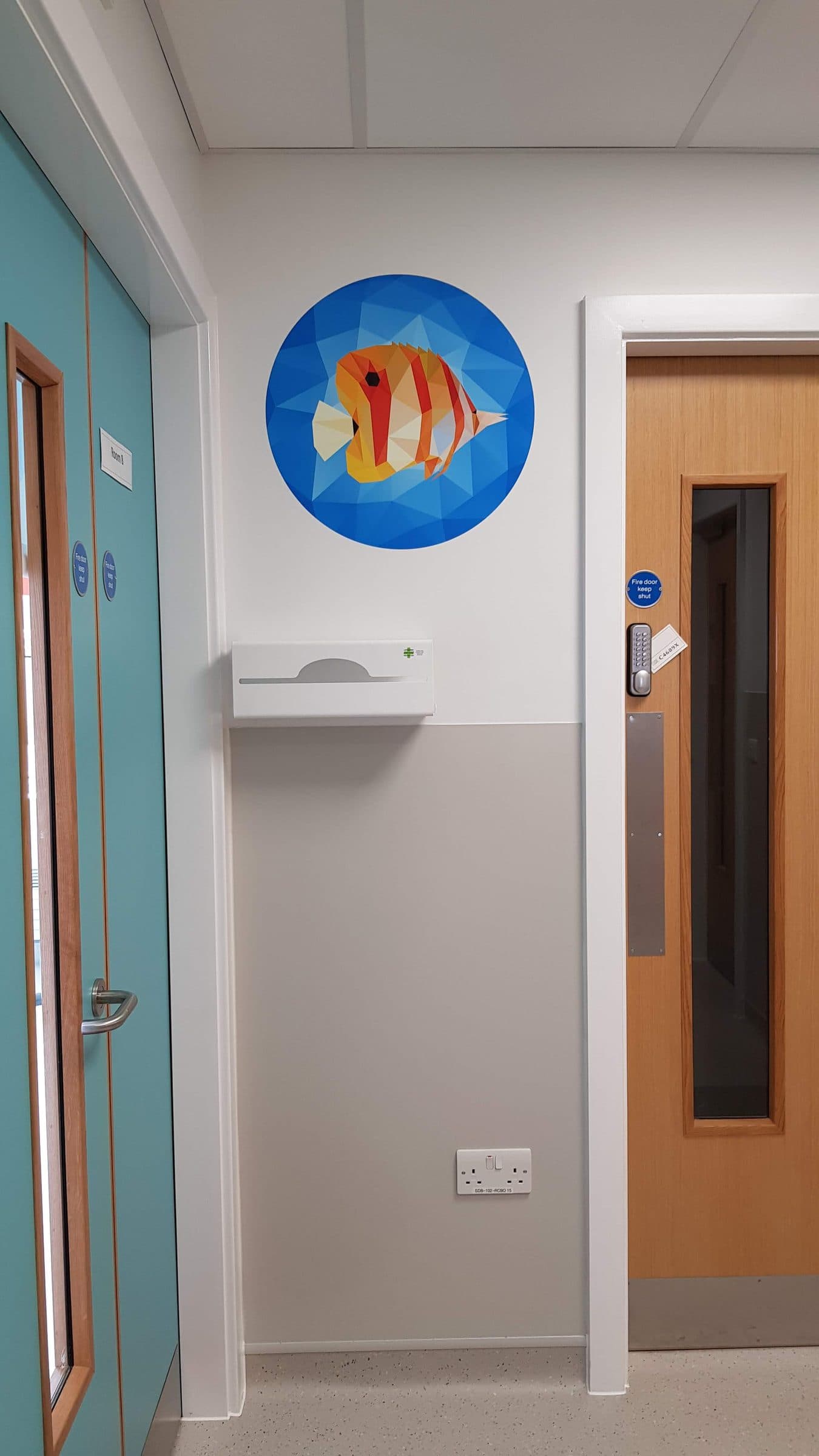
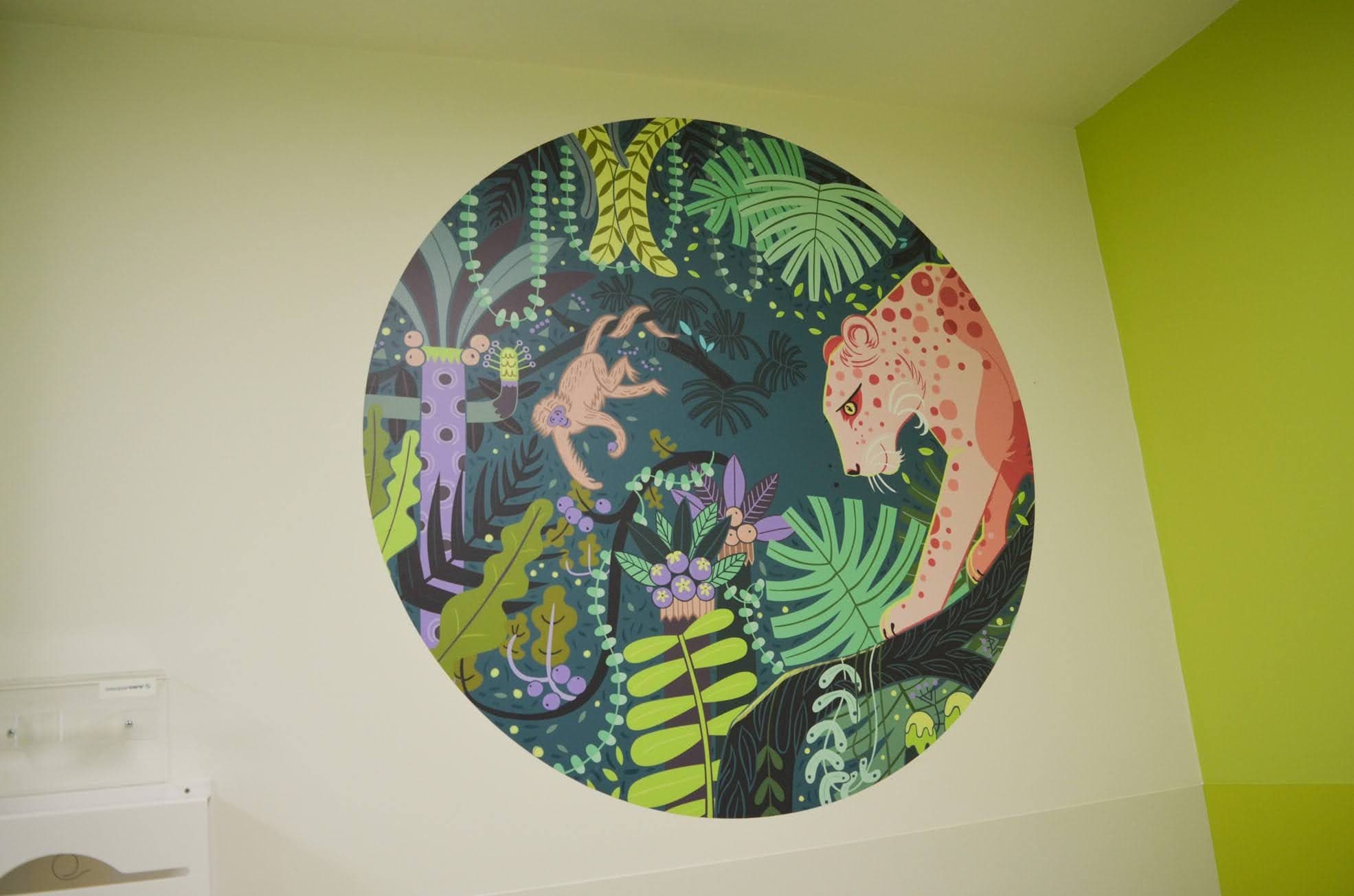
Animal and landscape motifs run through the department (the architect credits them to the artist Paula McGloin), and the signs take them as content rather than decorating around them. The directory gives level 3 a sun and level 2 a horse. Room 3 carries a dolphin in an image field the full depth of the panel. Consulting room doors are found by a roundel: a clownfish at one, a jungle at another. The arctic map on the corridor wall carries a You Are Here marker set into Ireland. A child told to look for the fish has been given a route.
One kit, repeated
Everything in the department is built from the same small set of parts: a flat panel with a square-cut edge, an off-white text field, a colour band for the level, an image field to the right. Directories, room numbers, reception identification and exits all sit on that detail. The variety a children's hospital needs comes from the illustration. The consistency it needs comes from the panel.