
Progressive disclosure in wayfinding: how much should a sign say?
Most signs fail by saying too much. The craft is deciding what a person needs at each decision point, then holding everything else back.
Stand at the entrance of a badly signed building and you meet the failure straight away: one panel, forty destinations, four arrows, and no idea which line applies to you. Progressive disclosure is what prevents that. Give people exactly what they need at each decision point, in the order the journey asks its questions, and hold the rest back until it becomes useful. Done well, nobody notices. Done badly, you get the wall of text nobody finishes.
We've written about hierarchical wayfinding, the strategy of sorting a building's destinations into primary, secondary and tertiary layers. Progressive disclosure is that hierarchy at work on the wall. The strategy decides the pyramid. Disclosure decides how that pyramid gets revealed, sign by sign, along the route. Call it the pacing. After nearly 50 years of designing, supplying and installing these systems, the pacing is where we see most schemes come apart, and it almost never gets a line in the brief.
The sign that says everything
Overloaded signs are rarely designed. They accumulate. Every department wants to appear at the front door, every stakeholder meeting adds a line, and nobody in the room speaks for the person actually reading the thing: a first-time visitor, in motion, who'll give any sign a couple of seconds before deciding it isn't for them. Under stress that window shrinks further, which is why hospitals expose the problem most brutally. The more a sign says, the less of it gets read.
The more a sign says, the less of it gets read.
The instinct behind it is generous: tell people everything, so nobody is left out. But navigation works by elimination. A reader scanning forty destinations is doing the system's filtering for it, at the worst possible moment, with a bag in one hand and an appointment time in the other. A paced system did that work weeks ago, on paper.
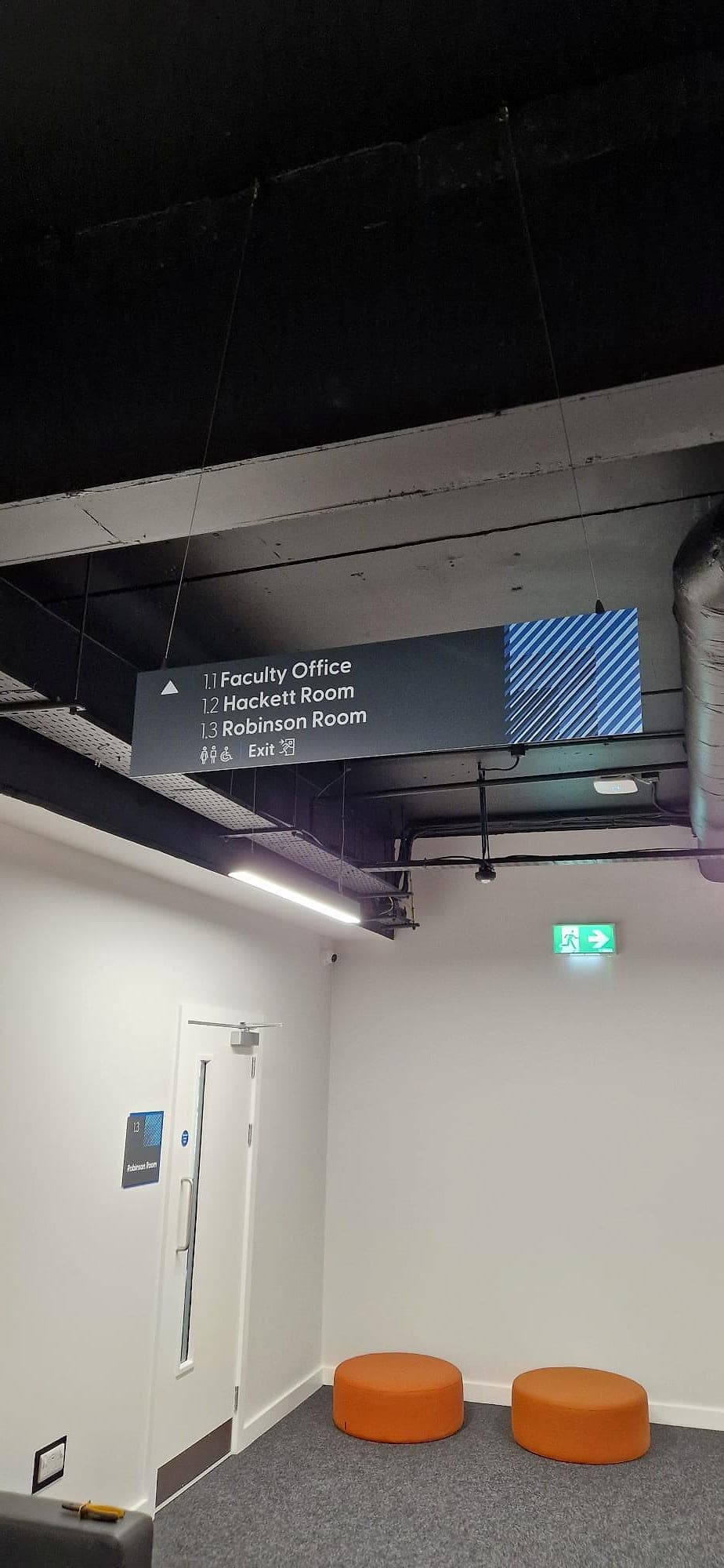
Progressive disclosure: the pyramid on the wall
Progressive disclosure gives each tier of the building its own vocabulary. The entrance and main directory carry the big moves: floors, zones, the handful of primary destinations that structure everything else. Corridor and junction signs carry the middle layer, departments and clusters, each named only from the point where it becomes a live choice. Doors carry the detail: room numbers, names, the fine grain that would drown any directory that tried to hold it. Wayfinding is the system behind the signs, and this is its core mechanism. Information released on approach, like a story told in the right order.
At Wexford Library the entrance monolith holds the whole building, three floors each reduced to its headline contents, precisely so that no other sign has to repeat it. That's the trade at the heart of the method. One sign is allowed to be comprehensive so that every other sign can be brief.
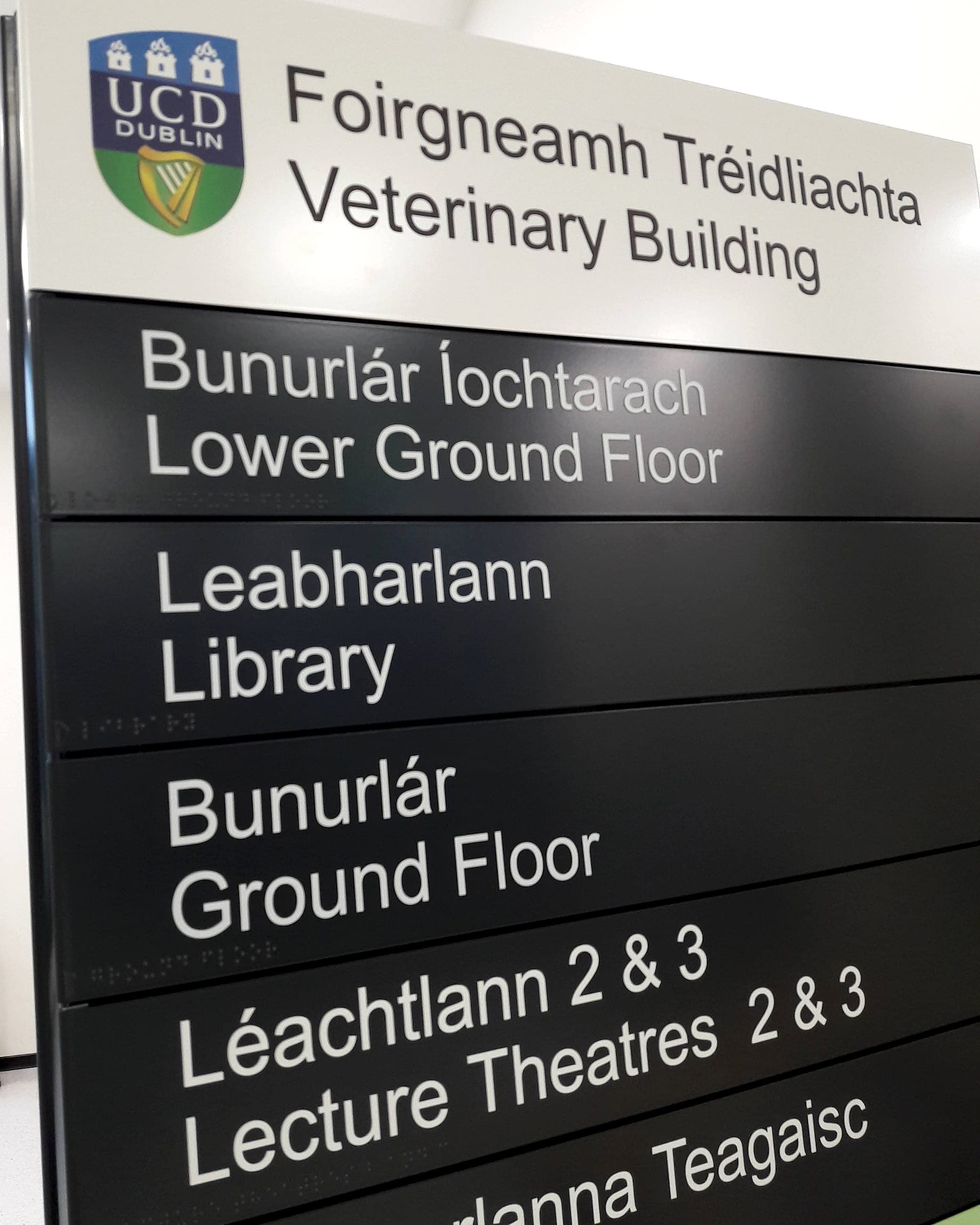
Information at the decision point, and only there
People don't navigate corridors; they navigate decisions. A journey through a building is a chain of junctions, lift lobbies, stair cores and thresholds, each one posing a single question. Which way now? The sign answers that and gets out of the road. Between decision points, the best thing a wayfinding system can do is stay quiet. A corridor with nothing to decide needs reassurance at most, not a repeat of the directory.
Every sign answers one question: what do I do next?
This is also where trust is built or lost. Once a system names a destination, it has made a promise, and progressive disclosure only works if that promise is kept at every subsequent decision point until arrival. A destination that appears at one junction and vanishes at the next sends people back the way they came, convinced they've missed a turn. It is also the easiest thing to break late in a job. A department gets renamed after the panels are drawn, one junction sign misses the revision, and a scheme that was right on the drawing is wrong on the wall. Pacing the information is half the craft. Keeping the trail unbroken to the door is the rest.
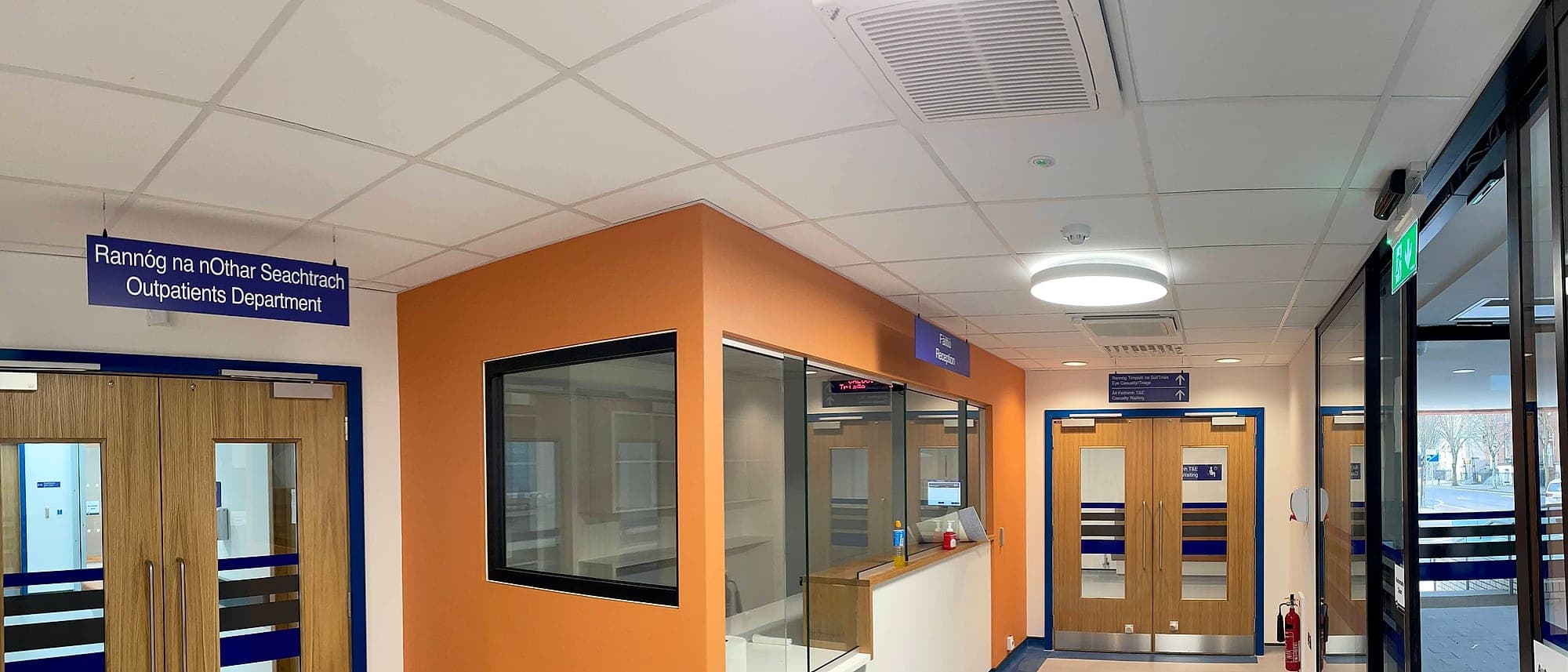
Working limits: how much is too much?
Every building is different, but the limits we design to are consistent:
- Around five destinations per directional sign. Beyond that, reading turns into searching. If a junction genuinely needs more, the naming layer above it needs work, not a bigger panel.
- Three layers of hierarchy, rarely more. Entrance, junction, door. If the destination schedule needs a fourth tier, the schedule is usually overcooked.
- No destination before its time. A room name met three junctions early is noise. Met at the right junction, it's the answer.
- One name per destination, everywhere: invitation letter, website, directory, corridor, door. Disclosure collapses the moment the layers disagree.
- Continuity to the door. Once named, a destination appears at every decision point until it's reached.
The discipline of leaving things off
None of this is technically difficult. What's difficult is the meeting where a department discovers it isn't on the front-door sign. Progressive disclosure is an editorial discipline before it is a design one: deciding, destination by destination, where a name first becomes useful, then defending the blank space left on the panel. That's the real work of wayfinding design, and the destination schedule is where the decisions get written down before a single sign is drawn.
It pays for itself twice over. A paced system needs fewer and smaller signs, which costs less to make and install. It also survives change. When a department moves, you amend the handful of signs that name it and leave the rest alone. The buildings we re-sign are almost never suffering from too little signage. Years of additions, not one subtraction.
Start with the questions, not the signs
If an existing building feels hard to navigate, resist the urge to add panels. Walk the main journeys, note where people hesitate, and ask at each point what the one question being asked there is, and whether the sign in front of you answers it or answers forty others instead. That audit, done honestly, is the beginning of a wayfinding strategy. Want a second pair of eyes on it? Talk to us. Deciding what a sign should leave out is most of what we do.
Planning a wayfinding project? Talk early, while the big decisions are still cheap.