
School signage in Ireland: primary and secondary, done properly
A school is a public building, a workplace and a child's daily landmark all at once. What its signage has to do, and the standards it has to meet.
School signage in Ireland is the full set of identification, directional, statutory and safety signs that let a primary or post-primary school work for everyone in it: pupils, staff, parents, and the visitor who has never been through the door before. Done properly it does four jobs at once. It puts the school's name on the building, funnels every visitor through one controlled entrance, meets accessibility and fire-safety law, and survives four hundred children a day at close range.
We've designed, supplied and installed wayfinding for national schools, Gaelscoileanna and post-primary campuses, among them Scoil Assaim and Gaelscoil Bhaile Munna. Schools are the most underestimated brief in the sector: a small building carrying a public building's workload.
What school signage actually has to do
It helps to separate the layers. They're budgeted and specified quite differently, and schools routinely buy one and assume they've bought all four.
- Identity: the name on the building, at the gate and on the boundary, so a family knows they've found the right place.
- Arrival and visitor control: getting every adult who isn't staff to reception before they get anywhere else.
- Wayfinding: rooms, halls, offices and yards named and numbered so a substitute teacher or an exam invigilator can find them unaided.
- Statutory and safety: escape routes, fire-safety notices, accessible-facility identification and workplace safety signs, where being right matters a good deal more than being nice.
Arrival: one gate, one door, one reception
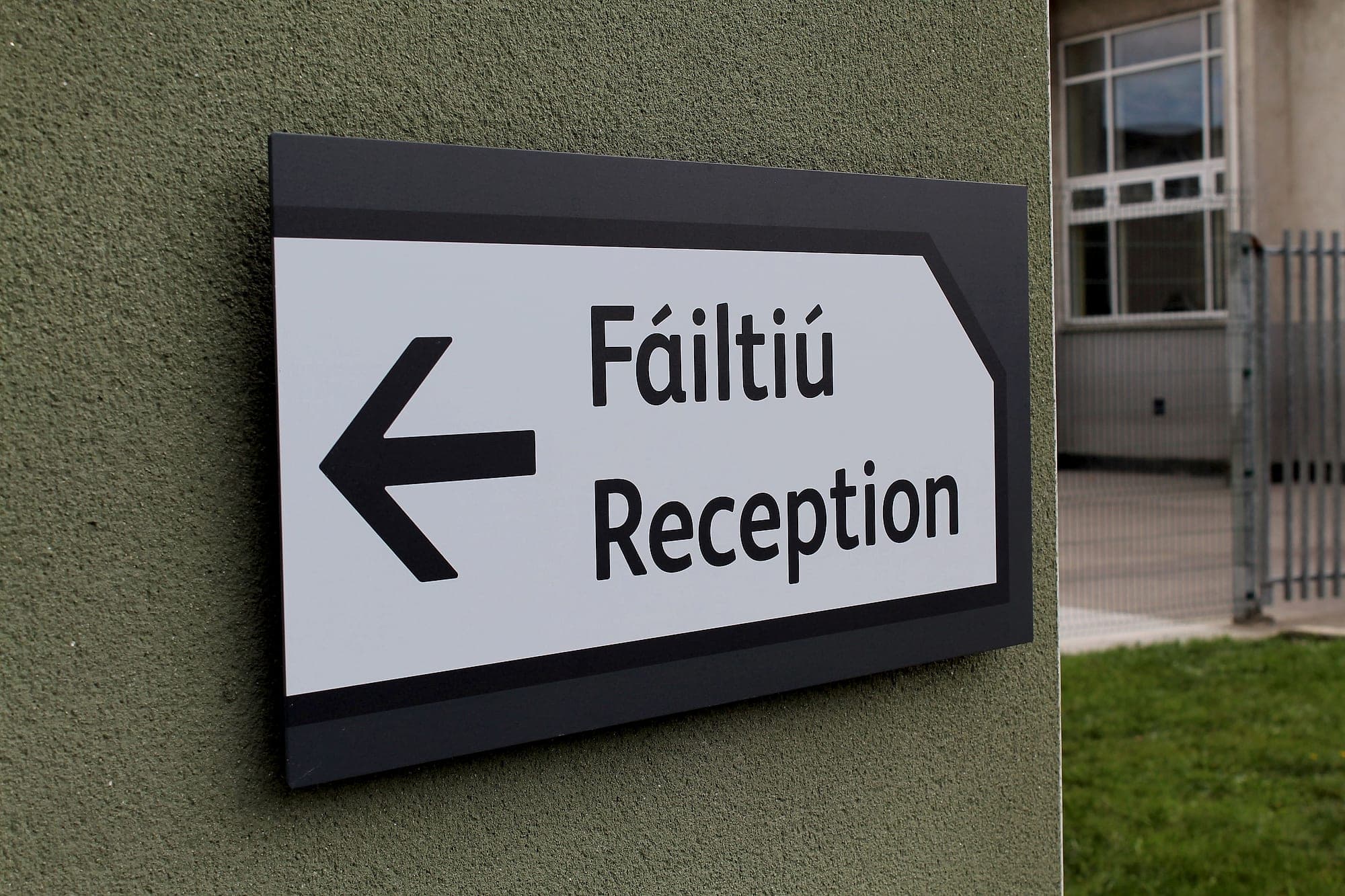
Safeguarding starts as a signage problem. A school's entrance procedure only works if a stranger can follow it without asking anyone, which means the route from the public road to the reception hatch has to read as one unbroken instruction: a boundary sign naming the school, a sign at the vehicle entrance separating visitor parking from the drop-off, and a directional sign that puts "Reception" in front of anyone arriving on foot. Shared sites sharpen this: where a primary and a post-primary share a campus, the first sign a driver meets has to resolve which school before anything else.
At the door, the entrance panel carries the working detail: office hours, the signing-in instruction, and the Child Safeguarding Statement every school holds under the Children First Act 2015. It is the most-read sign in the building, and usually the worst-designed one.
The name on the building
School identity signage is doing more work than it used to. Enrolment is competitive, and the name on the parapet is the first thing a prospective parent photographs. Built-up letters in aluminium or stainless, stud-fixed off the façade, hold their edge for decades and read cleanly against sky. Vinyl on a panel doesn't. And where the school crest appears it needs redrawing for fabrication, because badges designed for print collapse once they're cut at 600mm.
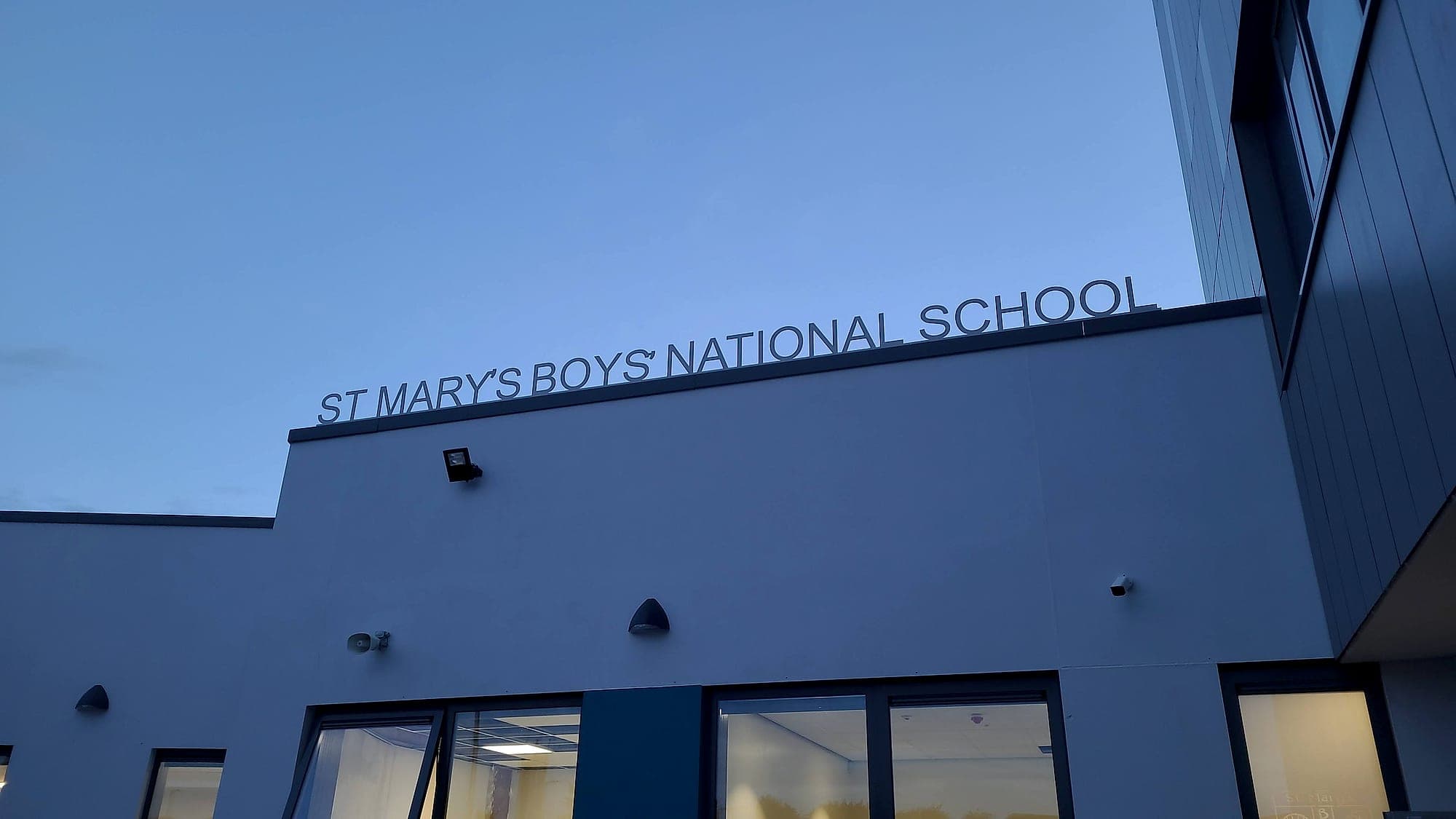
Schools buy the identity sign and assume they've bought the system.
Irish and English, and the Gaelscoil case
Almost every Irish school signs bilingually, and the good ones do it deliberately. The Official Languages Act, meaning the 2003 Act as amended in 2021, obliges listed public bodies to give Irish and English equal prominence. Whether a particular school is itself a listed body is worth checking: a school run by an Education and Training Board sits inside a public body's obligations in a way a voluntary secondary or a privately-patronaged primary usually doesn't. The question rarely decides anything, though. Bilingual signage is the norm, and the design problem is the same either way: two languages, equal weight, on a panel that must not become a paragraph.
The discipline is to keep the pair tight. Irish above English, same typeface, same size, differentiated by weight or colour if at all, and a pictogram left to carry the meaning neither language needs to spell out. In a Gaelscoil the calculation changes again: signage is in Irish alone, because the building is part of the immersion. That's a fine choice, provided the symbol set is strong enough that a visiting grandparent with no Irish still finds the office and the toilets.
Naming rooms so a stranger can find them
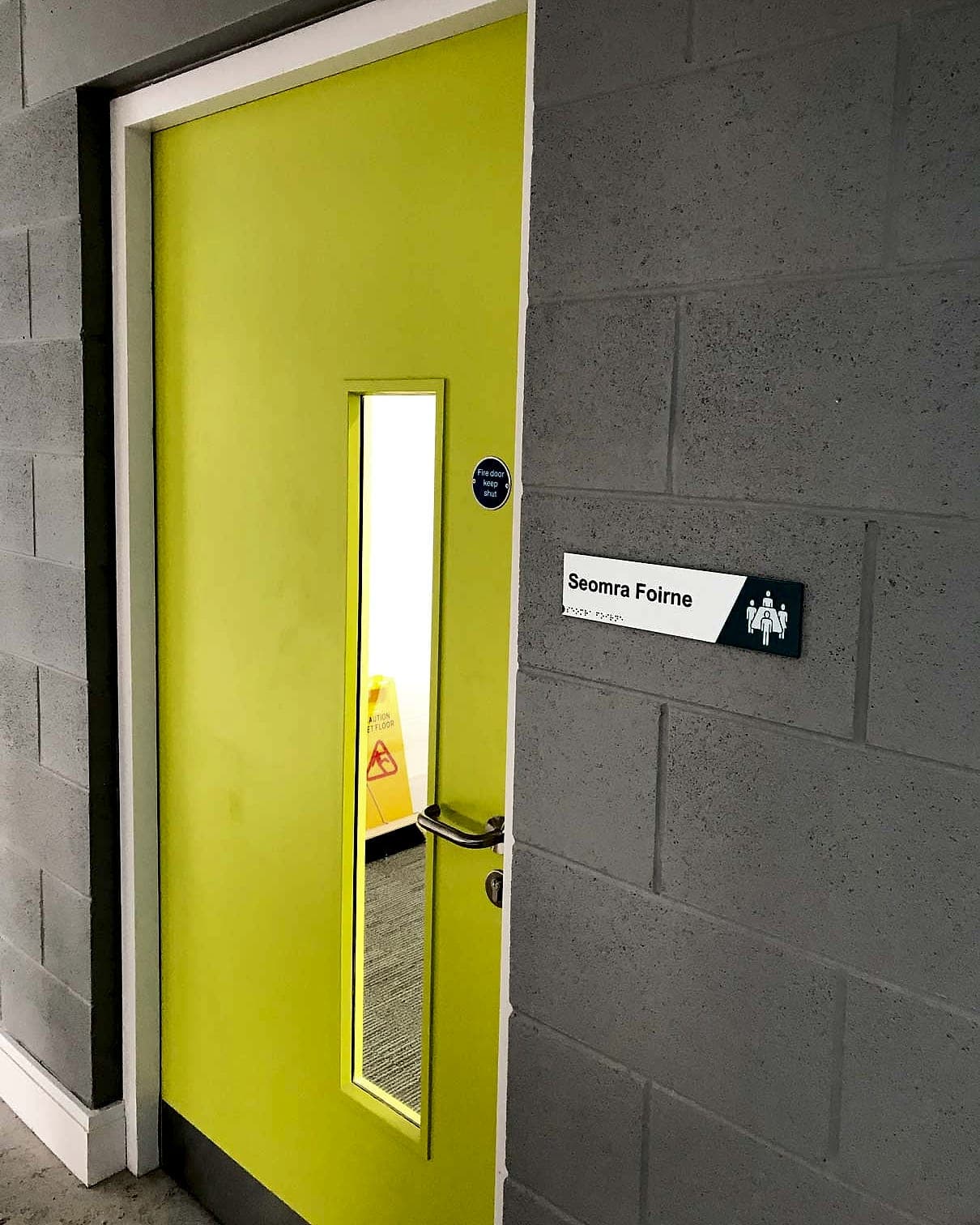
Internally the failure mode is always the same. Everyone who works in the school knows where everything is, so nothing gets named for the person who doesn't. Rooms acquire staffroom nicknames (the old prefab, Ms Byrne's room) that appear on no sign and no timetable. The fix is a destination schedule agreed before anything is manufactured: one authoritative list of names and numbers, used identically on the sign, the timetable, the evacuation plan and the booking sheet for the club that uses the hall on Tuesdays.
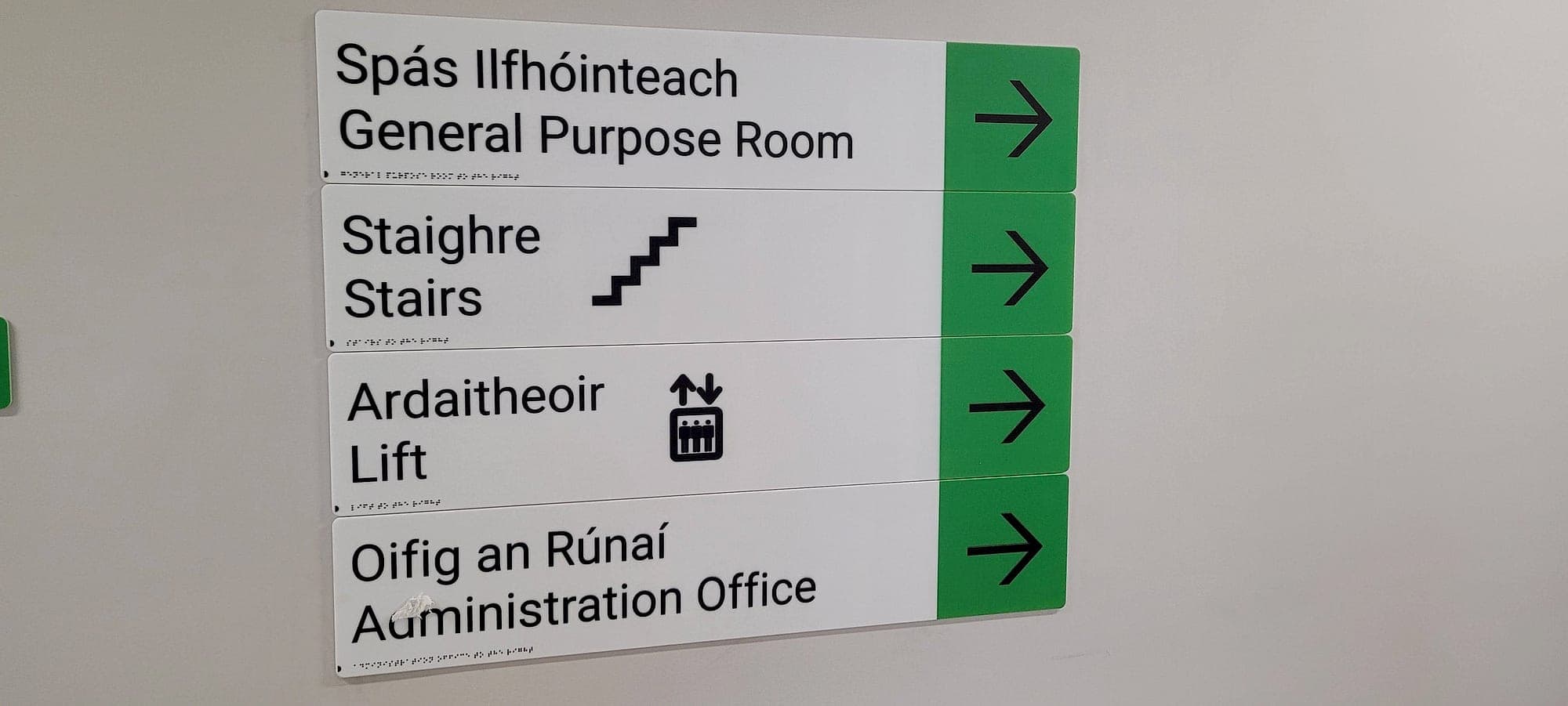
From there the progressive-disclosure logic of any large building applies unchanged, at smaller scale: the entrance names the zones, the junction names the room-number ranges, the door names the room. A post-primary campus with a sports hall, a technology block and a shared community wing needs exactly those three levels, and gets into trouble the moment it puts all of them on the first sign.
The compliance floor for school signage in Ireland
Schools sit at an unusual intersection: buildings under the Building Regulations, workplaces under health-and-safety law, places of public assembly. Four bodies of requirement bear on the signage, and none is optional.
- Part M / TGD M. New schools and extensions must be accessible, and Technical Guidance Document M carries the signage consequences: wording as short and clear as practicable, mixed-case lettering, the International Symbol of Access on accessible entrances and facilities, and tactile or braille provision where key information is low enough to touch.
- BS 8300. The technical detail behind Part M: sign heights, character sizes, viewing distances, and the 30-point Light Reflectance Value separation between text and background that makes a sign usable with low vision. The numbers are here.
- TGD B and escape routes. Fire safety sits under Part B; escape routes must be identified and signed, and the symbols come from ISO 7010, adopted here as I.S. EN ISO 7010. This is a statutory layer, and it should never be designed to blend in.
- Workplace safety signs. A school is a place of work, so the Safety, Health and Welfare at Work (General Application) Regulations 2007 govern safety signage in plant rooms, kitchens, workshops, labs and stores, which are the areas signed last and worst.
Everything we supply is made to these standards by default, and we certify compliance on completion. That matters in a school, where the person who signed off the fit-out has usually moved on by the first inspection and the file is all that's left.
Durability at child height
The last consideration is the one no standard covers. Below about 1.2 metres a school sign gets leaned on, picked at and kicked far more often than it gets read. Signage that would last fifteen years in an office corridor lasts a term in a primary school unless it's specified for the traffic.
- Rigid substrates: aluminium composite or solid-grade laminate. Thin acrylic cracks at the fixing.
- Mechanical fixings or full-face bonding below adult height. Foam tape at the corners will be a loose sign by Hallowe'en.
- Printed graphics protected by an anti-graffiti laminate, so pen and adhesive come off with solvent and the print stays put.
- Radiused corners and eased edges wherever a sign sits inside a circulation route.
- Modular systems with replaceable inserts, because rooms get renamed. A school that can change one blade in-house keeps its signage accurate; one that must reorder a whole panel leaves the wrong name up.
One caution on heights, and it's the point where we routinely disappoint a client. The accessible convention puts door-identification signs on the latch side at around 1.4 to 1.6 metres, reachable for a standing adult and a seated wheelchair user alike, and it isn't lowered to child height. A principal who wants the room symbols where a junior infant can see them isn't wrong about children. The compliant sign still doesn't move. Put the second idea in a second layer: colour, graphics, room symbols carried down the wall.
Planning a new school, an extension or a summer-works refresh? See our education work, or talk to us while the room names are still on a drawing. That's when they're cheapest to fix.
Building in education? Talk early, while the naming decisions are still cheap.