
Campus wayfinding: helping universities feel navigable
Campus wayfinding gives a whole university estate one system, from the gate to the door plate. Naming, bilingual signage, accessibility and room to change.
Campus wayfinding is one navigation system for a whole university or college estate: a single schedule of building and room names, a sign family that runs from the campus gate to the door plate, bilingual Irish and English where the institution is a public body, and accessibility built in from the start. Its job is to get a student, a lecturer or a visitor from the entrance to the right room without asking anyone, on an estate that was rarely designed as one.
University wayfinding matters more every year. Campuses grow, take in more students, staff and visitors, and absorb buildings that were never planned to sit together. Good wayfinding does two jobs at once here: it gets people where they need to be, and it lets the institution sound like itself while doing it. We've delivered 18+ full campus rollouts in Ireland and worked with Trinity College Dublin for almost 30 years, from the Grangegorman quarter to the University of Galway, and this is what that work has taught us.
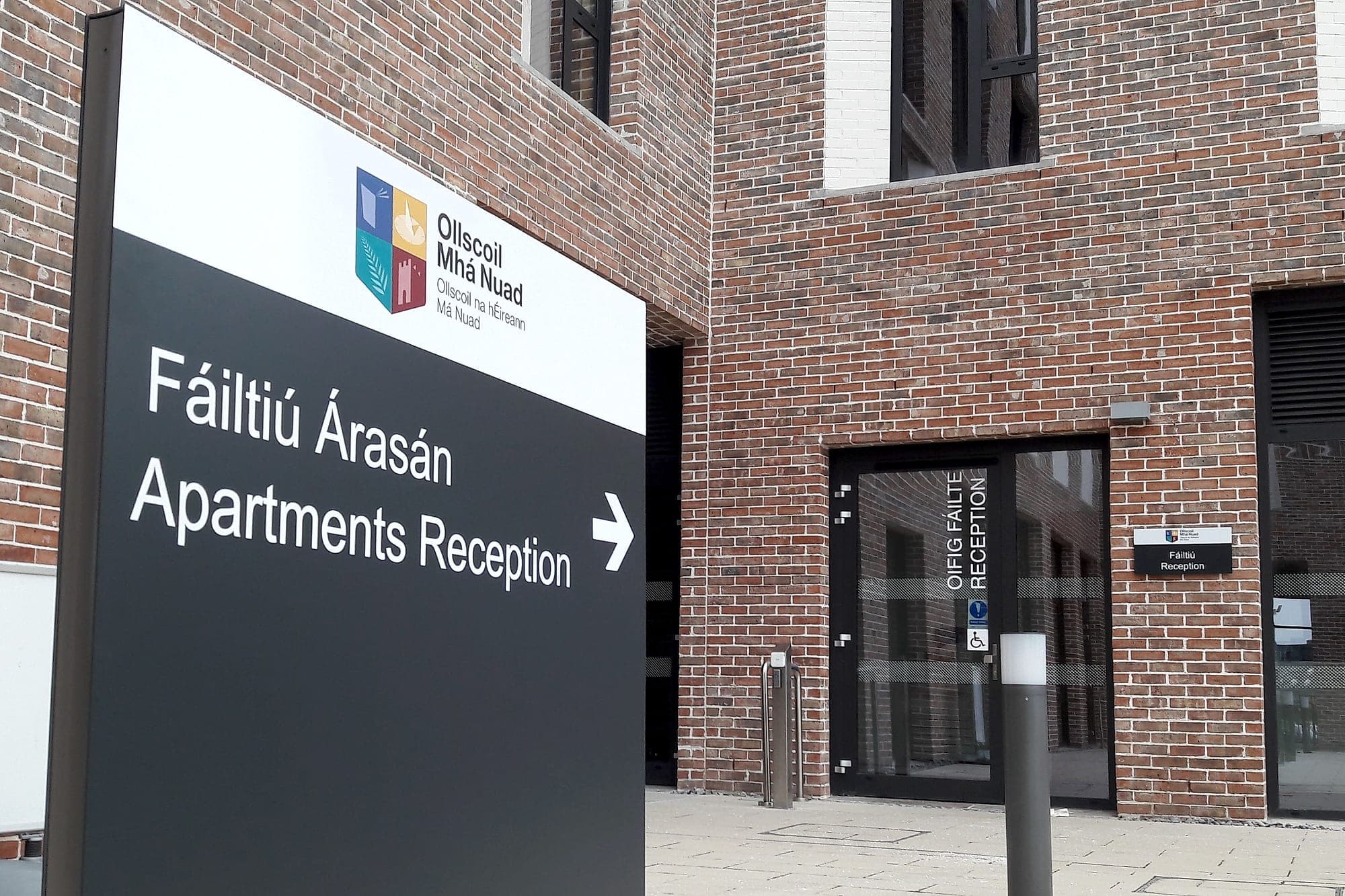
A campus gets built one building at a time. Each new building arrives with its own architect, its own contractor and its own signage package, and within a decade the estate speaks in five typefaces. Names shift faster than the buildings do: schools merge, departments move, donors name rooms. And every September the audience turns over, when thousands of people arrive who have never seen the place.
Scale does the rest. UCD's Belfield campus runs to 133 acres, and the university says plainly that new students can find it overwhelming. A building that explains itself at the door is doing work the rest of the campus would otherwise have to do with a map.
Within a decade the estate speaks in five typefaces.
Sign the estate, not the building
The fix is to make the decisions once, for the whole estate, so each new building joins a system that already exists. That starts with a campus-wide destination schedule: every zone, building and room named once, in both languages, given its tier in the wayfinding hierarchy, with a list of every sign that will carry it. It needs a room-numbering convention that tells people something. At National College of Ireland every room number begins with its floor, from S1.01 to S6.18, so a timetable is already the first direction.
It also needs one sign family. Trinity College Dublin has been a client for almost 30 years, and its signage has grown with the university because the systems used outside and in were chosen to extend. Each new building adds to the family instead of starting another one.
The arrival sequence: gate, car park, building
Campus wayfinding starts on the road. The first signs have to answer three questions in order: is this the right campus, where do I park or get dropped off, and which building do I need? That means entrance monoliths and identity totems at the boundary, arrival totems on the approach, and a campus directory at the point where people leave the car and start walking.
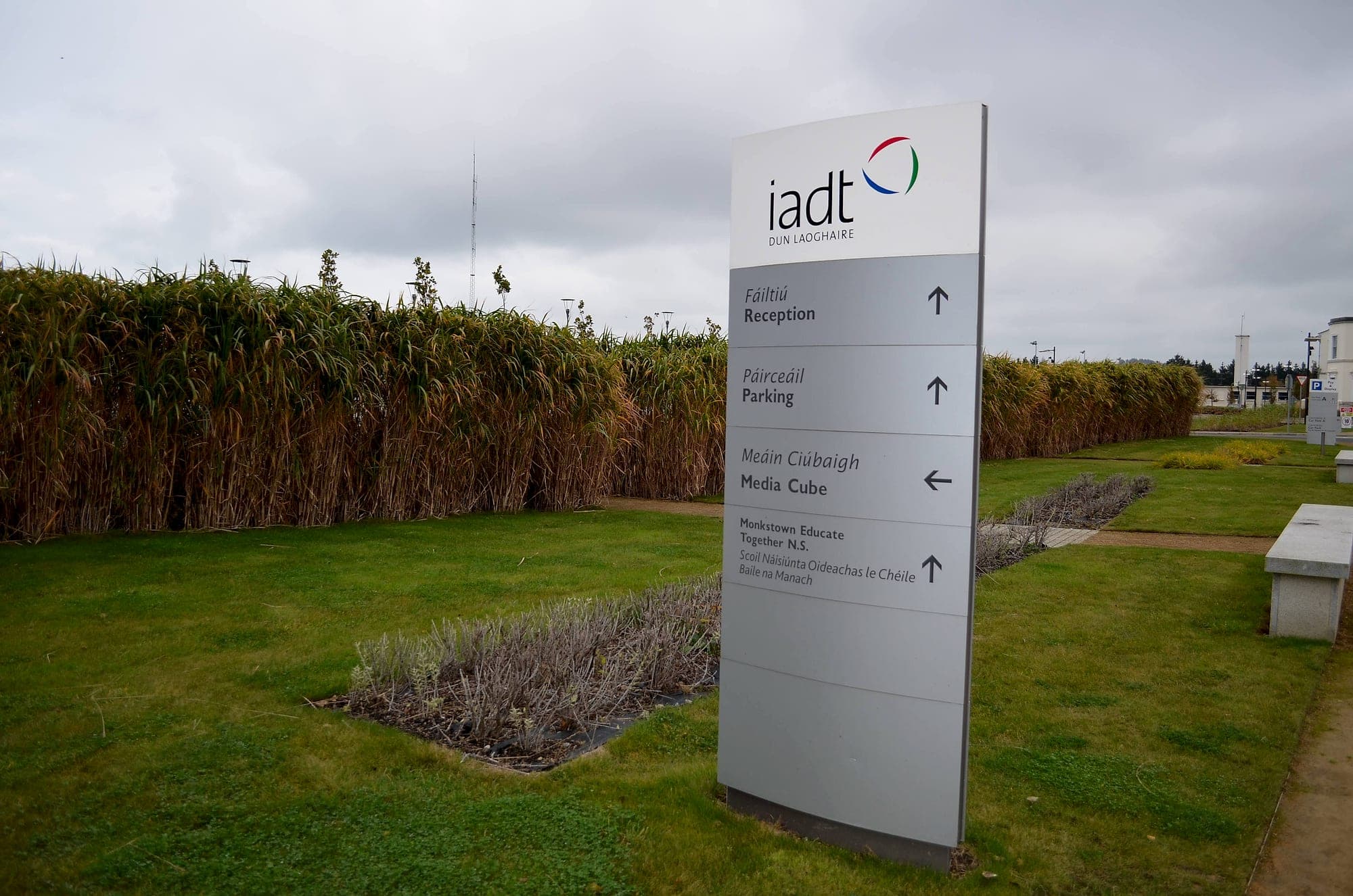
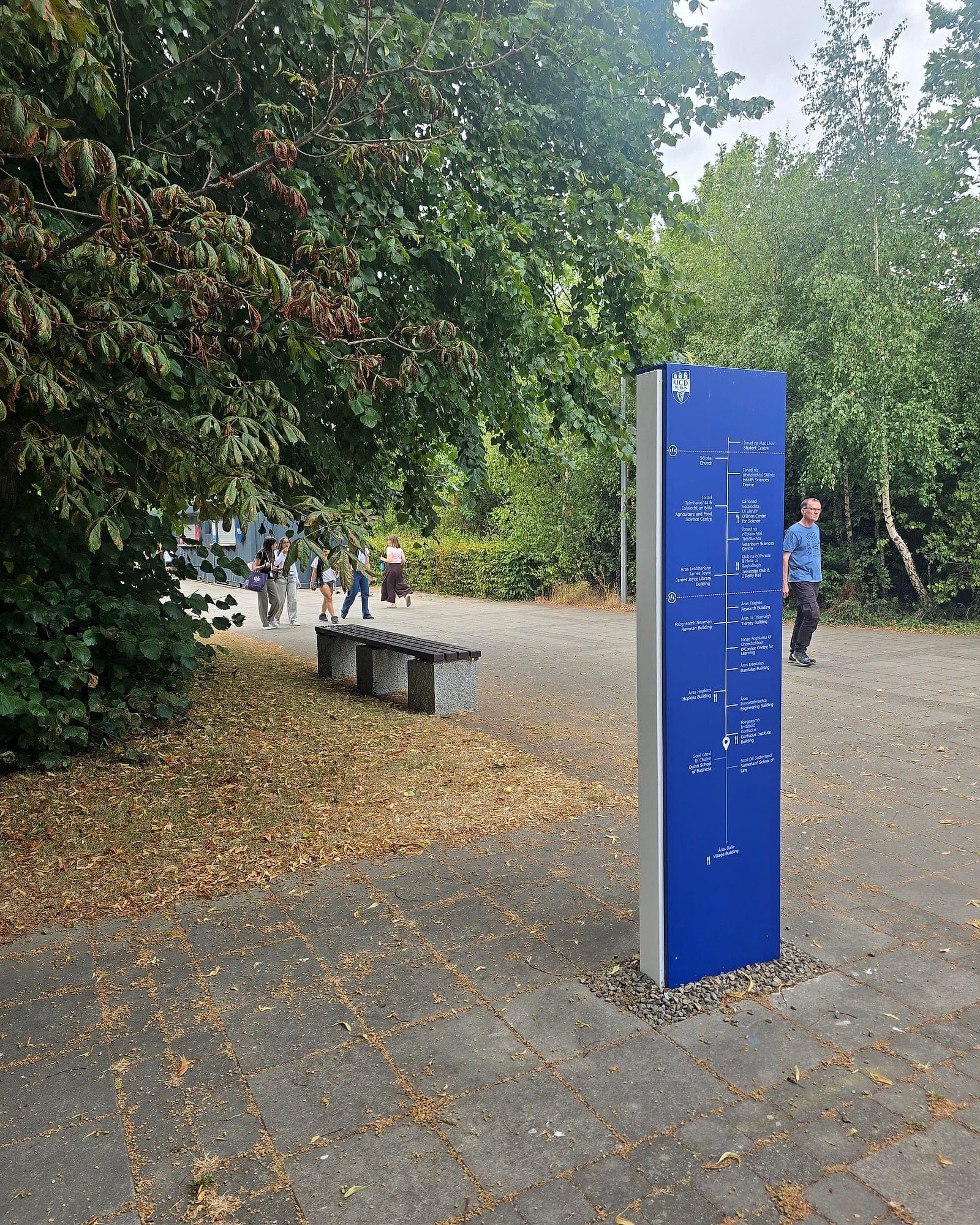
Once people are on foot, the network changes scale. Directory totems with a you-are-here marker sit at the main path junctions, fingerposts handle the smaller splits, and building identification confirms arrival from far enough away that nobody walks to the wrong door. At TU Dublin Grangegorman a four-arm fingerpost at a shared-surface junction names the estate's own places and the streets beyond it. Where a campus mixes vehicle and pedestrian routes, they need separate signs, one sized for a windscreen and one for walking pace.
Bilingual by law, and by design
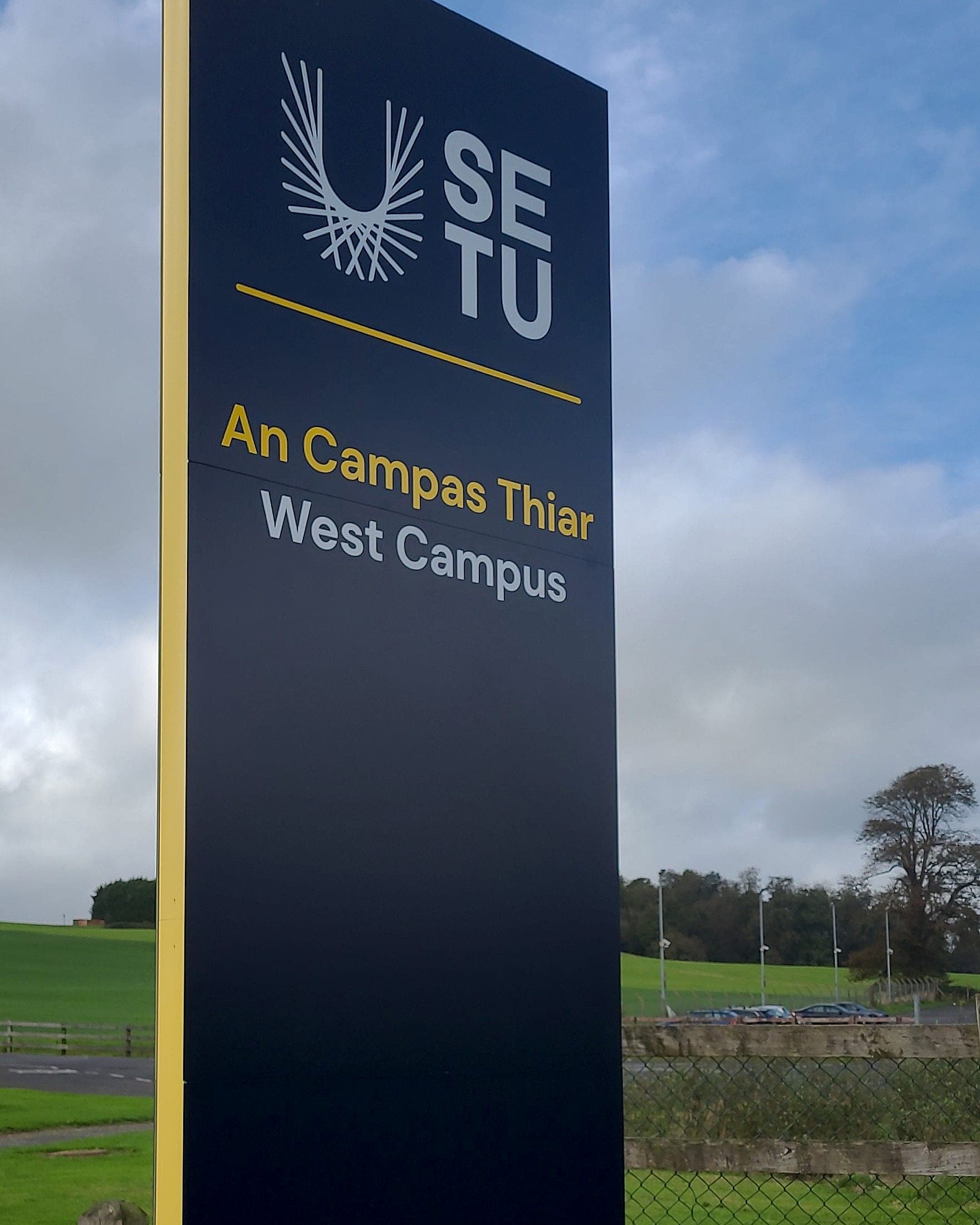
Irish universities and technological universities are public bodies, so the Official Languages Act applies to every sign they put up: Irish first, never smaller, less prominent or less legible than the English. That doubles the copy on every panel, and it has to be planned from the first layout. When Waterford Institute of Technology and Institute of Technology Carlow became South East Technological University on 1 May 2022, the new name had to appear on campuses in three counties, Irish first and at equal size, with the old identities removed first. Campas Bhóthar Chorcaí above Cork Road Campus. An Campas Thiar above West Campus.
New buildings coin new words, and a coined word has no Irish waiting to be looked up. At the UCD Moore Centre for Business, rooms like the Think Lab, and rooms named after donors and sponsors, had to be given Irish names before they could be signed at all.
Inside the buildings
Indoors, the work is what any complex building needs, done consistently across many of them. A directory at every entrance and lift lobby, broken out floor by floor. Directional signs at junctions carrying room ranges rather than every room. Door signs with tactile lettering and braille in the 1,400–1,700mm band, as Part M and BS 8300 expect. And floor identification you can't miss: in the UCD Moore Centre each stairwell level is a single vinyl numeral 1.7 metres high, so you know where you've arrived before you've read anything. At the UCD Confucius Institute, each floor directory carries a colour-coded plan of that floor, so a room's name and its location arrive in the same glance.
What makes campus wayfinding work
- Make it distinctive. Every campus has wayfinding; yours shouldn't look like everyone else's. Let it carry the institution's character, values and culture.
- Make it inspiring. Students and staff spend years here. A considered, generous system helps them feel proud of the place.
- Involve students. The people who use a space are the best guide to what it needs, and involving them builds buy-in and belonging.
- Go digital where it helps. Digital and mobile wayfinding increasingly complement physical signage; the best campuses blend the two.
Distinctive needn't mean elaborate. The TU Dublin sign family takes its 45-degree cut from the angled terminals of the university's own logotype, and fits itself to whatever it's fixed to: a monolith on grass at Blanchardstown, a long panel along a rubble stone wall at Tallaght, a square plate on the granite plinth at Bolton Street.
Built for change
A campus is never finished, so the system has to absorb change without a new sign family every time. Modular directories and replaceable inserts mean that when a department moves, one blade is remade and the rest stays on the wall. Many Irish campuses include protected structures, which need signs that can be removed later without damaging the fabric; a section 57 declaration can take up to twelve weeks, so it belongs at concept stage, and heritage building signage covers the detail. Installation runs around timetables and exams, with the big changes planned for the summer works window.
The digital layer sits on top of all that. The orientation lecterns at SETU's Cork Road campus carry a QR code in the corner for the version of the map that travels in a pocket. A campus is also one of the few places indoor navigation gets used, because the student portal is already on everyone's phone. More on that in smart wayfinding.
- 18+
- full campus rollouts delivered in Ireland
- ~30 years
- as wayfinding supplier to Trinity College Dublin
- 1.8
- design rounds to approval, on average
Common questions
Appendix- Q.What does campus wayfinding include?
- The strategy and naming for the whole estate; external signage such as entrance monoliths, totems, directories, fingerposts and building identification; internal directories, directional and door signs; accessible and statutory signage; and, where it helps, a digital layer such as QR-linked maps. All of it is drawn from one schedule of names.
- Q.Where should a university start with a wayfinding project?
- With what's already on the walls and what everything is called. A survey of the existing signage and a single estate-wide schedule of zones, buildings and room numbers come first. The sign family and the rollout plan follow from them.
- Q.How do you handle a university merger or a change of name?
- By treating removal as part of the job. When SETU was formed, the external drawing packs set out every new sign and every old identity to be taken down, campus by campus, so the new university appeared consistently across Waterford, Carlow and Wicklow.
- Q.Can campus signage go on protected buildings?
- Yes. Signs are designed and fixed so they can be removed later without damage, usually into mortar joints or as freestanding elements. A section 57 declaration settles what's exempt and can take up to twelve weeks, so raise it at concept stage.
- Q.Should a campus use digital wayfinding?
- As a layer over a complete physical system, yes, where information genuinely changes or the map needs to travel with the reader. QR-linked maps on orientation lecterns work well, and indoor navigation can work on a campus because students already carry the university's app. Every route should still work when the phone is flat.
Planning a new building on an existing campus, or bringing a whole estate under one system? See our education work, or talk to us before the next building arrives with its own signage package.
Building in education? Talk early, while the naming decisions are still cheap.