
Bilingual by law: the Official Languages Act and your signage
What the Official Languages Act means for signage: Irish first, never smaller or less prominent. Who it binds, and how to keep bilingual signs clear.
Under the Official Languages Act 2003, public bodies in Ireland must put up their signage in both Irish and English. The signage regulations made under section 9 of the Act, S.I. No. 391 of 2008, set out how: the Irish text appears first, it must not be less prominent, visible or legible than the English, its lettering must be no smaller, and both say the same thing. The Official Languages (Amendment) Act 2021 strengthened the regime again.
For anyone delivering a public building, that makes language a design constraint from the first layout. Two languages of equal weight need room on the panel, and the room has to be planned. We've signed hospitals, universities, county councils and Garda buildings to the Act for years, from the HSE campus at St Mary's in the Phoenix Park to SETU's campuses across the south east. This is what the law asks for, and how to meet it without crowding the sign.
What the Official Languages Act requires on a sign
Read together, the Act and the signage regulations come down to five rules that land directly on the panel:
- Both languages, permanently. A public body's signs carry Irish and English, not one in place of the other.
- Irish first, above the English or to its left wherever the two appear together.
- Equal prominence: the Irish must not be less prominent, visible or legible than the English.
- No smaller. The Irish lettering can't be smaller than the English.
- The same message. Both versions say the same thing, and neither is a shortened gloss of the other.
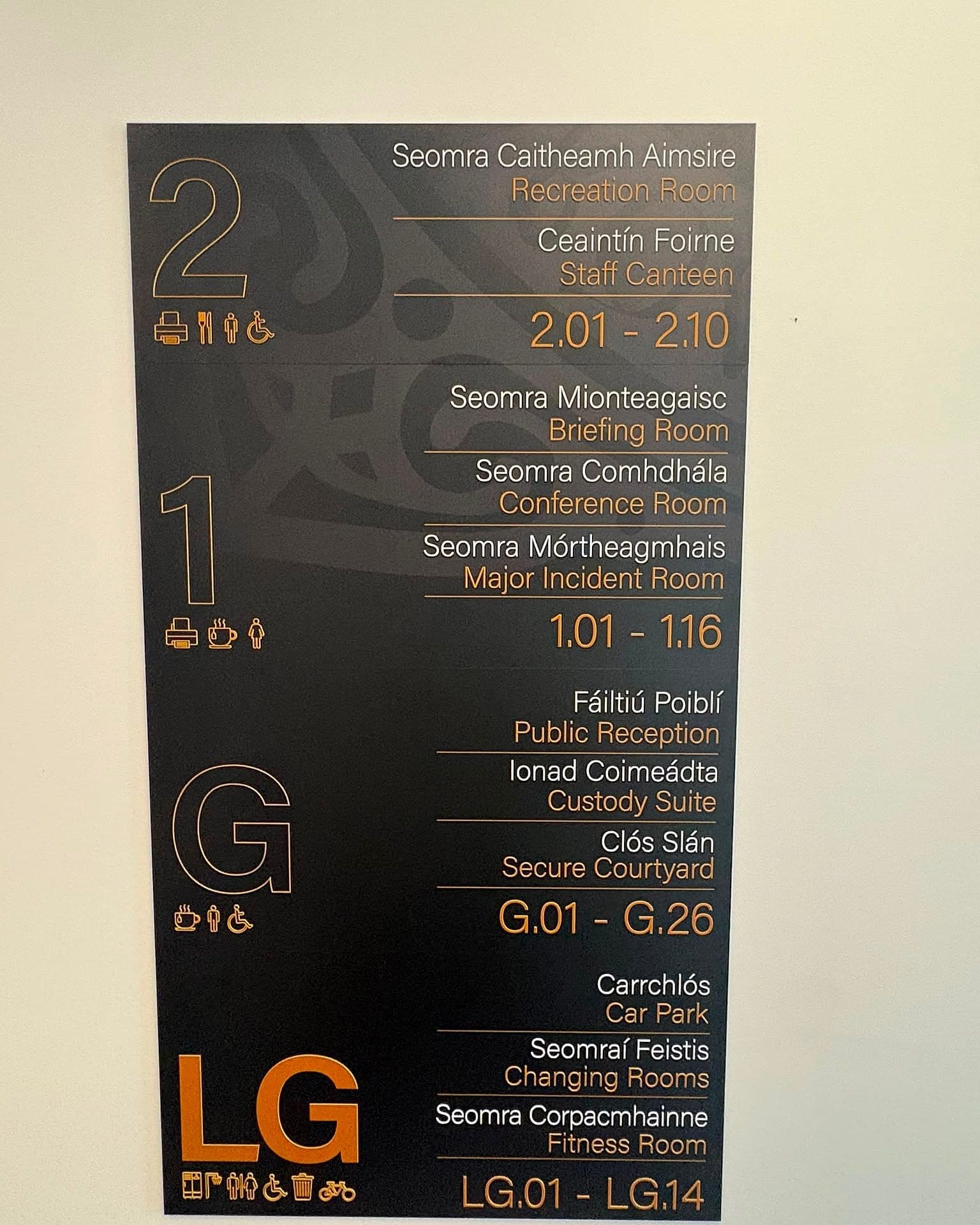
None of those is a matter of taste. A brand guideline that sets the English in a heavier weight, or tucks the Irish into a caption beneath it, doesn't survive contact with the regulations. Where the law does leave room is in how the order is carried. At St Mary's the Irish sits above in the heavier weight and the English beneath in the lighter one, so the hierarchy comes from weight rather than size, and the panel still reads cleanly at a distance.
Two languages need room, and the room has to be planned.
Who the Act applies to
The Act applies to government departments and offices, local authorities, the HSE, universities and other third-level institutions, and state agencies, boards and companies. ETB schools sit inside it too, and it sets the norm for most Irish schools besides. If a project sits in any of those, bilingual provision is part of the brief from day one, and getting the Irish right, with correct hierarchy and equal status, is something a specialist handles as a matter of course.
Private developers and commercial operators generally sit outside the duty, but the line can blur. A hall run by a university is inside it while a privately owned block on the next street isn't, and a state-owned or publicly tenanted facility carries the duty even when its neighbours don't. Gaeltacht areas have their own position: the 2021 amendment moved public-body signage there towards Irish only, so confirm it for the specific site with the client's Irish language officer before artwork is signed off.
The design challenge: two languages, one panel
Two languages of equal weight can crowd a sign, especially directional signage, where a lot of text competes for limited space. A few principles keep it clear for Irish and English readers alike:
- Keep it simple. Fewer signs and less text make it easier to tell the two languages apart.
- Size up, don't shrink. Increase the height of the sign to give two lines of text room to breathe. Never shrink one language disproportionately to make it fit.
- Colour can help. As long as each language has equal prominence, different colours let readers skim and find their language at a glance.
Typography has to pull its weight too. The síneadh fada needs clean clearance above the line, so line spacing set for English alone will clip it, and a typeface without well-drawn accented capitals has no business on a public body's shortlist. Our essay on wayfinding typography goes into the detail.
Getting the Irish right
Translation is where bilingual signage most often goes wrong, and a bad line of Irish stays on the wall for a decade. Budget for proper translation and proofing before manufacture. Then settle every name once, in the destination schedule, so the directory, the corridor and the door all use the same Irish. A room called one thing on the directory and something shorter on its door is, as far as the reader can tell, two different rooms.
New buildings make it harder because they coin new words. At the UCD Moore Centre for Business, rooms like the Think Lab and the Business eLearning Creator Suite had no Irish waiting to be looked up, and several rooms carried people's names, which Irish declines rather than leaving alone. The Moore Atrium became Aitriam Uí Mhórdha. Each name had to be resolved on its own terms and checked with the university before it was set in metal.
Beyond the door sign
The duty follows the information, whatever carries it. Directories and floor plans are text-dense, so equal prominence for Irish has to be in the layout from the first sketch. Evacuation plans in public buildings carry Irish and English in the header, legend and instructions. Screens, and the pages behind QR codes, count as well: a digital directory showing English while the sign beside it shows both is an inconsistency waiting to be raised. Statutory safety pictograms are the one fixed point. The ISO 7010 symbol stays exactly as drawn, and only the text supporting it becomes bilingual.
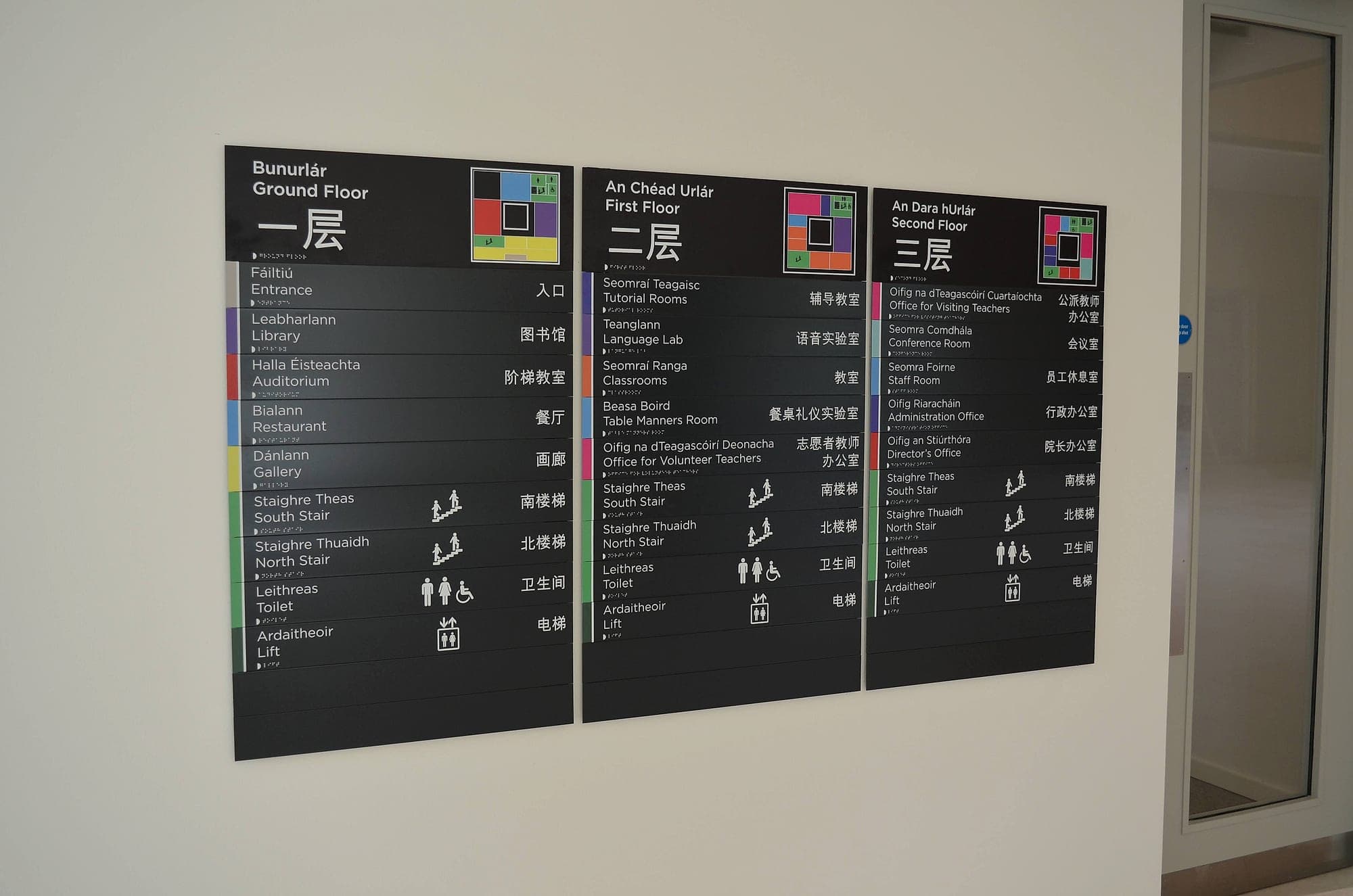
The best schemes take Irish further than the regulations reach. At the UCD Moore Centre the glass manifestations and quote walls run Irish and English in the same colours and the same weight, so the language isn't confined to compliance signage. At the UCD Confucius Institute, Chinese joins Irish and English on one sign face: the statutory pair stacks at equal size on the left, and the Chinese takes the right-hand field at a size that reads as equal in presence.
- 2003
- The Official Languages Act gives Irish and English equal status
- S.I. 391
- of 2008: the signage regulations made under section 9 of the Act
- 2021
- The amendment Act that strengthened the regime
Bilingual signage across an estate
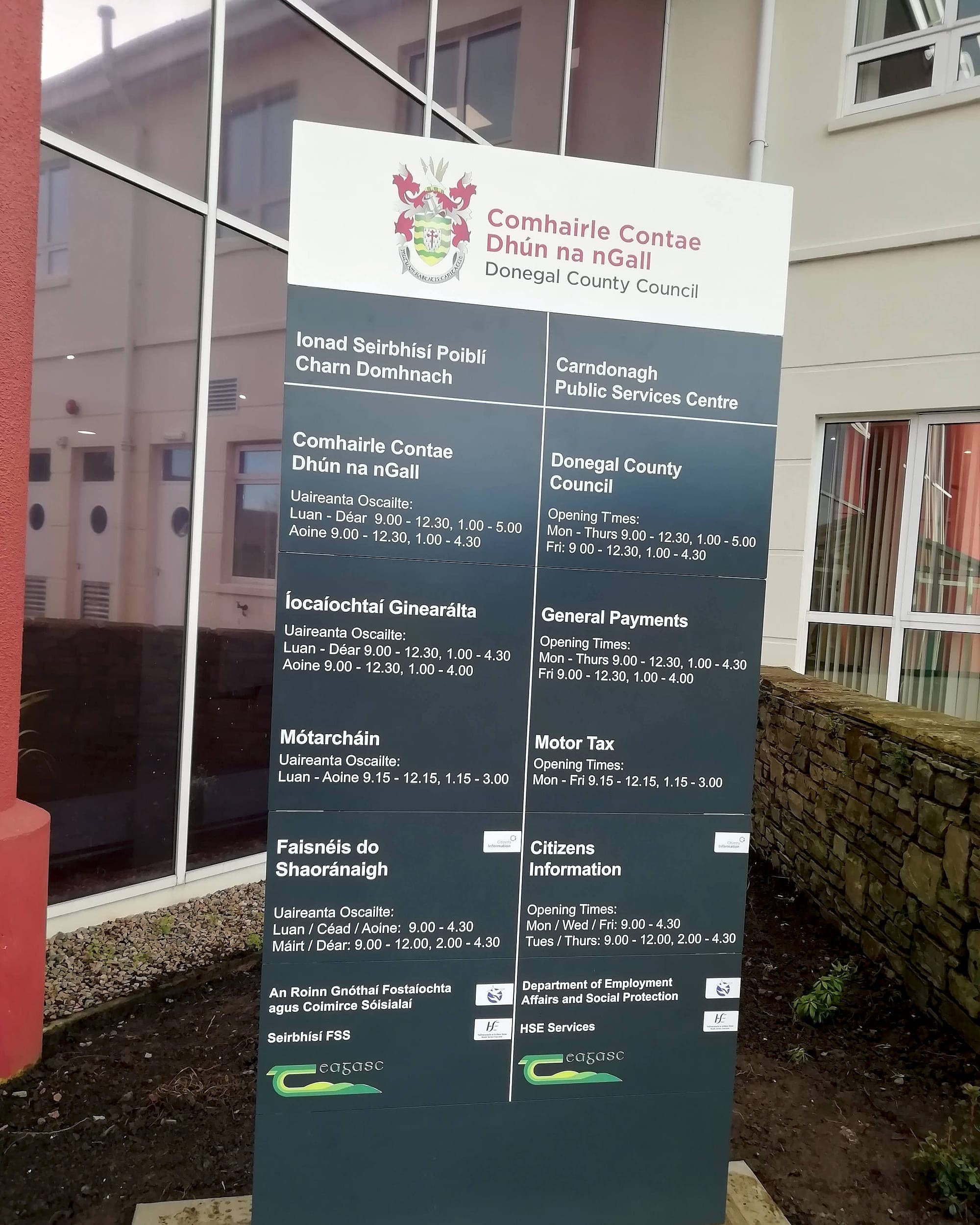
One building is a design problem. A council with a string of public services centres, or a university spread over several counties, is a consistency problem. When SETU came into being on 1 May 2022, campuses in Waterford, Carlow and Wicklow all had to say so in Irish first, and the old institute names had to come off the walls before the new ones went up. On the TU Dublin external programme the Irish sits above the English in the heavier weight on every panel, from Bolton Street to Blanchardstown. For Donegal County Council the same rules ran through six public services centres across the county. We've set out how to hold that line in council signage at county scale.
Common questions
Appendix- Q.Does my signage have to be in Irish and English?
- Yes, if the building belongs to or is run by a public body under the Official Languages Act: government departments, local authorities, the HSE, universities and other third-level institutions, state agencies and ETB schools. Private developers and commercial operators generally sit outside the duty, though many choose bilingual signage anyway.
- Q.Which language goes first on a bilingual sign in Ireland?
- Irish. Under S.I. No. 391 of 2008 the Irish text appears first, above or to the left of the English, and it must not be less prominent, visible or legible than the English, or set in smaller lettering.
- Q.Can the Irish and English be in different colours?
- Yes, provided neither language ends up less prominent or legible than the other. Giving each language its own colour or column helps readers find their line at a glance. What isn't allowed is shrinking or fading the Irish to make room.
- Q.What about signage in Gaeltacht areas?
- The Official Languages (Amendment) Act 2021 moved public-body signage in Gaeltacht areas towards Irish only. Confirm the position for the specific site with the client's Irish language officer before artwork is approved.
- Q.Does the Act apply to digital signage and maps?
- The duty follows the information. Directories, floor plans, evacuation plans and the digital layer of a public body's wayfinding should carry Irish and English on the same footing as the signs beside them.
Delivering a public building, or bringing an existing estate into line? We size every panel for both languages from the first layout and have the Irish proofed before anything is made. See our public-sector work, or talk to us before the artwork is set.
Planning a wayfinding project? Talk early, while the big decisions are still cheap.