
Council signage at county scale: consistency across dozens of sites
Three buildings, one local authority, three different signage systems. County-wide consistency is won in the documentation, long before anything reaches a wall.
Walk into three buildings owned by the same local authority and you will often meet three different signage systems: three typefaces, three versions of the crest, three ways of setting Fáiltiú against Reception. Council signage almost never fails at the level of the individual sign. It fails at the level of the estate, because those panels were bought in different years, by different departments, from different suppliers, against no written standard. Consistency across dozens of sites is a documentation problem before it is a design problem.
We've delivered county-scale signage for Mayo County Council, Donegal County Council and Tipperary County Council: headquarters, area offices, libraries, depots and public services centres, installed in tranches over several years. Nobody signs a county in a week. What follows is the method that keeps the last building looking like the first.
Consistency across dozens of sites is a documentation problem, not a design problem.
Why council signage drifts out of step
A local authority isn't one client. It's a housing department, a library service, a machinery yard, a fire service, an arts office and a corporate estate, each with its own budget line and its own idea of urgency. Drift follows predictably:
- Signage is a line item inside a building project, so its standard gets set by whoever won that building.
- Small orders go direct to whichever local supplier can turn them around, working from a photograph of an existing sign.
- The crest is re-drawn from a low-resolution copy. Two rollouts later, nobody holds the original artwork.
- Departments rename themselves. The sign says Motor Tax; the website says Motor Taxation; the letter says Customer Services.
- Nothing records what is already installed, so every new project re-surveys the same buildings. Or, more often, doesn't.
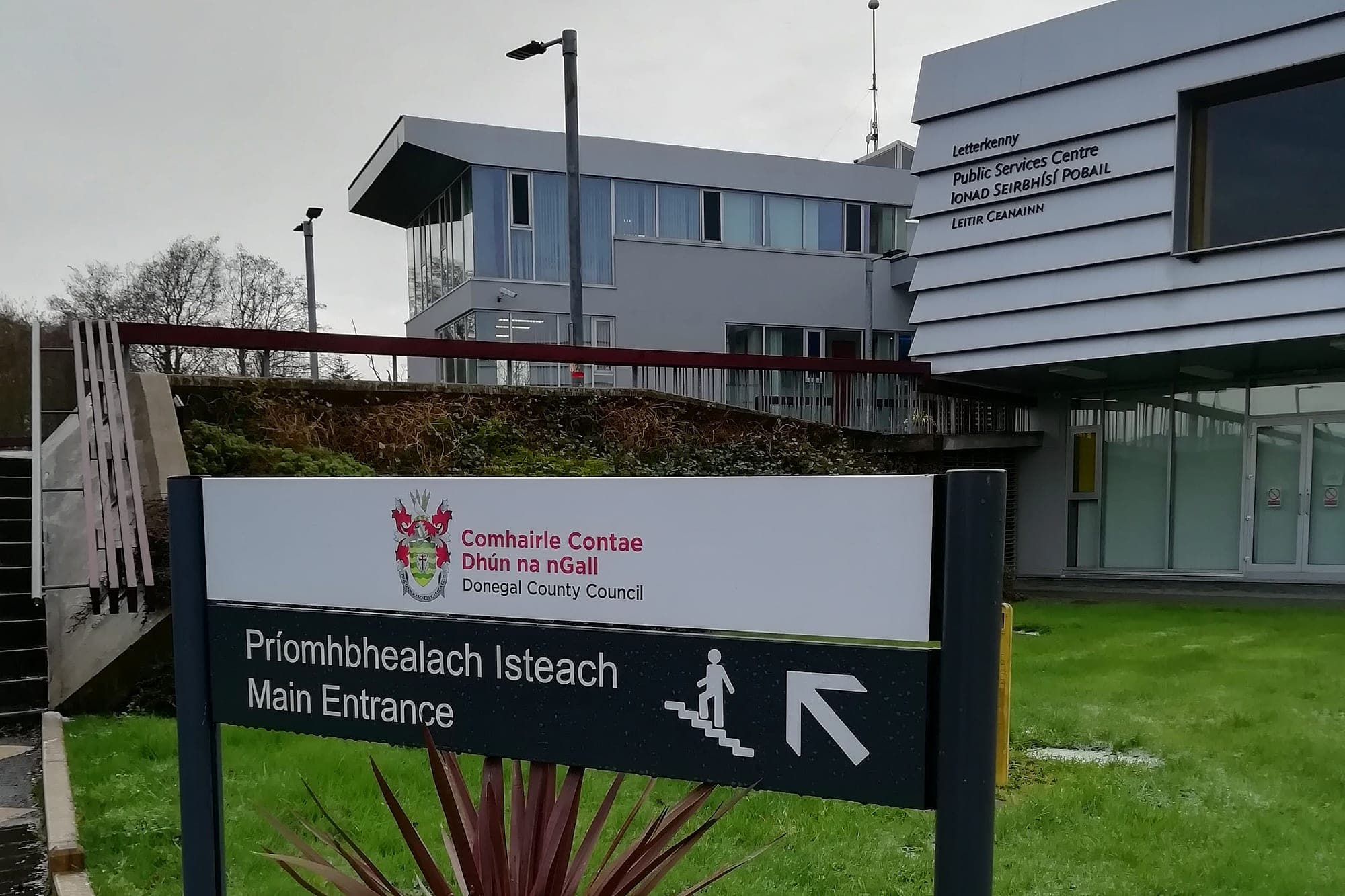
Start with an asset register, not a sign schedule
A sign schedule describes what you are about to install. An asset register describes what you already own, which at county scale is the more valuable document, and it should exist before the first new panel is drawn.
- A unique ID per sign, tied to the building and to a room or external location reference.
- Sign type from the family (building identification, external totem, entrance direction, floor directory, room identification, statutory), plus size, substrate and fixing method.
- The artwork reference and revision, so that a replacement is a re-print and not a re-draw.
- Install date and warranty expiry, held per sign. A project-level date tells you nothing once one panel has been replaced.
- A photograph. Nothing settles an argument about condition or position faster.
- A named owner for changes. One person, not a department.
Councils that keep this register can price a county-wide refresh from a spreadsheet. The rest spend a fortnight driving. It is also the document that makes a maintenance agreement meaningful, because both sides know exactly what is covered. If a council could fund only one thing this year, it should be the register.
The standard kit: what should be identical everywhere
The heart of a rollout is a short, ruthless specification: the things that must be identical in every building in the county, written so a fabricator can work from them without ringing anyone.
- The typeface, named and licensed, with the weights permitted and the ones that aren't.
- The crest or logo as a locked artwork file, with a minimum height and a minimum clear space around it.
- Colours specified by reference and recorded with their Light Reflectance Value, not just a Pantone number, because LRV is what the contrast calculation needs.
- The sign family itself: one drawing per type, at fixed sizes, so a library and a machinery yard order from the same menu.
- Bilingual layout rules: Irish first, matching size and weight, one agreed arrangement for two-column and stacked settings.
- Mounting heights and fixing details, including the tactile and braille zone on room identification.
- Materials, finish and warranty period, so a cheap substitution reads as a breach.
Fix those seven things and the rest can be delegated safely. Leave any one of them open and it becomes the seam along which the estate splits.
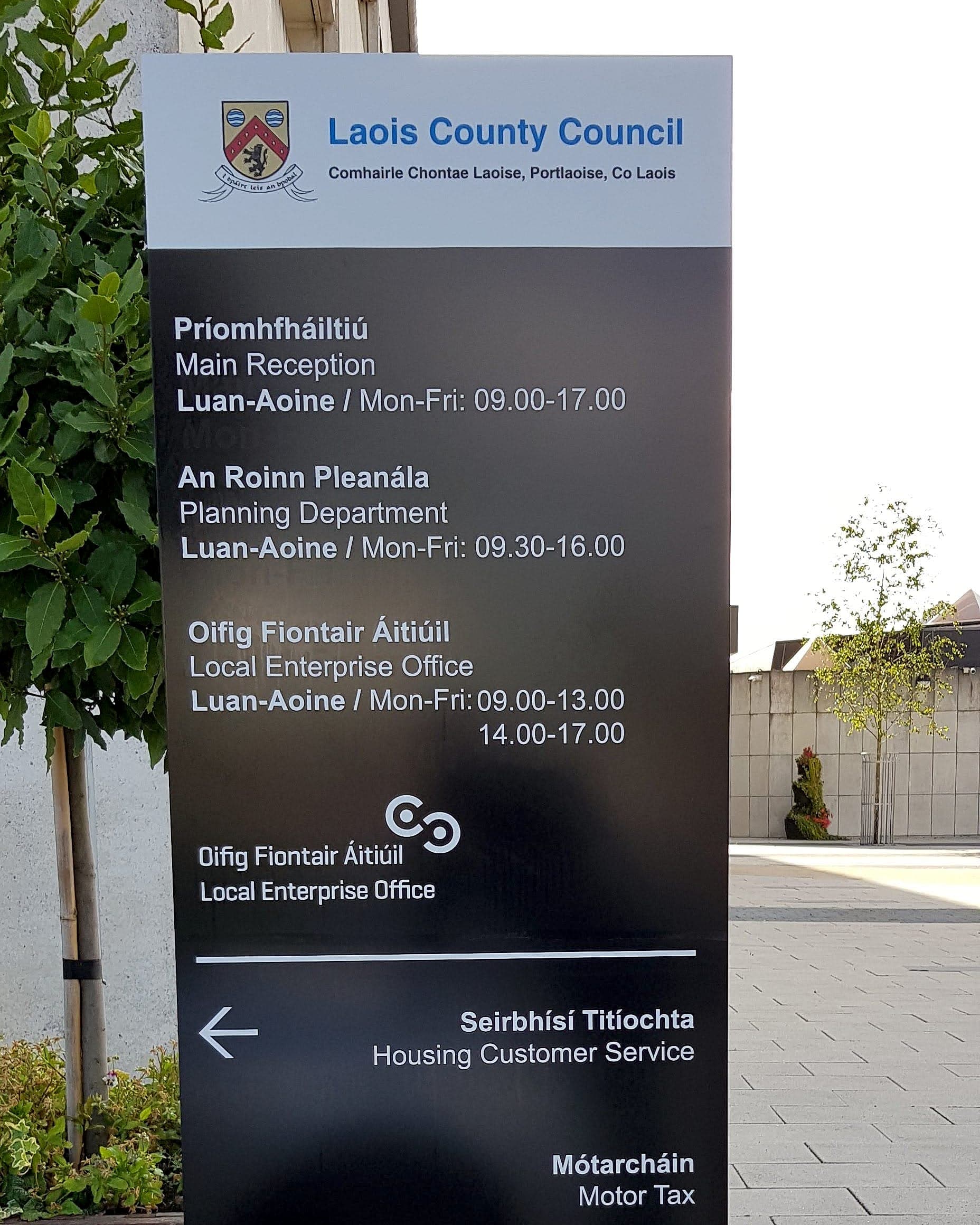
Local variation: what should be allowed to differ
A standard that forbids everything gets ignored. Decide once which variables are legitimately local, then hold the line on everything else.
- Building name and municipal district identity. A civic office in one town and an area office in another are not interchangeable, and the sign should say so.
- Opening hours, which are genuinely site-specific and the most common reason a panel gets replaced.
- Quantity and depth. A branch library may need one external panel and four internal; a county headquarters needs a full directory and forty room signs.
- Fixing method on protected structures. Much of a council estate is heritage fabric, where panels fix into mortar joints or free-stand clear of the wall. Nothing gets drilled into cut stone.
- Language balance in Gaeltacht areas: the 2021 amendment to the Official Languages Act moved public-body signage there towards Irish only. Confirm the position for the specific site with the council's Irish language officer before artwork is signed off.
Bilingual, on every site, without crowding the panel
Every sign a local authority erects sits under the Official Languages Act, and the regulations made under it are specific about how two languages share a panel: where Irish and English appear on the same sign, the Irish comes first, is no less prominent, visible or legible than the English, uses lettering no smaller, and says the same thing. That rules out the most common shortcut of all, which is shrinking the Irish to make a line fit.
At county scale this is a template decision, not a per-sign one. Agree the two-column and stacked arrangements once, size panels for two languages from the start, and every later building inherits a compliant layout. We take the detail further in bilingual by law; the point for a rollout is that a mistake made in the template is a mistake made in forty buildings.
- 31
- local authorities in Ireland: 26 county, 3 city and 2 city-and-county councils, each an estate in its own right
- ×2
- languages on every panel, Irish placed first and no smaller, the Official Languages Act baseline
- ~20%
- less, end to end, when one supplier carries the scheme from design to installation
Procurement: frameworks, call-offs and one production run
County-scale council signage rarely arrives as a single contract. More often a supplier or panel of suppliers is appointed once, and individual buildings are drawn down by call-off as capital budgets allow. That structure is a gift to consistency, provided the standard lives in the framework's technical specification. Put it in the first project's drawings and it dies with that project. The specification is the only document every later call-off is obliged to read.
It also lets buildings be batched. Signs for several sites cut, printed and finished as one production run come off the same sheet, the same printer profile and the same colour batch, a match no amount of re-ordering achieves later. Where a rollout must run over three years, we still survey the whole estate up front: quantities and prices firm up, and the artwork for year three is drawn while the people who agreed the naming are still in post.
Phasing a rollout so the county never looks half-done
A phased programme spends years in a transitional state, which is exactly when a standard erodes. Four rules keep it honest:
- Pilot one complete building, external, internal and statutory, and sign it off on the wall. A visual proves nothing. Everything learned in that first building is cheap; everything learned in building nine is not.
- Sequence by public footfall, not by ease of access. The buildings citizens actually visit should stop being inconsistent first.
- Complete buildings, not sign types. A county with every totem replaced and no internal signage looks worse than one where six buildings are simply finished.
- Keep statutory signage on its own budget line, covering fire, safety and accessibility, so it survives value engineering when a phase is trimmed.
A rollout is a standard with a schedule attached to it.
Keeping it consistent after handover
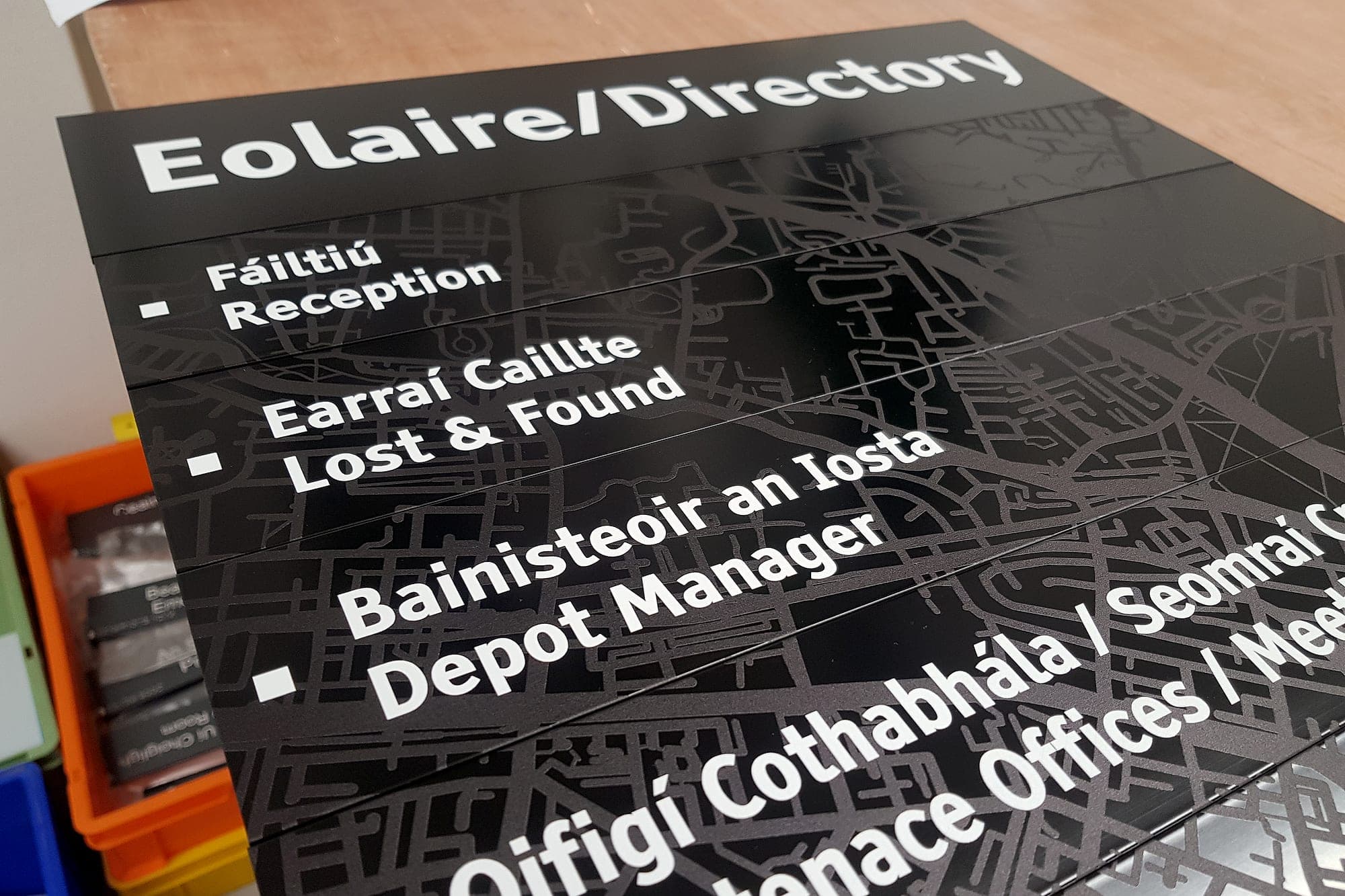
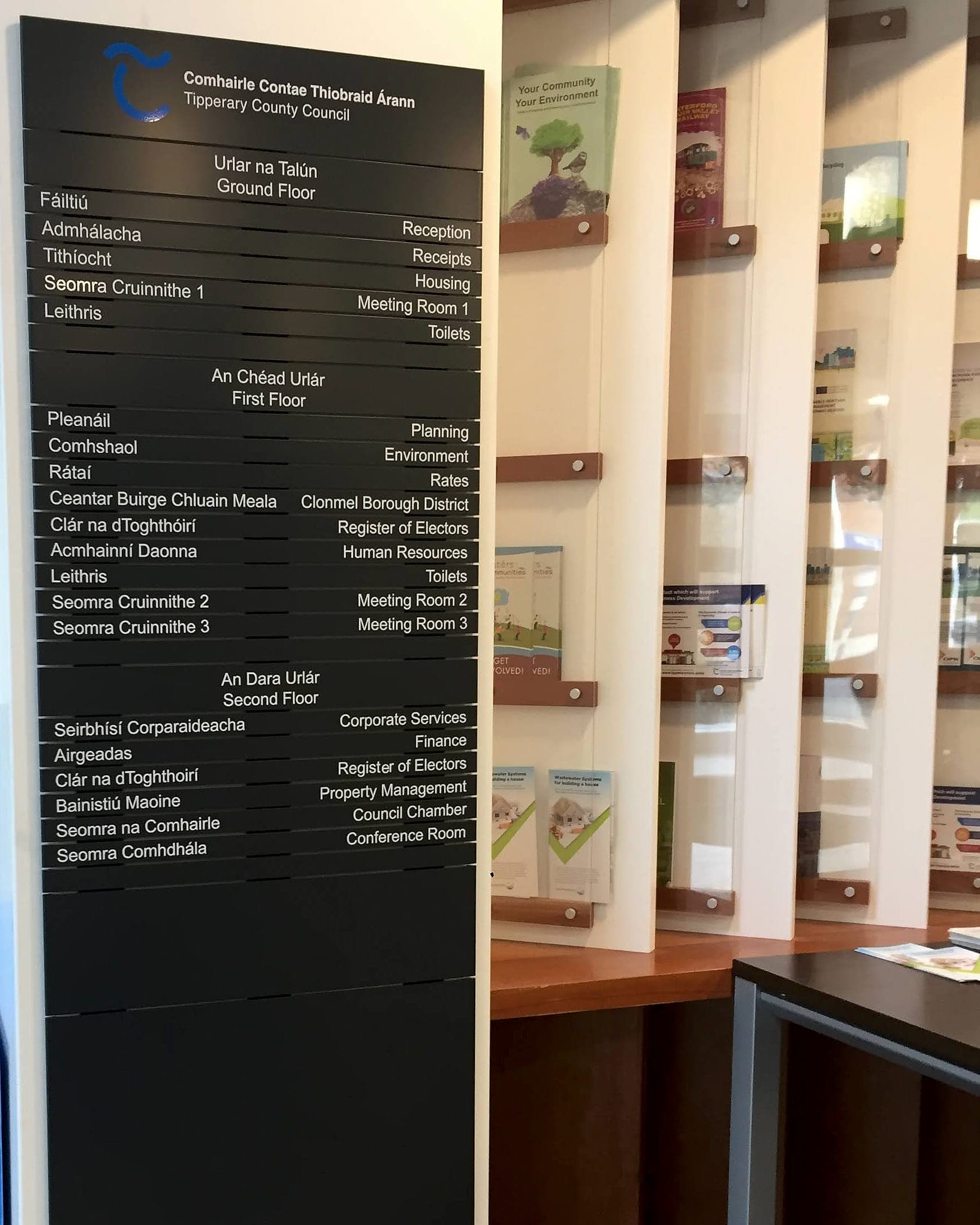
The rollout ends; the estate doesn't. Departments move, districts are renamed, a service closes on Wednesdays. A system designed for change absorbs all that without a redesign: modular directories where one slat is remade and the rest of the panel stays on the wall, room signs with a replaceable insert, and a naming record kept alongside the destination schedule so the wall, the website and the letter stay in agreement.
Governance matters as much as hardware. One route for change requests, one artwork master, one supplier working from it, and an annual walk of the estate to update the register. It's unglamorous, and it's what separates a council signage standard from a council signage anecdote.
Accessibility is the one part of the kit that can't be phased. Technical Guidance Document M sets the floor for new works and material alterations: contrast, mixed-case lettering, mounting heights, tactile and braille on key locations, and the International Symbol of Access on accessible entrances, with BS 8300 behind it on the detail. Built into the standard, it costs nothing extra. Retrofitted into forty buildings, it costs a second rollout. Everything we supply is made to those criteria by default, and we certify on completion; there's more in accessibility and Part M.
Planning a county-wide programme, or trying to bring an estate that has drifted back into one system? See our public-sector work, or talk to us at the register stage, before the first panel is drawn.
Building in public sector? Talk early, while the naming decisions are still cheap.