
Print or pixels: the true cost of digital vs static signage
A screen and a sign do not cost the same things. A ten-year, line-by-line look at digital vs static signage, and a way to decide it sign by sign.
The honest answer on digital vs static signage is that the two are not a like-for-like purchase, and pricing them as if they were is how buildings get the sum wrong. A fabricated sign is a capital cost with almost no tail: bought once, installed once, then silent for a decade. A screen is a capital cost with an operating cost attached, and that means power, a content licence, somebody's time every week, a replacement cycle counted in years. Over a ten-year life the screen is normally the more expensive object. It is also, in a narrow set of places, the only one that works.
The problem is structural. Nobody signs off a tender line called "four hours a month of a facilities officer's time, for ten years", so it never appears, and it is frequently larger than the hardware. We supply static signage and specify the digital layer over it, so we have no reason to sell a screen and none to talk anyone out of one. This is the arithmetic we put in front of clients.
Digital vs static signage is a ten-year question, not a purchase
Set the comparison over the life of the fit-out, ten years for an office and longer for a hospital or a residential core. The invoice is a moment. The decision lasts the decade, and over that window the two options have completely different shapes. The static line is almost all cost in year zero, then flat. The digital line climbs every year afterwards, for reasons that have nothing to do with the sign and everything to do with running an estate of small computers.
None of which is an argument against screens. It's an argument for counting before the mounting positions are drawn. A display commits a building to a power spur, a data run, a licence and a job description, all of it landing at one point on one wall. Our view, for what it's worth: the screen in the average office lobby is decoration with a power supply behind it, and the space would read better with one good panel.
The static line: what a fabricated sign costs after day one
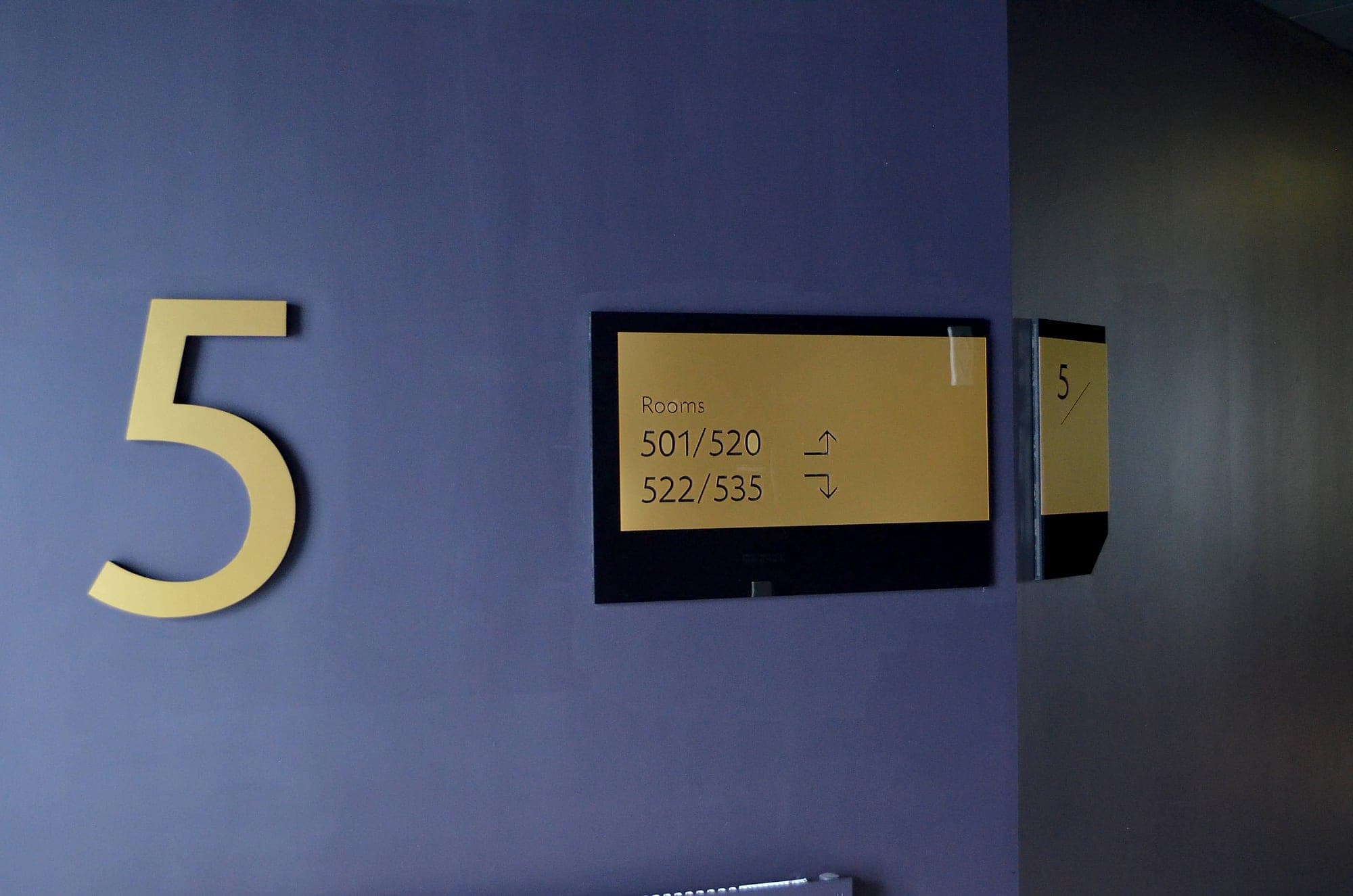
Design, manufacture, installation, and then a long flat line. Painted and printed aluminium, acrylic and stainless steel consume nothing. No feed to lose, no firmware, no licence renewal, no dependency on a supplier still trading in 2036. The realistic ongoing costs are cleaning, which the building does anyway, and replacing a panel when a name changes or someone reverses a trolley into one.
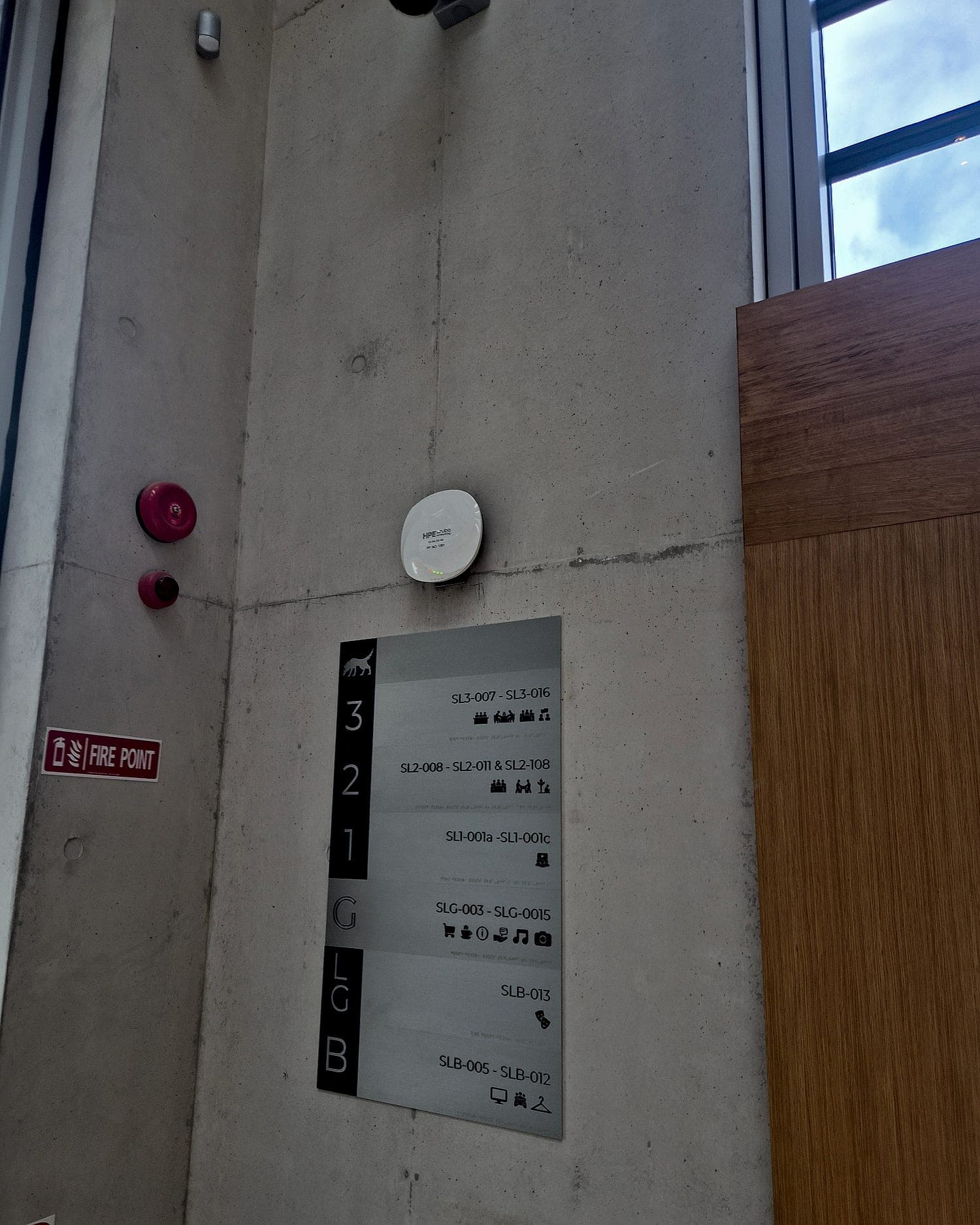
Change is the objection, and it is weaker than it sounds, because static does not mean fixed. A directory built as separate slats in a side channel, a cassette insert behind a face, a magnetic tenant strip: change a department name and you change one part, same day, no electrician and no software. That decision gets made on the drawing. We mark the volatile lines in the destination schedule before anything is cut, because engineering a line to be replaceable costs nothing at that stage and rescues the whole panel later.
The digital line: five costs that never reach the tender
Screen hardware is the visible number and rarely the biggest one. The costs that decide whether a digital scheme is affordable sit behind it:
- First fix. Power and data at a precise point on a precise wall, a rated mount, an enclosure in public areas. All of it is builder's work, priced by someone other than the signage supplier, which is exactly why it goes missing from the comparison.
- The content-management licence. Per screen, per year, indefinitely. And the software the estate is stuck with is whichever one a fit-out contractor chose in a fortnight, five years ago.
- Content operations. The recurring cost that dwarfs the rest: someone has to keep the screen true, and notice when it stops being true. Half a day a month across an estate is a salary line, and it's the one that doesn't get done.
- Energy and heat. A display draws power every hour the building is open, for ten years. In a glazed lobby it needs the brightness to beat daylight, which raises the draw and the cooling load behind it.
- The replacement cycle. Panels dim, media players lose support, bezels are discontinued. Commercial displays are commonly planned around a five-to-seven-year refresh, so a ten-year comparison contains roughly two, and they fall due together across a whole building.
A tender prices the purchase. Nobody prices the ten years that follow it.
- 0 W
- the power a fabricated sign draws, in year one and in year ten
- 10 yr
- warranty behind the signage we supply and install
- ~20%
- saved when one supplier carries the scheme from design to installation
Failure modes: what each one does on a bad day
Cost is only half the comparison. The other half is how each one fails. A static sign degrades honestly and slowly, a scuff here, a name two years out of date there, and people discount it accordingly. A screen fails suddenly and invisibly: the wrong tenant list shown with total confidence, a desktop error, or nothing at all. A visitor can't tell a live feed from a frozen one.
That asymmetry matters more than the money. A stale printed panel is a mild embarrassment. A bright animated one carries an authority it hasn't earned, and sends people confidently to the wrong floor. When the power goes, every screen in the building is a black rectangle at exactly the moment navigation matters most, which is why the escape route is never allowed to depend on one.
The compliance floor a screen cannot reach
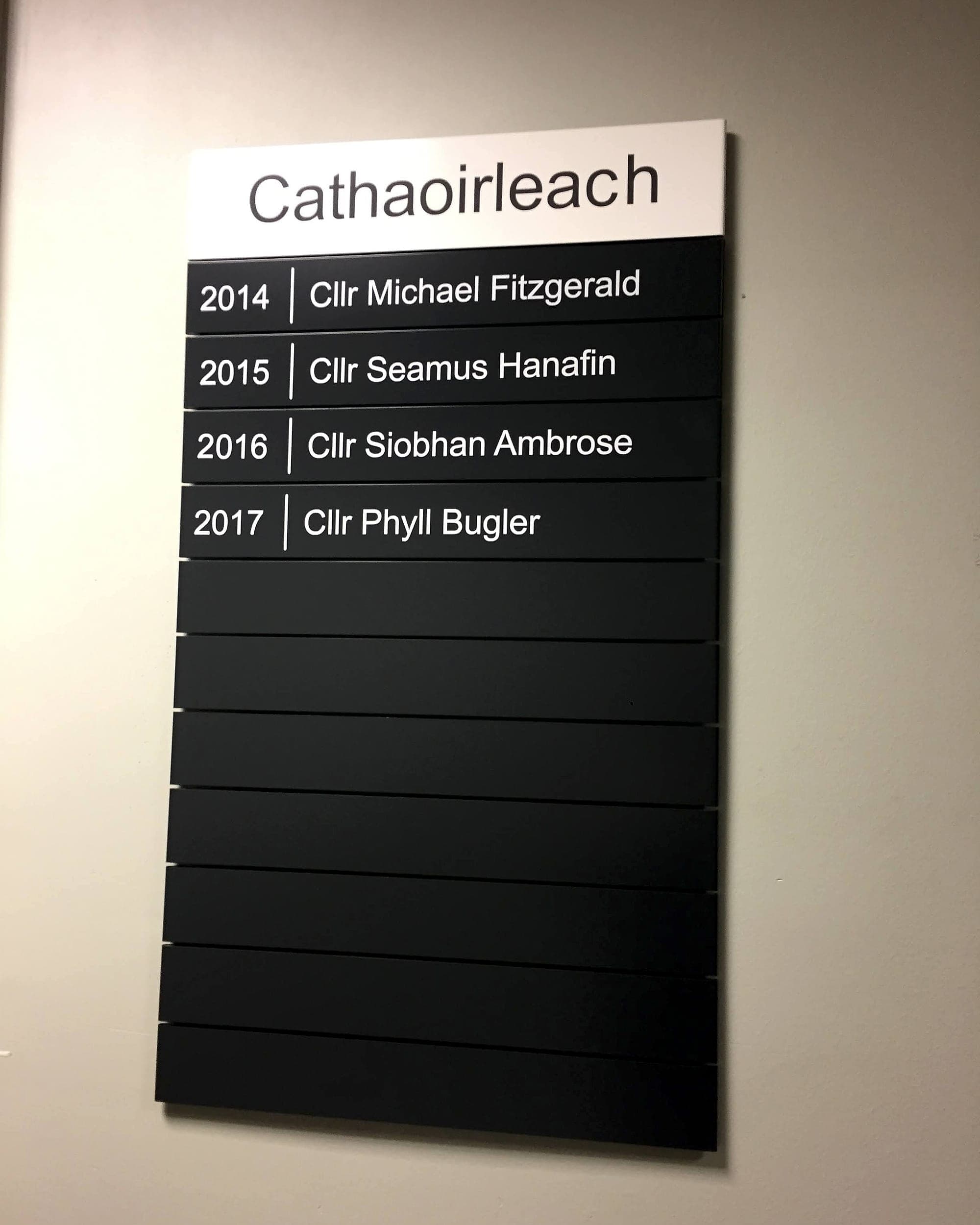
Some of a sign's work is not content at all. Technical Guidance Document M asks that signage be as clear, short and concise as practicable, and that key location information, directories and orientation signs among them, also be provided in tactile form where it is low enough to touch: embossed characters, symbols, braille. BS 8300-2 is the practice behind that. Glass offers a person with low vision nothing to read with a fingertip.
The same holds across the statutory layer. Escape and fire-safety signage under TGD B has to stay legible when the mains supply is gone, which is why it is photoluminescent or fed from the emergency lighting. Safety symbols follow ISO 7010 so they read the same to someone who has never been in the building. In a public body, Irish and English both appear permanently and at equal prominence under the Official Languages Act, not in one pane of a carousel. In England, residential buildings above 11 metres carry floor and flat identification for firefighters to read in poor visibility under the Fire Safety (England) Regulations 2022. The compliant static system is therefore being installed either way, which reframes the question. It was never digital instead of static. The only question is what a screen adds on top of what you are buying regardless.
The decision framework: five questions, sign by sign
Run these per location, not per building. Most schemes that go wrong made one blanket decision for forty positions.
- How often does this content change? Below once a quarter, static with a changeable component wins on every line. Weekly, a screen starts to pay. Hourly, and nothing else will do: clinic lists, room bookings, event programmes.
- Where does the content come from? With no system already generating it, the screen gets typed by hand, and hand-typed content is what goes stale. Feed it from the room or booking data the building holds, as we set out in digital directories.
- Who owns it on a Tuesday in March? Name the role in writing, before the hardware. Ownership by committee is ownership by nobody, and a directory notices within a year.
- What happens when it is black? If the answer is that someone cannot find an exit, a ward or their floor, the information belongs on a wall.
- What does year eight look like? Two panel replacements, one software migration, one supplier acquisition. If nobody in the room owns that plan, buy the panel.
Answered honestly, the framework usually lands on one screen: a single well-sited display at arrival carrying today's variables, over a complete static system running from the entrance to the door handle. One screen is one content job, one power run, one thing to fix. Twenty is a small IT estate nobody was hired to run. Where this argument is weakest is content that genuinely moves by the hour. A clinic list is a real thing, and no amount of slat engineering will carry it. Where dynamic content is worth the running cost is set out in digital wayfinding.
What we specify when we are asked
Static for everything read while moving: rooms, levels, junctions, escape routes, accessible facilities. Changeable static for anything slower than a season, so slats, cassettes and tenant strips, engineered at design stage. Digital only where the content comes from another system and is out of date before a panel could be remade. Then a maintenance walk that checks the screens against the doors, because the failure people remember is two authorities disagreeing, not a broken sign.
Costed that way, the digital vs static signage argument mostly dissolves. The layers stop competing, and the total lands below either extreme: up to 20% below a fragmented route when one supplier carries the scheme from design to installation, which is the same arithmetic as the end-to-end number. If you're pricing a lobby now, see how we handle the digital layer over a static system, or talk to us while the mounting positions are still lines on a drawing.
Planning a wayfinding project? Talk early, while the big decisions are still cheap.