
Signage cost: why end-to-end delivery lands up to 20% lower
On a fragmented package, as much as a fifth of what a client pays buys no signage at all. It buys stacked margin, rework and argument. Here are the honest numbers.
Signage cost is rarely a manufacturing problem. On a fragmented package, with a designer here, a sign contractor there and an installer subcontracted by somebody else, a meaningful share of what you pay buys no signage at all. It buys margin charged on other people's margin, rework caused by information that never travelled between the parties, and the administrative cost of establishing whose fault something was. Deliver the same scheme end to end, with one supplier, and the identical specification typically lands around 20% lower.
The figure surprises people, because fragmented procurement almost always looks cheaper on the day the tenders are opened. That's the whole difficulty. The leaks are real, they are predictable, and none of them appear on the comparison sheet.
Where signage cost leaks on a fragmented package
Signage sits awkwardly in a construction programme. It's small enough to be treated as a finishing trade, and it lands late, when the programme is already tight and the main contractor is counting the days to handover. Yet it depends on information generated months earlier by people who have since moved on: room numbering, department names, door schedules, wall build-ups. Split the package across three or four commercial parties and every one of those dependencies becomes a hand-off. Hand-offs are where the money goes. The underlying cost drivers are the same either way, whether that's sign count, materials, access or compliance scope. What changes is how many times you pay to move information between them.
- Margin stacking. Each party in the chain applies its own overhead and profit to the one below.
- Rework: panels made to superseded information, and discovered on the wall.
- Double-handling. The same survey, the same schedule and the same artwork rebuilt two or three times by different hands.
- Programme drag: a sign contractor waiting on a designer who is waiting on a client, with preliminaries running throughout.
- Disputes, and the cost of establishing responsibility, which lands on somebody even when it appears to land on nobody in particular.
Leak one: margin on margin
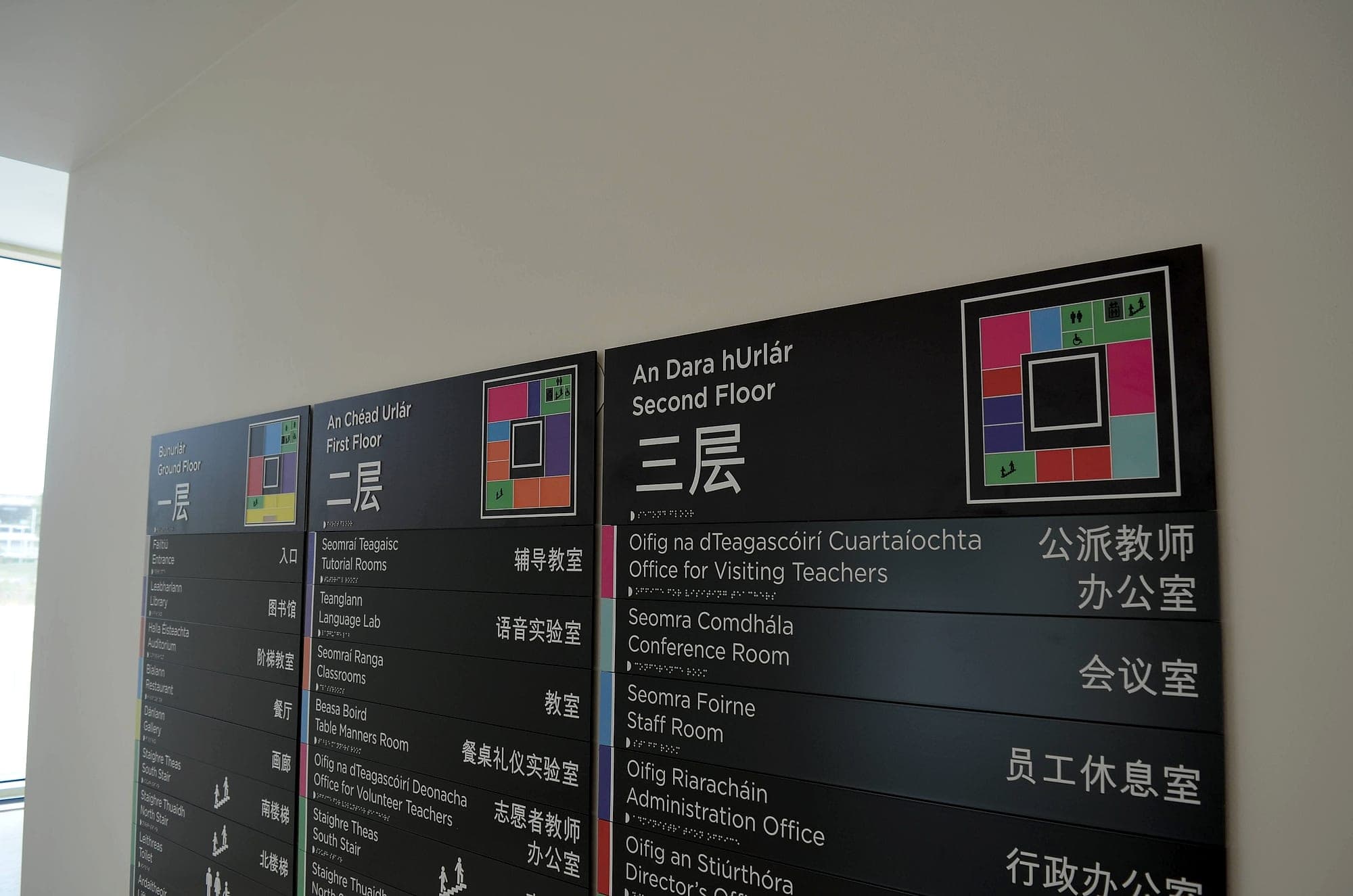
This is the arithmetic nobody enjoys. Where a main contractor buys design from one firm, the sign package from another and subcontracts the installation to a third, you are paying three commercial mark-ups on the same aluminium. None of them is unreasonable in isolation. Compounded, they are the largest and least visible component of a fragmented signage cost, and unlike rework they're entirely certain. You pay them whether or not anything goes wrong. Of the four leaks this is the one we'd close first, and it's the one nobody wants raised at a tender review.
Leak two: rework, which is never small
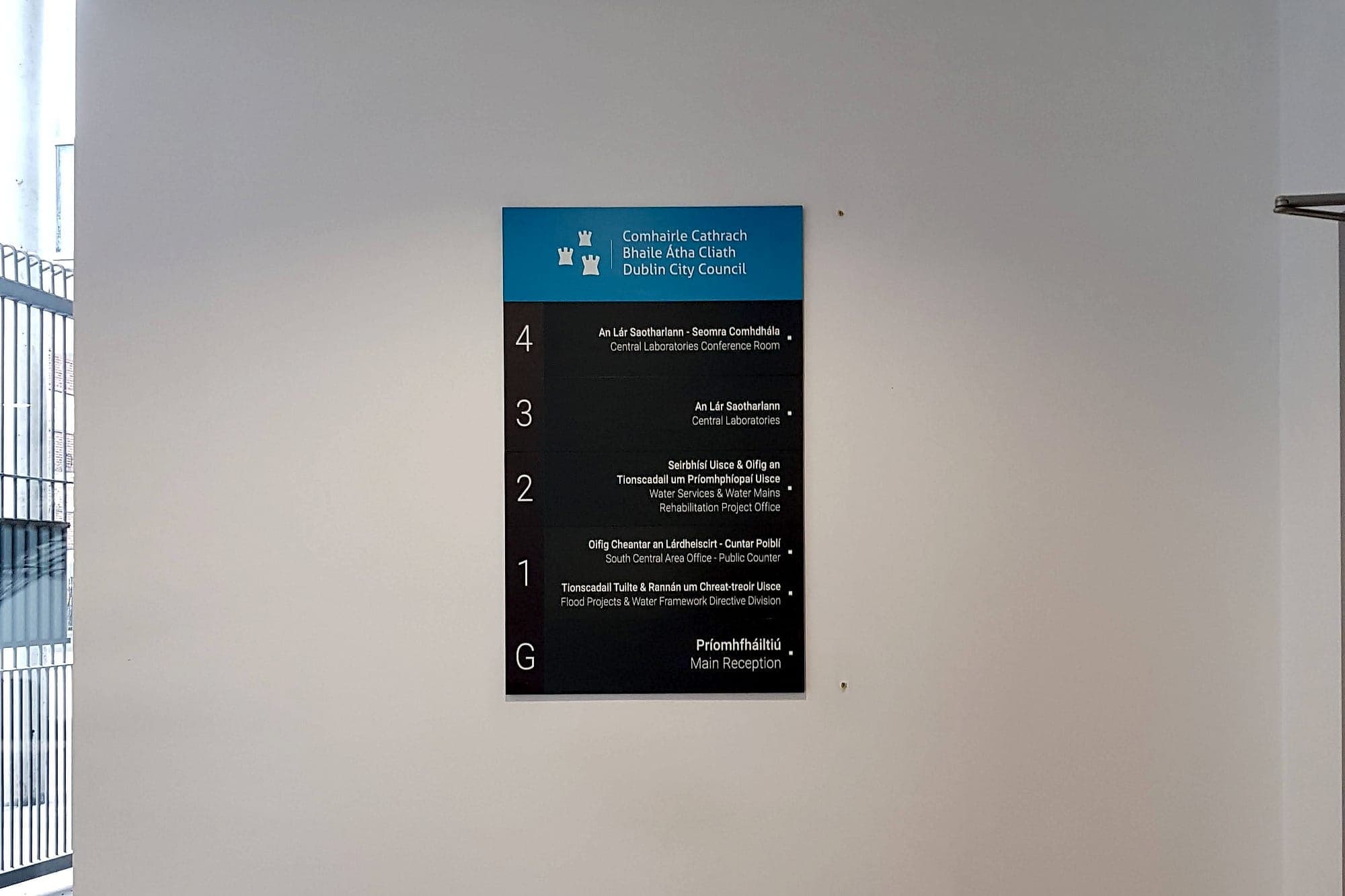
A sign is a physical record of a decision made weeks earlier. When the decision changes and the change doesn't reach the workshop, you don't get a revised file, you get a crate of manufactured panels. A department renamed at handover, on a package where nobody's contract obliged anyone to tell the sign maker, puts a full floor of door signage back into production.
The compliance items are worse, because nothing announces the failure. Part M of the Building Regulations and the technical guidance in TGD M set the accessibility floor for signage in Ireland: visual contrast, tactile and braille provision, mixed-case lettering, mounting heights that work seated and standing. BS 8300 carries much of the detail Irish specifications lean on. For public bodies, regulations made under the Official Languages Act govern how Irish and English appear together, with Irish first and no less prominent. A panel that misses any of this isn't a snag, it's a remake, and on a split package the argument about who specified it takes longer than the remanufacture.
The cheapest quote and the cheapest project are rarely the same package.
Leak three: double-handling the same information
Every signage project needs the same three artefacts: a survey of what is actually on site, a destination schedule of what every sign says, and a production file per item. On an integrated job each exists once. On a fragmented job the designer surveys, the contractor re-surveys because it won't warrant somebody else's dimensions, and the installer measures again on the day because the first two were done before the walls were built out.
The same duplication happens to the schedule. A spreadsheet issued by the design team gets retyped into the sign maker's system, which introduces the transcription errors that later become the rework in leak two. Dull waste, and worth several percent of the package on its own. It's also the leak that software closes fastest. Run approvals through one shared record and, for us, they come down from months to days, mostly because nobody is guessing which version is current.
- ~20%
- lower delivered signage cost when one supplier carries the scheme from design to installation
- Days
- not months, for approvals when sign-off runs through one shared record instead of emailed PDF revisions
- 10 yr
- warranty we can give because one supplier owns the specification, the supply and the installation
Leak four: the dispute nobody budgets for
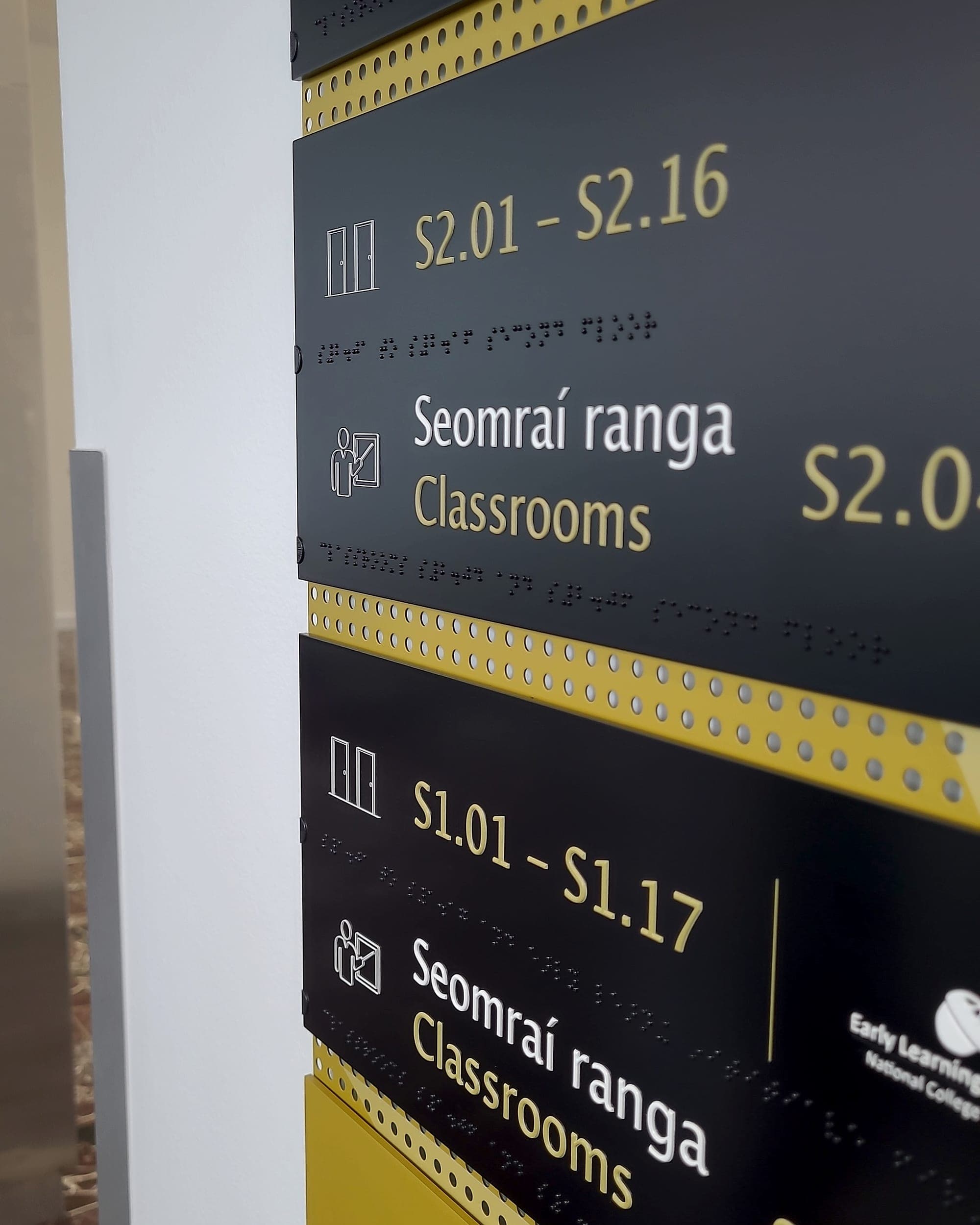
When signage goes wrong on a split package, the failure is almost always at a boundary. The sign is correct but the wall can't take the fixing. The artwork is approved but the substrate shifts the measured contrast below the accessibility threshold. The schedule is right but the installer was given last month's version. In each case the defect belongs to nobody, so it gets resolved by correspondence, and correspondence is charged at professional rates by everyone in the chain except the person who has to live with the building.
Nobody budgets for the argument. It's often the most expensive line.
What "one supplier" has to mean to be worth anything
The phrase gets used loosely, so it's worth being precise about what actually removes cost. A single point of commercial responsibility only pays if the same organisation genuinely carries the risk from first survey to signed-off installation.
- One survey, owned by the party that will be held to the dimensions.
- One schedule, live, that the design team and the workshop read from the same copy of.
- Compliance designed in: contrast, tactile, braille and bilingual provision decided with the artwork, not after it.
- Manufacture and installation inside the same warranty, so a fixing failure and a lamination failure have the same phone number.
- One party accountable for the handover record: the schedule as built, plus the compliance evidence the building will need for years.
That last point is the one clients underrate. Signage is amended constantly over a building's life. If the as-built schedule sits with a supplier who is still on the hook for it, a department move costs a panel. If it evaporated when the package closed, it costs a fresh survey.
Where end-to-end does not save you money
Honesty is cheaper than a claim that doesn't survive contact. End-to-end delivery won't beat a fragmented package on every line, and it's worth knowing where it won't. It's no substitute for value engineering done properly either, which is a different discipline again.
- Very small packages. Twenty door signs on one floor have no hand-offs to remove; buy them from whoever is nearest and quickest.
- Pure commodity items. Standard statutory and fire-safety signage is a catalogue purchase, and an integrated supplier has no structural advantage in buying it.
- Schemes where a specialist fabricator genuinely outperforms: cast bronze, structural glass, illumination engineering. The right answer there is a specialist inside a coordinated package, not a heroic attempt to make everything in-house.
- Projects where the client has real, resourced signage management of their own. Some estates departments run this better than any supplier could, and they should.
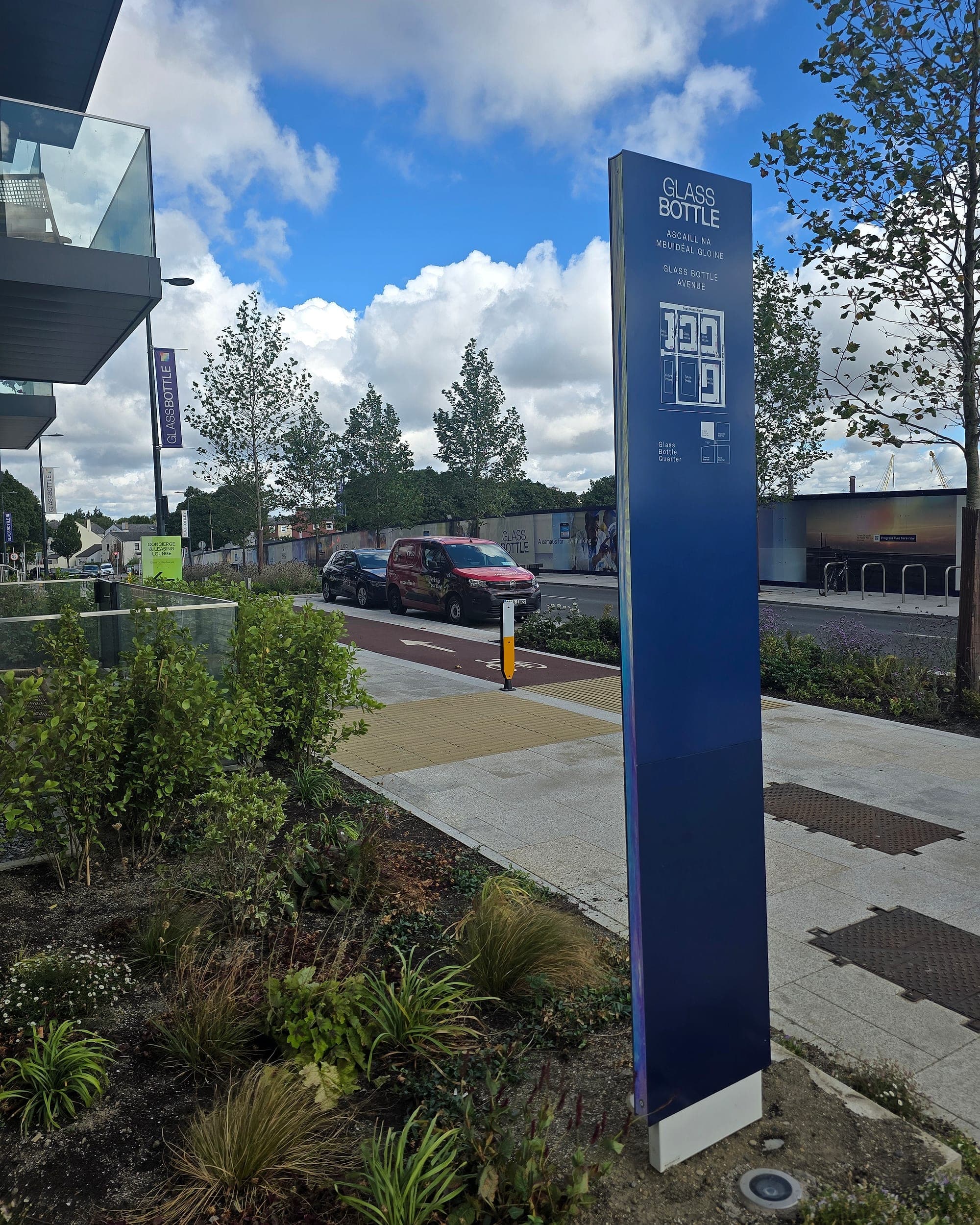
Up to 20% is a package-level figure on a coordinated scheme of any scale: a hospital wing, a campus, a residential masterplan, a council building fit-out. It isn't a discount code.
How to test the claim before you award
Comparing a fragmented signage cost against an integrated one on price alone compares two different scopes. Three questions separate them quickly, whichever procurement route the job is taking, and none of them require a quantity surveyor.
- Who owns the survey, and whose dimensions is the warranty written against? If the answer involves two companies, you are paying for two surveys.
- What happens when a room is renamed after approval but before installation? Who pays, and what is the stated turnaround?
- What compliance evidence arrives at handover, and from whom? A supplier who certifies contrast, tactile and bilingual provision as part of the package has already priced the work; one who does not will price it again later.
Ask those three and the comparison sheet usually rearranges itself. The rest of the argument is set out in how we work. If you want the cost side of it in more detail, talk to us while the drawings are still cheap to change.
Planning a wayfinding project? Talk early, while the big decisions are still cheap.