
The four types of wayfinding signage, and when each earns its place
Identification, directional, informational, regulatory. Every sign in a building does one of those four jobs, and knowing which is which is where good wayfinding starts.
There are four types of wayfinding signage: identification signs, which confirm you've arrived; directional signs, which point the way at decision points; informational signs, which explain a place through directories, maps and opening hours; and regulatory signs, which state what the law or the building requires. Every sign in a well-run building does exactly one of these jobs. Most wayfinding problems begin when one sign is asked to do two of them at once.
The definitions are easy. The judgement is the hard part: which type belongs where, and in what proportion. That is what wayfinding actually consists of. We've designed, supplied and installed all four types for schools, libraries, county councils, ports and hospitals across Ireland, so what follows is how we think about each one, with a built example.
The four types of wayfinding signage at a glance
- Identification names a destination at the destination: door signs, room names, building fascias, desk and department signs. The full stop at the end of a journey.
- Directional moves people between destinations: arrows on suspended signs, wall panels at junctions, external monoliths at gates and car parks.
- Informational describes the place as a whole: directories, floor listings, site maps, opening hours. It answers questions before they're asked.
- Regulatory carries obligation: fire-escape signage, statutory safety signs, accessible provision, site rules and speed limits. Nobody in the building gets a vote on these.
A useful test for any sign in any building: which of the four jobs is this doing? If the answer is "two of them", it usually needs to be two signs. If the answer is "none of them", it's decoration, and it's competing for attention with the signs doing real work.
A sign asked to do two jobs usually does neither well.
Identification: the sign that says you've arrived
Identification is the most numerous type in almost every building. Every room, every door and every desk anyone might be sent to needs one, which is also why it's the most neglected: each sign looks too small to matter on a schedule. We've under-counted it ourselves. A visitor who followed six correct arrows and then can't confirm they've reached the right door has still had a failed journey, and the name on the sign has to match the name on the letter, the timetable and the website exactly. Identification is where naming inconsistency finally gets caught.
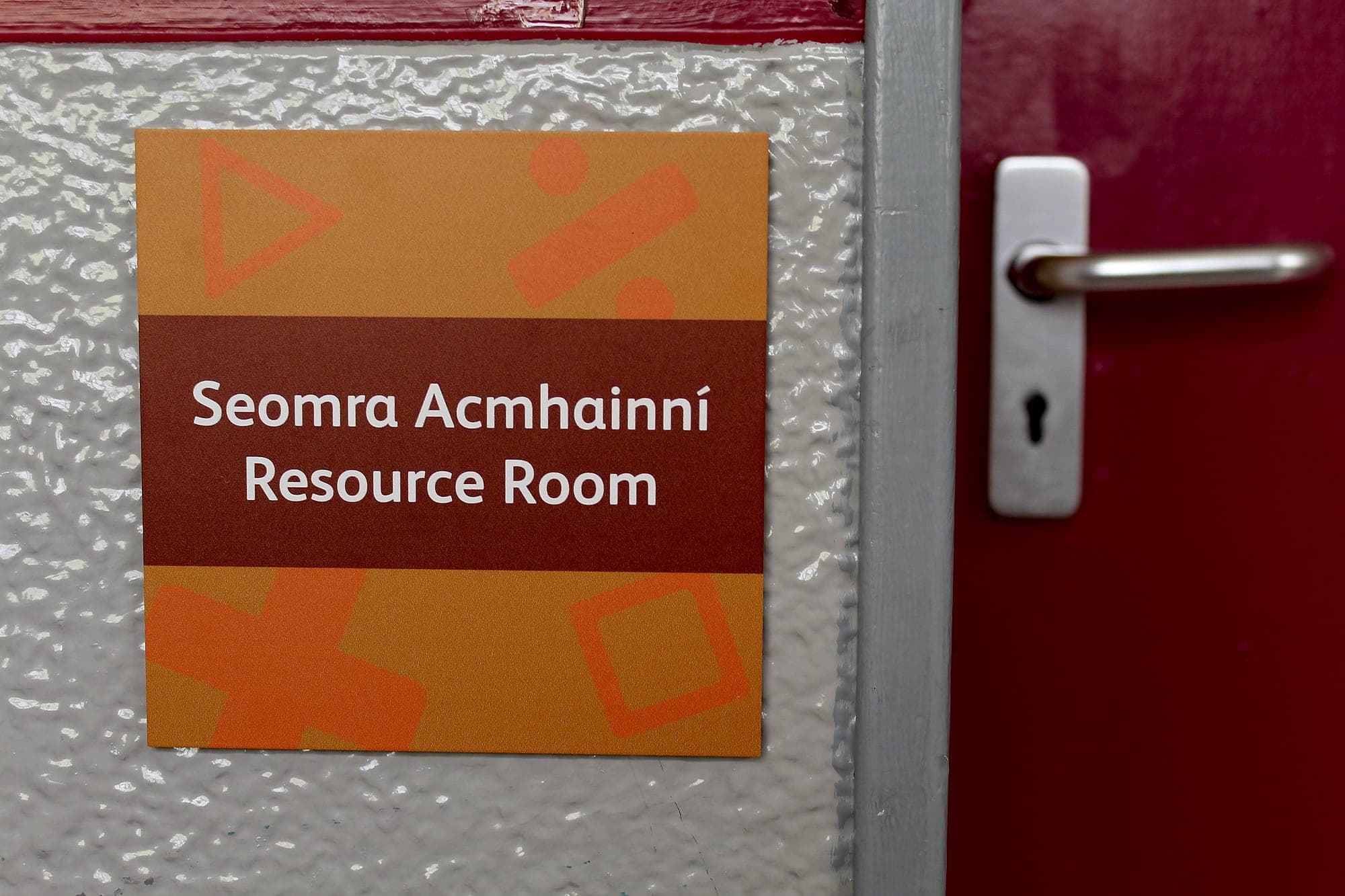
Craft points that separate good identification from adequate: mount on the latch side of the door, so the sign stays legible and reachable when the door stands open; keep a consistent height throughout the building so people learn where to look once; and treat permanent rooms such as toilets, stairs and lift lobbies as tactile and braille locations by default, because identification is the type accessibility legislation cares about most. At Scoil Assaim the room signs also carry the school's colour and pattern language. The layer people stand closest to is the one that carries the character of a place.
Directional: arrows at the moments of doubt
Directional signage exists only at decision points: junctions, lobbies, stair cores, gates. Its discipline is restraint. Each sign shows the destinations that matter at that junction and no more, letting the destination hierarchy release detail progressively along the route. A directional sign listing everything in the building isn't thorough; it's a directory nailed up in the wrong place.

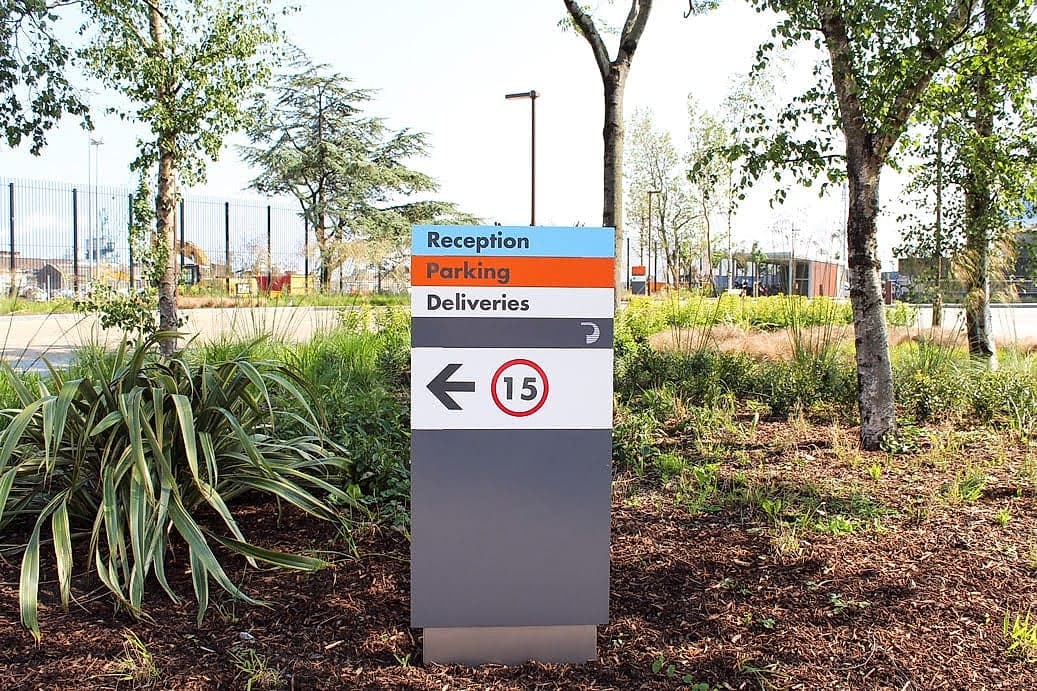
Format follows sightline. Suspended signs are worth their rigging where corridors are busy and walls are cluttered. Hung in the line of travel, they read over heads and survive whatever furniture arrives later. Wall-mounted panels suit calmer junctions. Outside, directional signage becomes monoliths and totems: freestanding, readable at vehicle speed, doing their work before anyone reaches a door. At Dublin Port the estate is navigated largely by vehicle, so the directional layer sits on totems at every junction, listing reception, parking and deliveries, sized for a windscreen.
Informational: the building explaining itself
Informational signage answers the questions people have before they've chosen a direction. What's here, which floor, when is it open, where am I on the site. Directories and maps are the classic forms, and they live at pause points: entrances, lift lobbies, receptions, anywhere standing still for ten seconds is natural. That's the real distinction from directional signage, which serves people already moving. Put a directory at the entrance and it takes a dozen questions a day off the reception desk.
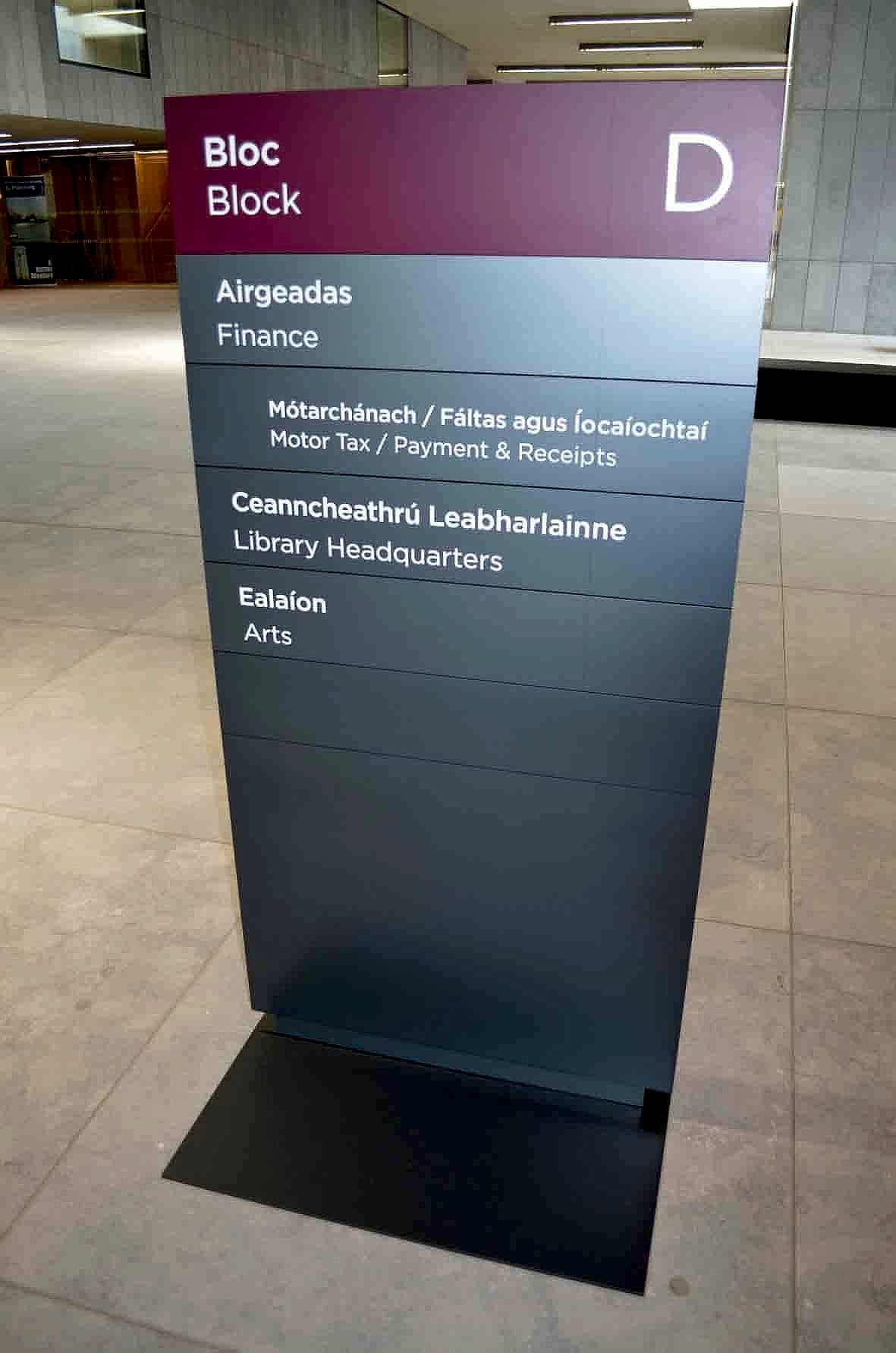
At Wexford County Council's headquarters the campus resolves into lettered blocks, and a freestanding monolith at each one carries the block letter above a bilingual listing of its departments: identification in the header, information beneath, the whole building summarised in a single pass. In public buildings the informational layer is also where the Official Languages Act works hardest. Directories are text-dense, and equal prominence for Irish has to be in the layout from the first sketch. Squeeze it in later and either the panel grows or the type shrinks, and neither is a happy conversation.
Regulatory: the signs the law writes for you
Regulatory signage is the type you don't get to art-direct. Its content, and much of its form, is fixed by legislation and standards:
- Fire-safety and escape signage: locations and photoluminescent performance driven by fire certification and I.S. 3217, symbols by ISO 7010.
- Accessible provision: tactile, braille and visual-contrast requirements under Part M of the Building Regulations, with BS 8300 as the working guidance.
- Safety and site rules: mandatory, prohibition and warning signs under the Safety, Health and Welfare at Work regulations; speed limits and traffic control on campuses and estates.
The craft here is integration. Regulatory signs carry legal weight precisely because they look like nothing else in the building, so the temptation to restyle them into the brand palette has to be resisted every single time it comes up. What you can design is their relationship to everything else: consistent mounting logic, no collisions with the wayfinding layer, no gaps discovered at fire-officer inspection. We build regulatory provision into every scheme by default and certify compliance on completion. Retrofitting it afterwards is where signage budgets leak.
When each earns its place: getting the mix right
Audit an existing building and the usual finding is imbalance. There are plenty of signs. Buildings accumulate directional ones the way desks accumulate paper, each added to patch a complaint, while the identification and informational layers stay thin, so you end up with a building that points constantly and confirms rarely. The symptoms are consistent:
- Arrows to destinations that aren't clearly identified when you reach them.
- Directional signs listing ten destinations at a junction that only needs three.
- Printed A4 pages taped beside "finished" signage: the building's users correcting the system by hand.
- Regulatory signs doing double duty as wayfinding because nothing else is there.
The fix is rarely more signs. It's the right type in the right place: identification made consistent first, directional signage pruned back to decision points, information gathered where people pause, and the regulatory layer checked back against the certification. That's a planning exercise before it's a manufacturing one, and far cheaper on paper than on walls.
Common questions
Appendix- Q.What are the four types of wayfinding signage?
- Identification signs confirm arrival at a destination (door and room signs, building names); directional signs point the way at junctions and decision points; informational signs describe the place (directories, maps, opening hours); and regulatory signs carry legal or operational requirements (fire escape, accessibility, safety and site rules).
- Q.What's the difference between directional and informational signage?
- Directional signage serves people already moving: an arrow and a short list of destinations at a junction. Informational signage serves people deciding, so it belongs on directories and maps at entrances and lobbies, where pausing is natural. Merging them produces overloaded signs that fail at both.
- Q.Do regulatory signs count as wayfinding?
- Yes. Escape routes, accessible toilets and tactile provision are navigation, just legally mandated navigation. They should be planned within the wayfinding scheme, with consistent mounting and no collisions with other signs, while keeping the standardised forms the law requires.
- Q.How many of each type does a building need?
- There's no fixed ratio, but identification is almost always the most numerous, because every nameable destination needs one. After that comes directional at decision points only, a small informational layer at pause points, and regulatory provision set by the certification.
Planning a signage scheme, or inheriting one that points more than it confirms? See how we approach wayfinding design, or talk to us while the sign schedule is still a spreadsheet.
Planning a wayfinding project? Talk early, while the big decisions are still cheap.