
Internal signage systems: modularity, updates and change
Most internal signage is bought as a set of objects and then lived with as a system. The difference shows the first time a department moves.
An internal signage system is the coordinated family of signs inside a building: directories, directional signs, room and door signs, floor identification and statutory signage, all built from one kit of parts. Shared profiles and sizes, a fixed type hierarchy, agreed colours, and one rule for how information is added, changed or removed. What separates a system from a set of signs has nothing to do with how it looks on handover day. It is whether the next change to the building can be absorbed by the signs, or whether it starts a new procurement.
Buildings move. Departments merge, a floor is re-let, a seminar room becomes a store, a ward is renumbered. None of that is unusual, but a package that treated every panel as a finished object will meet all of it badly. The honest measure of internal signage is what the building looks like after fifty small changes, not the photograph taken the week it went up.
What makes internal signage a system
Three tests, all of them practical. Repeatability: can a new sign be produced next year without a design decision, or is the drawing already implied by the rules? Reversibility: can one fact change without replacing the substrate? Traceability: does every sign have a number, a location and a held artwork file, so that "change room 214" is a few minutes of work and nobody has to go out and survey the corridor again? Where all three hold, a change is a line item. What makes them hold is an agreed kit of parts:
- Carrier. The part fixed to the wall or ceiling: tray, rail, panel or bracket. It should outlive several generations of content.
- Face. The printed or engraved surface. Whether it is the same piece as the carrier decides everything about updating.
- Insert. The deliberately changeable element, behind a lens, in a channel or on a magnetic bed, for information with a short half-life.
- Rules. Type sizes, contrast, margins, arrow forms and the bilingual convention, written down so a sign made in year eight matches one made in year one.
- Schedule. The numbered register of every sign, its location, content and artwork, handed over live and editable.
Modularity: choosing the unit of change
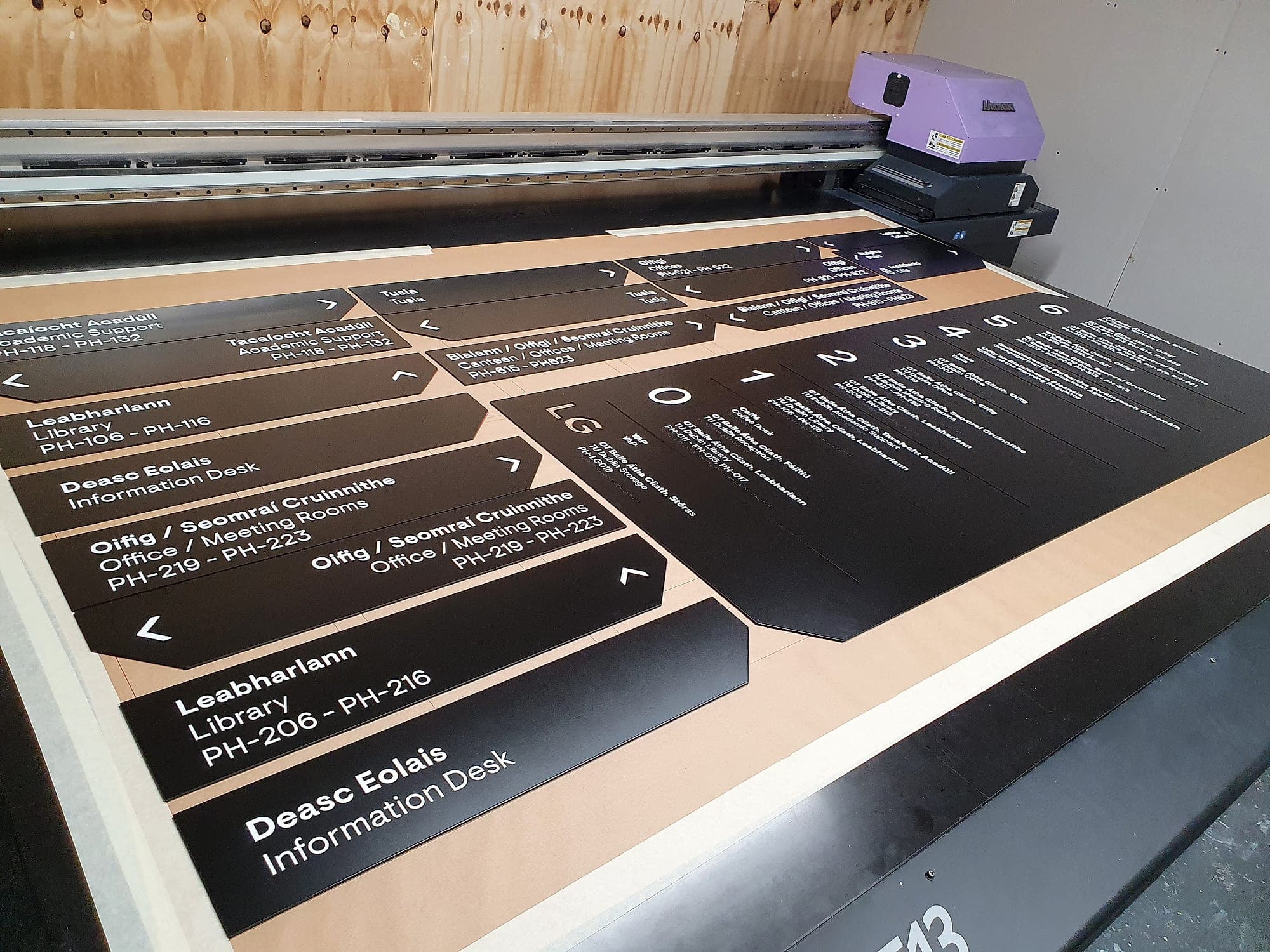
Modularity is one decision made early: what is the smallest piece of a sign that carries a single fact, and can that piece be replaced on its own? Get it right and a department move costs one strip. Get it wrong and it costs a new panel, a new survey and a scaffold tower.
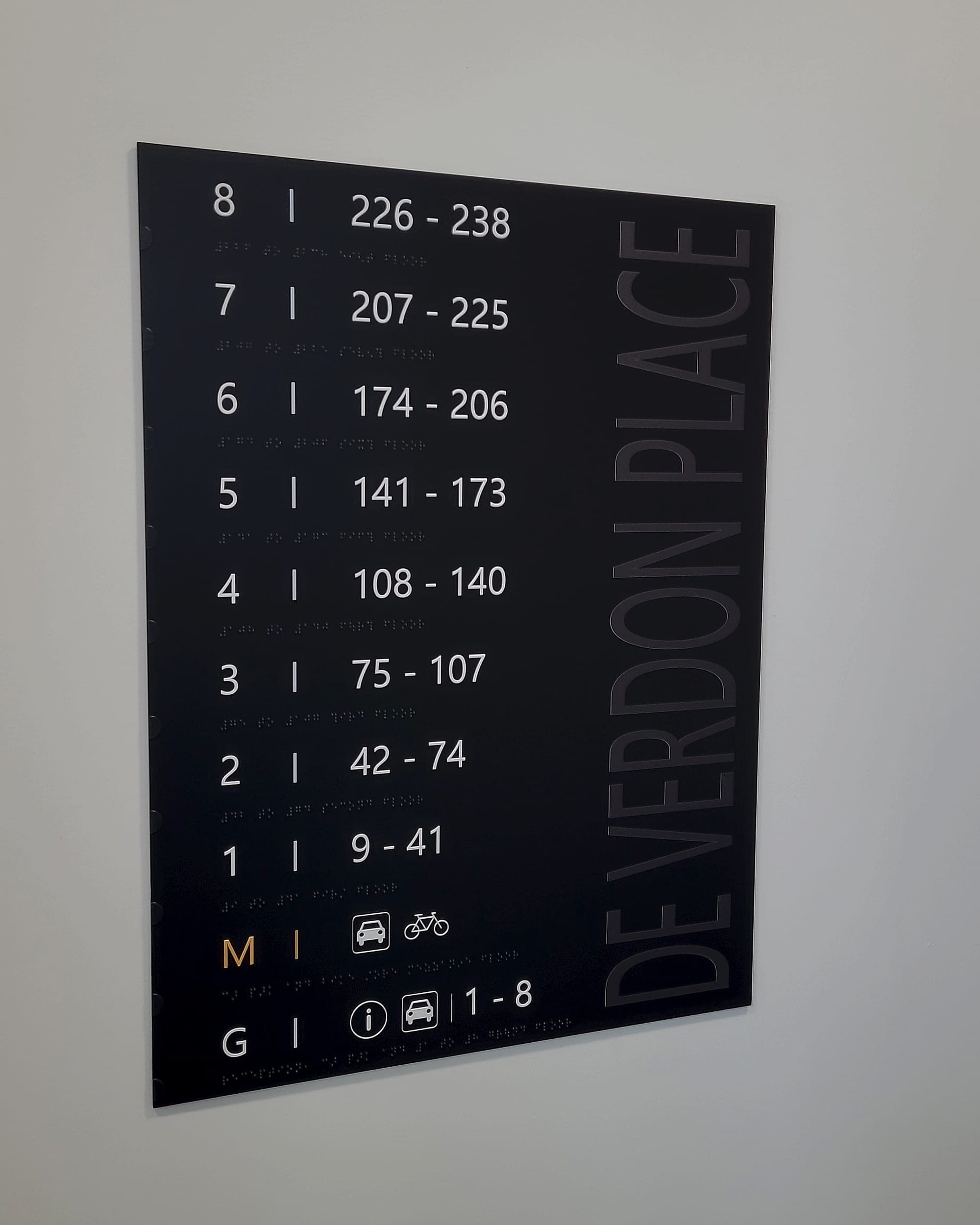
Directories are where this bites hardest. A single-panel building directory is the most elegant object and the least forgiving: change one line and you remake the whole thing. At Trinity Business School that panel carries five levels of rooms on one face, and it can take that treatment because the names there are stable. Where names are not stable, the same information belongs in bands, one floor per module in an aluminium carrier, or slide-in strips in a channel, so that a change costs in proportion to its size. We think the single-panel directory gets specified far more often than it can be justified, and usually because it's the version that photographs best.
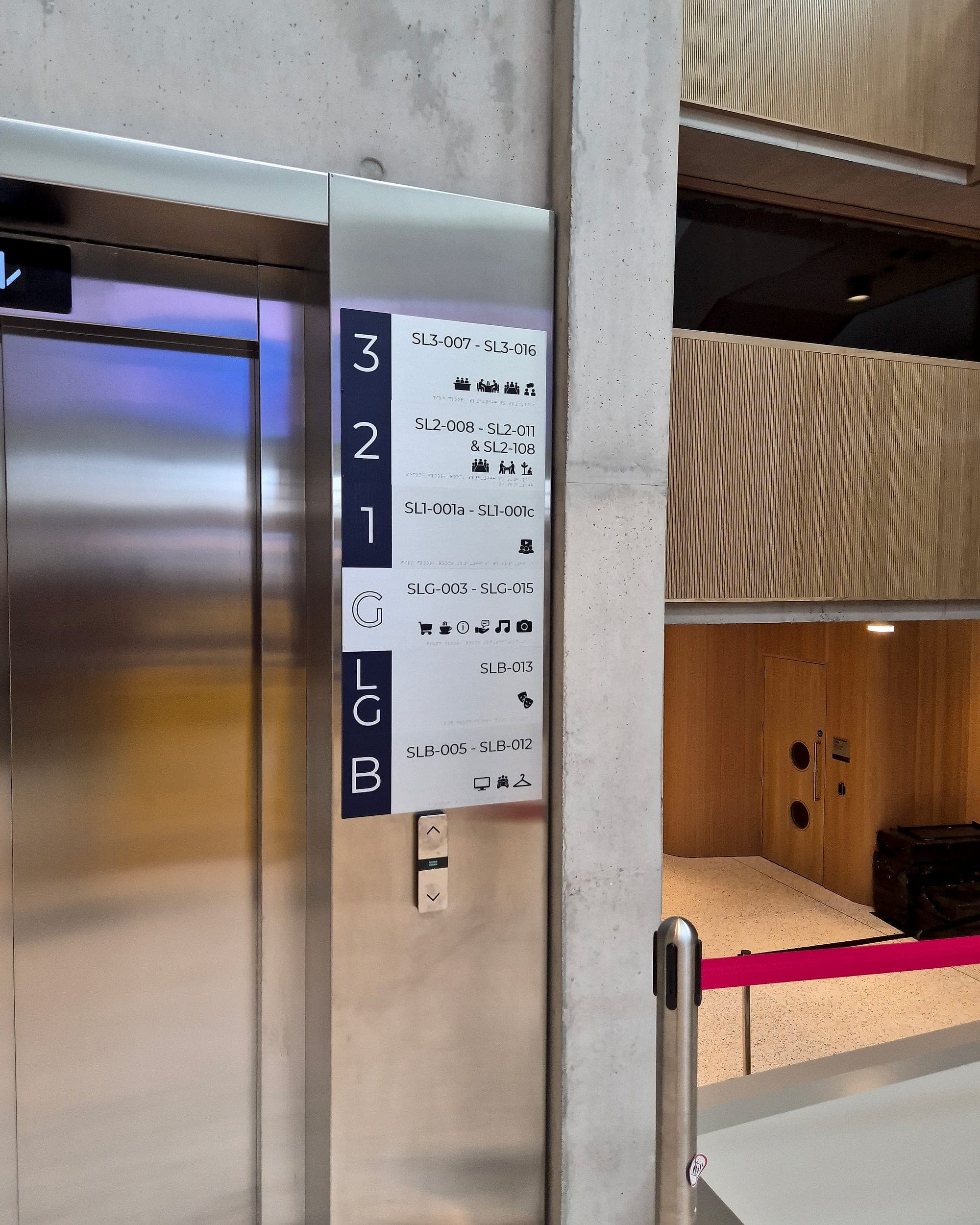
A building changes faster than its signs. Build the signs expecting it.
Changeable inserts, and where they must stop
Inserts are the cheapest modularity there is: a printed sheet behind a lens, a vinyl strip in a channel, a magnetic face on a steel bed. They suit anything with a short half-life, like a name on an office door or a room's current function, and nothing else. We have pushed it too far the other way as well, and built a directory out of so many separate pieces that it read as a stack of pieces. Modularity has an aesthetic limit as much as a practical one.
Two constraints govern them. The first is that an insert inherits the sign's compliance obligations, and being easy to change relaxes none of them. Contrast has to hold on every future insert, not just the one photographed at handover: the working figure is 30 or more LRV points between text and background, with TGD M and BS 8300 setting the baseline for character height and mounting position. Where the Official Languages Act applies, the Irish text goes first and in lettering no less prominent than the English, and that is as true of a five-minute insert change as of the original manufacture. Which is why we issue insert templates with the system.
The second constraint is that some signs may not be changeable at all. Tactile and braille information has to be raised and durable, so a tactile door sign is re-manufactured, never re-printed. Safety signage takes its form from the workplace safety regulations and the ISO 7010 graphical set, and escape-route signage from TGD B. None of it is a candidate for a slide-in strip. In England, the Fire Safety (England) Regulations 2022 require high-rise residential buildings to carry floor identification and flat numbering that stays legible in low light or smoke; permanence is the point of it. A good internal signage system is explicit about which parts are fixed and which are open, and never lets the two get confused on site.
Number by range, name by exception
The most effective modularity isn't in the hardware at all, but in what the signs are allowed to say. Names change constantly; numbers change almost never. A sign reading "Oifigí / Offices 219–223" survives every reorganisation that "Finance Department" does not, and it is the more useful sign anyway, because a visitor with an appointment in room 221 can act on it immediately.
So the rule we work to is this. Navigate by floor and number, and name only the destinations that are genuinely landmarks: reception, the library, the restaurant, the lecture theatre with a donor's name on it. That decision belongs in the room-numbering work and the destination schedule, before a panel is drawn. It costs nothing at that stage, and it decides how much of the system is still true in 2036.
The manufacturing decisions that keep a system open
A few choices made in the factory decide whether a building can update its own signage. Direct-printed faces are crisper and cheaper; applied vinyl on a plain tray can be re-laid on the same carrier years later. Mechanical fixings cost more to install than tape and far less to reverse; a taped panel that lets go in year two takes the paint with it, and somebody is back making good a wall nobody expected to touch again. A tray depth chosen to take an insert lens cannot be retrofitted. We keep artwork, cutting files and material records for every sign we supply, which is the only reason a matching one-panel reorder is possible in year six.
After handover, the system needs an owner
The commonest failure of internal signage is neither manufacture nor installation. It's that six months on nobody knows what the sign schedule was, the first change gets made in A4 and sticky tape, and the building's signage is permanently two systems. The fix is unglamorous. Hand over a live schedule, ideally as part of the model and the room data. Name an owner in facilities. Leave insert templates and a few blanks on site, because the first change always comes sooner than anyone plans for. Our ten-year warranty only means anything if the system is still recognisably itself at year ten.
If you're specifying internal signage for a building that will keep changing, and they all do, modularity belongs at the same table as the material and the typeface. Talk to us about manufacture and maintenance, or start with the naming while it's still cheap to fix.
Planning a wayfinding project? Talk early, while the big decisions are still cheap.