
What signs are made of: a signage materials guide for specifiers
Acrylic, aluminium, stainless, brass, timber, solid surface, glass. Where each belongs, how long it lasts, what it costs, and what it does to compliance.
Signage materials are the substrates and finishes a sign is physically made from: acrylic, aluminium and composite panel, stainless steel, brass and bronze, timber, solid surface, glass and stone, together with the vinyls, films and inks that carry the message across them. The choice sets the sign's lifespan, its maintenance burden, how it behaves under fire and accessibility regulation, and a good share of what it costs.
We design, supply and install, and we warrant what we supply for ten years, so we live with our own material decisions for a decade rather than handing them over at delivery. This is the reasoning we use, material by material. For how the pieces are cut, folded and finished, see how signs are made; for the specification wording itself, specifying signage as an architect.
Five questions before you choose a material
Most material arguments resolve themselves once these five are answered honestly, in this order:
- Inside or outside? Weather is the single biggest divider. UV, rain, frost and salt eliminate more materials than budget does.
- How long must it last, and who maintains it? A twenty-year bronze plaque and a five-year retail fascia are different objects.
- What is it fixed to? Plasterboard, brick, curtain walling, insulated render and listed stone each rule out fixings, and the fixing usually decides the sign. Draw the panel first and you'll draw it twice.
- Does the content change? Anything that gets updated, like staff names, department moves or room numbers, wants a replaceable insert. Engrave a name into metal and you've engraved a future variation order.
- What does it have to comply with? Contrast, tactility, fire performance and, in public bodies, bilingual text all push the material choice before aesthetics get a vote.
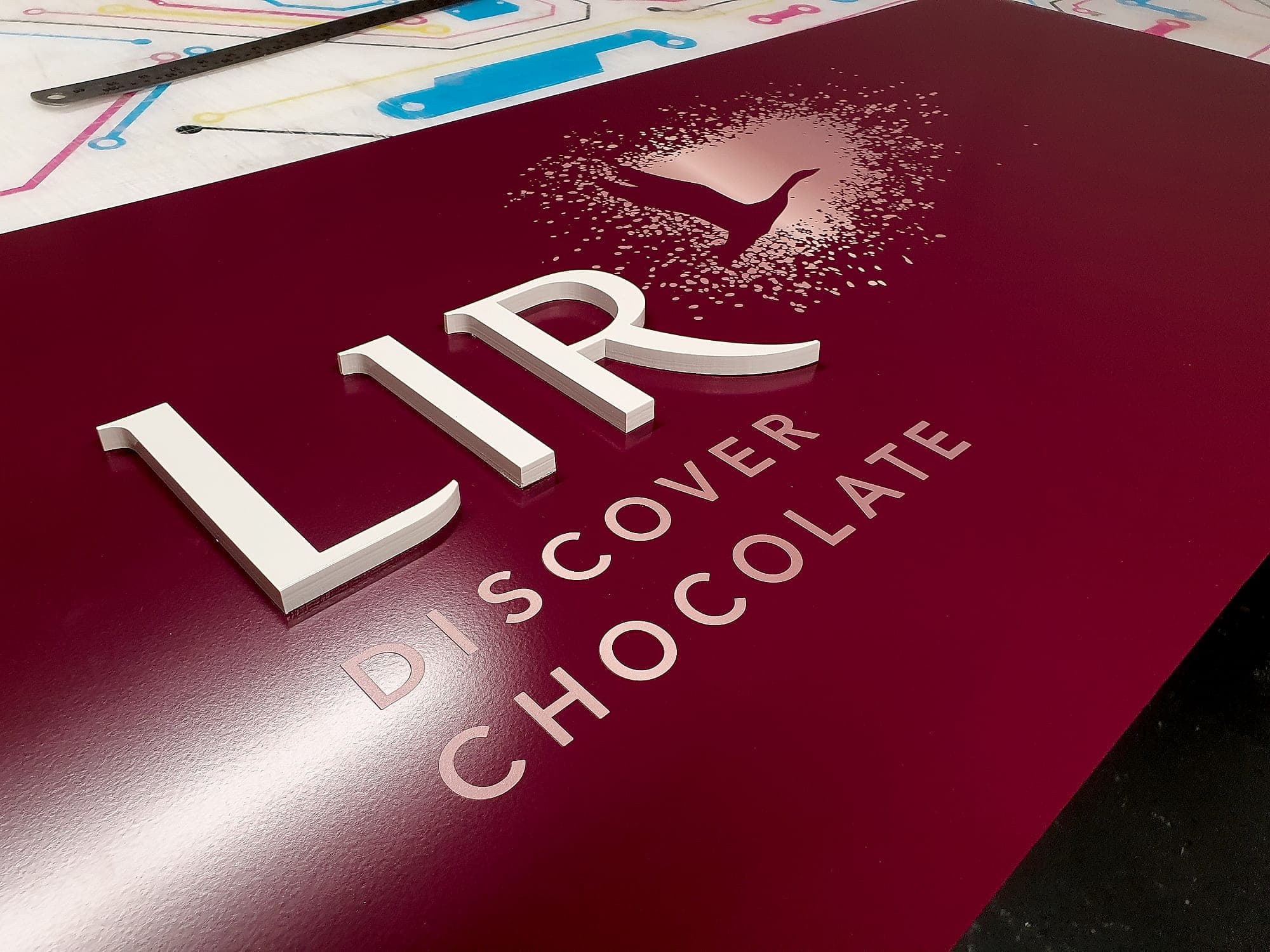
Acrylic: the interior workhorse
Cast acrylic is the default for internal panels, flat-cut letters and layered signs, and deservedly so. It gets a snobbish press from design teams and doesn't deserve it. It machines and laser-cuts to a clean polished edge, it takes vinyl and direct print well, it can be sprayed to any colour, and in 3mm to 20mm it covers almost every internal sign type from a door plate to a 300mm reception letter. Colour is solid through the section, so a scuffed edge still reads as the colour it is meant to be.
Its weaknesses are worth knowing. Acrylic is brittle and chips at over-tightened fixings, and it scratches more easily than a coated metal, which matters in a corridor that meets trolleys. Extruded acrylic is cheaper than cast but cuts less cleanly, so for anything with a visible edge, specify cast. Outdoors it's UV-stable and unforgiving of impact. We keep it in sheltered positions out there.
Aluminium and composite panel: the exterior default
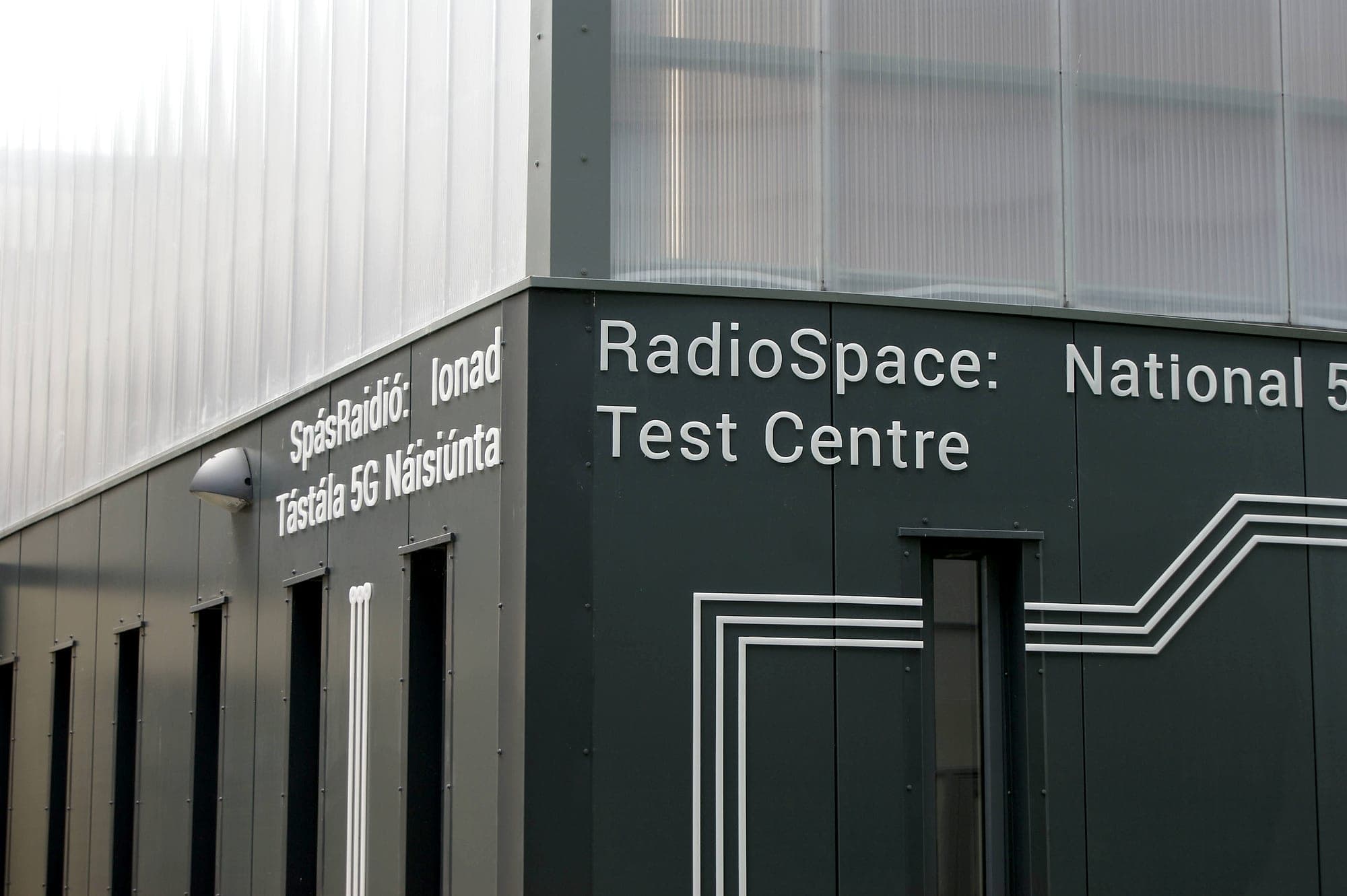
Outside, aluminium does most of the work. Two or three millimetre sheet folded into a tray gives a rigid, flat, self-draining panel with no visible fixings, powder-coated to a RAL or BS colour, or anodised instead for a metallic finish that can't chip. It's light enough to hang off a facade and stiff enough to stand as a totem, and it doesn't rust. What eventually goes is the coating at the edges.
Aluminium composite panel (two thin aluminium skins bonded to a core) is flatter and cheaper for large faces, but the core is a fire question, not a cost question. Where combustible material in an external wall is restricted, specify a mineral-cored panel with an A2-s1,d0 reaction-to-fire classification, or drop back to solid aluminium. Confirm it in the submittal. Don't assume the fabricator has. Coastal and estuarine sites, the kind of exposure you get at Dublin Port, also argue for heavier gauges and better coating systems than an inland car park needs. More on that in external signage durability.
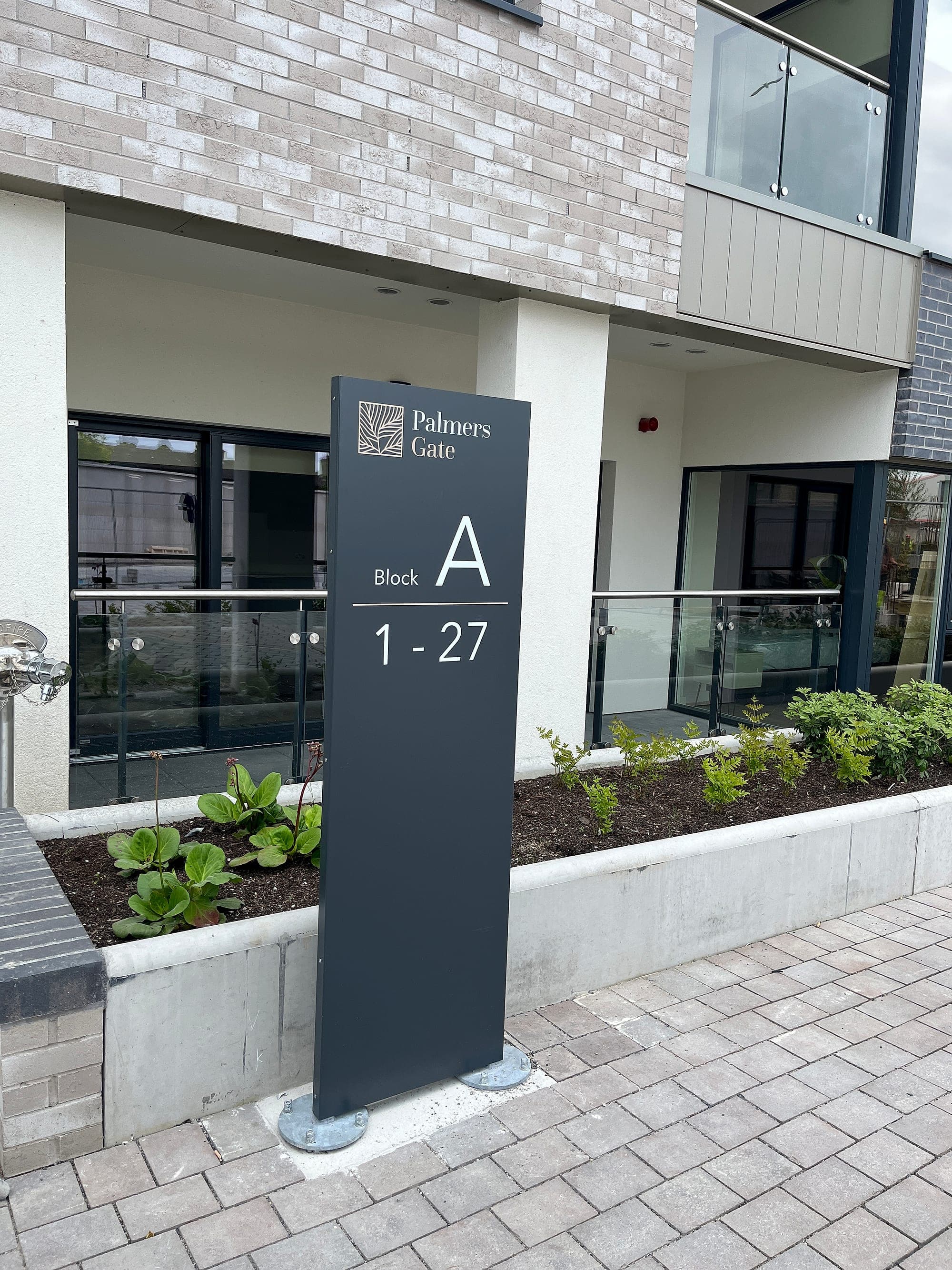
Stainless steel, brass and bronze: the permanent register
You choose these when the sign has to read as part of the building. Stainless steel is the practical one: grade 304 for general internal and sheltered external use, 316 where salt air or chlorinated pools are in play. Brushed satin hides handling marks far better than mirror polish, which shows every fingerprint on a door plate within a week.
Brass and bronze are the slow materials. Left unlacquered they patinate, darkening unevenly with touch and weather. Beautiful if that's the intention, a complaint if nobody said so at design stage. Lacquered, they hold their colour, but then the lacquer becomes the maintenance item. Either is legitimate. What is not is leaving it unwritten: a client who was never told to expect patina will read it as tarnish, and tarnish reads as a defect.

A material is a maintenance decision wearing a design decision's clothes.
Timber, solid surface, glass and stone
The remaining families are specials: right in the right place, and expensive mistakes elsewhere.
- Timber. Warm, and unbeatable where a building is already timber-lined or set in landscape. Externally it moves, silvers and needs a maintenance regime, so specify the species and the finish, not just "oak". Hardwoods and thermally modified softwoods behave; untreated softwood does not.
- Solid surface (Corian and equivalents). Thermoformable, seamless, non-porous and repairable by sanding, which is why it's worth its cost in healthcare and hospitality, where signs get cleaned hard and knocked often.
- Glass. Toughened or laminated, usually back-painted, standing off the wall on polished barrels. It photographs beautifully and reads poorly in low contrast, so resolve the legibility before the elevation.
- Stone. Reserved for building identification and commemorative work. Cut once, correct never, which makes proofreading the real cost.
Vinyls, films and print: the layer that does the talking
Most signs fail at the graphic layer long before the substrate gives up, so it deserves as much attention as the metal underneath.
- Cast vinyl conforms to curves and rivets and holds colour for years outdoors; calendered is cheaper, thicker and shrinks back over time. Use cast anywhere that matters.
- Digital print wants a laminate over it outdoors. The laminate carries the UV, not the ink.
- Direct-to-substrate UV printing gives a flat, durable graphic with no film edge to lift, and suits panels that will be wiped daily.
- Etched and frosted films do manifestation and privacy in one move on glazing, and are the cheapest element on any project to get wrong at setting-out.
- Applied graphics on a powder-coated tray remain the most repairable combination we specify: the panel outlives several generations of content.
Lifespan and cost: what to expect
Cost bands vary with quantity, size and finish, so treat them as relative. The ordering rarely changes. Lifespans assume normal maintenance and an Irish climate.
- Foam PVC and dibond. 1–3 years external, longer inside. Lowest cost band, and right for temporary and phase signage only.
- Cast acrylic. 10+ years internal, 5–10 external in a sheltered position. Low to middle cost band, and the internal default.
- Powder-coated aluminium tray. 10–15 years before recoating becomes a conversation. Middle cost band, and the external default.
- Anodised aluminium. 15–20 years with no coating to fail. Middle to upper cost band.
- Stainless steel (304/316). 20 years plus, at the upper cost band. Buy it for permanence.
- Brass and bronze. Effectively indefinite, with the appearance changing throughout. Highest cost band per letter.
- Timber. 10–15 years external with maintenance, far less without. Middle cost band, plus a maintenance liability.
- Vinyl graphics. 3 years calendered, 7–10 cast with laminate. Lowest cost band, and the item you'll replace first.
- 10 yr
- warranty on what we supply, the reason our material choices are conservative
- 30+
- LRV points of visual contrast between text and background, the accessibility baseline material choice has to hit
- ~20%
- saved when one supplier carries the scheme from design to installation
Where signage materials meet compliance
This is the part discovered late. Four regulatory pressures act on the material, not the drawing:
- Contrast and tactility. Technical Guidance Document M asks that signage be clear and concise and that key information be available in tactile form; the working detail sits in BS 8300: character heights, mounting, and the visual contrast between text, sign face and background. A gloss finish that mirrors a window can defeat a contrast calculation that passed on paper, which is why we check light reflectance values on the actual finish rather than the swatch.
- Fire performance of the substrate. Reaction-to-fire classification governs what can sit on an external wall and in a protected escape route. That's the composite-core question again, and the reason large internal panels in escape corridors get specified with the classification written down.
- Visibility in smoke and low light. In England, the Fire Safety (England) Regulations 2022 require wayfinding signage in residential buildings over 11 metres to be visible in low light or smoke conditions. That's a material requirement, met with photoluminescent or equivalent products.
- Bilingual text. Under the Official Languages Act, Irish and English carry equal prominence in public bodies. Two languages means more text, which means larger panels or smaller characters, and character height is itself an accessibility constraint. Decide the material and the size together, or the sign fails one of them.
Specify the finish, not just the material. The finish is what fails first.
Common questions
Appendix- Q.What are the best signage materials for outdoor signs?
- Powder-coated or anodised aluminium for most external panels and totems; grade 316 stainless where there is salt air; cast vinyl with a UV laminate for the graphics. Acrylic works externally in sheltered positions, and timber only with an agreed maintenance regime.
- Q.How long should signage last?
- In an Irish climate, expect 10–15 years from a powder-coated aluminium external sign before recoating is worth discussing, 20 years plus from stainless, 10 or more from internal acrylic. The graphic layer is shorter-lived: 3 years from calendered vinyl, 7–10 from cast with a laminate. We warrant what we supply for ten years.
- Q.Which signage materials are cheapest?
- Foam PVC and dibond, which is why they suit temporary and construction-phase signage. On a finished building they are a false economy: replacing them twice costs more than specifying aluminium once. On most projects the biggest cost driver isn't the material at all, but rework caused by names and quantities changing after manufacture.
- Q.Can signs be recycled?
- Aluminium and stainless steel are straightforwardly recyclable and hold scrap value. Acrylic can be, where a stream exists. Composite panels and laminated vinyl graphics are the difficult ones. The largest sustainability gain of all is designing panels so the content can be replaced without replacing the sign.
Material choice is easiest to fix at specification stage and most expensive to fix after installation. If you're writing a signage package now, see how we handle manufacture, or send us the drawings and we'll tell you where the spec will cost you later.
Planning a wayfinding project? Talk early, while the big decisions are still cheap.