
External signage: designing for weather, vandals and time
External signage rarely fails at the face. It fails at the fixing, the edge and the foundation: the parts nobody looks at on the drawing.
Durable external signage comes down to four decisions: the substrate, the finish, the fixings and the foundation. Get all four right for a wet, windy, salt-carrying climate and a sign is still straight and legible in ten years. Get one of them wrong and it looks tired in three. The one that's wrong is almost never the one anybody argued about.
Nobody specifies a colour that fades or a post that leans. Those outcomes arrive by omission: a fastener chosen for price, a joint that traps water, a panel that can't be replaced without dismantling the frame. We design, supply and install outdoor signage across Ireland, on council campuses, hospital sites, schools and apartment schemes, and because we go back and maintain it we get to see which of our own decisions aged well. Some of them didn't. What follows is what that taught us.
What the Irish climate actually does to external signage
Ireland is not a harsh climate in the dramatic sense. There is little extreme heat, little sustained frost and no desert UV. What we have instead is persistence: wind off the Atlantic, rain that arrives horizontally, and humidity that keeps surfaces damp for weeks at a time. Signage doesn't get destroyed here. It gets slowly worried apart.
- Wind, not weight, sizes the foundation. A 600mm-wide totem is a sail. Wind actions are calculated to Eurocode 1 (EN 1991-1-4), and Ireland's western half carries some of the highest design wind speeds in Europe. The same panel needs a very different pad in Belmullet than in Blackrock.
- Driven rain finds every horizontal joint. Water that lands on a face runs off; water that sits in a capping seam, a fold or a screw recess goes nowhere and works on the coating from behind.
- Salt travels inland. Coastal exposure is not a thin band along the shoreline; salt-laden air reaches well inland on prevailing winds, which is why we set fastener grade off the site address.
- Damp grows things. On north elevations, under trees and behind hedging, algae and lichen colonise a matt finish within a couple of seasons. It's cosmetic, but it reads as neglect.
- Freeze-thaw finds the water you left behind. Any pocket that holds rain in November is working on the joint by January.
Materials and finishes that earn their keep
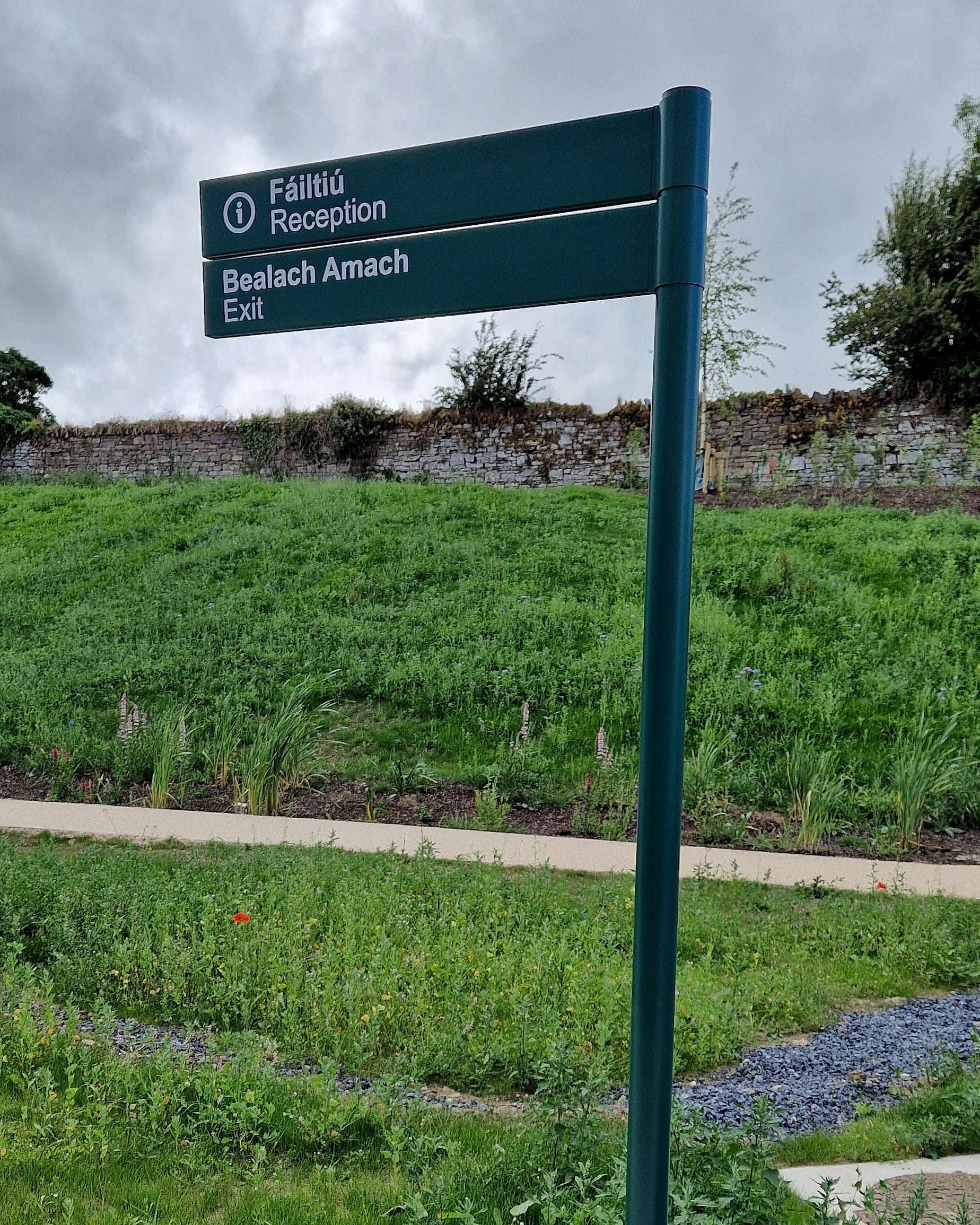
Aluminium is the default for external work, and for good reason: it doesn't rust, it takes a powder coat beautifully, and it can be folded into a tray that stiffens the panel without adding a frame. Steel appears where structure demands it, in post cores and large gantries, and then it wants galvanising under its coating. Stainless is specified by grade: 304 is fine inland, 316 is the coastal answer, and the difference shows up first on the fasteners, which is exactly where nobody looks. There's a fuller treatment of the trade-offs in our materials guide for specifiers.
Finish is where budgets get cut and lifespans get shorter. Powder coating is not one product: architectural and marine specifications differ in pre-treatment, film build and pigment stability, and coastal work wants the seaside-class version. If one line has to come out of an external package, our view is that it should never be the coating. Printed graphics want a UV-stable ink and an overlaminate, and that laminate is the sacrificial layer, far cheaper to replace than the panel beneath it. Where a graphic must not fade, the honest answer is not to print it at all: cut vinyl in a colour-through film, or engraved and infilled lettering, will outlive any print.
Weather gets in at the joint.
Foundations and fixings: the half of the job nobody sees
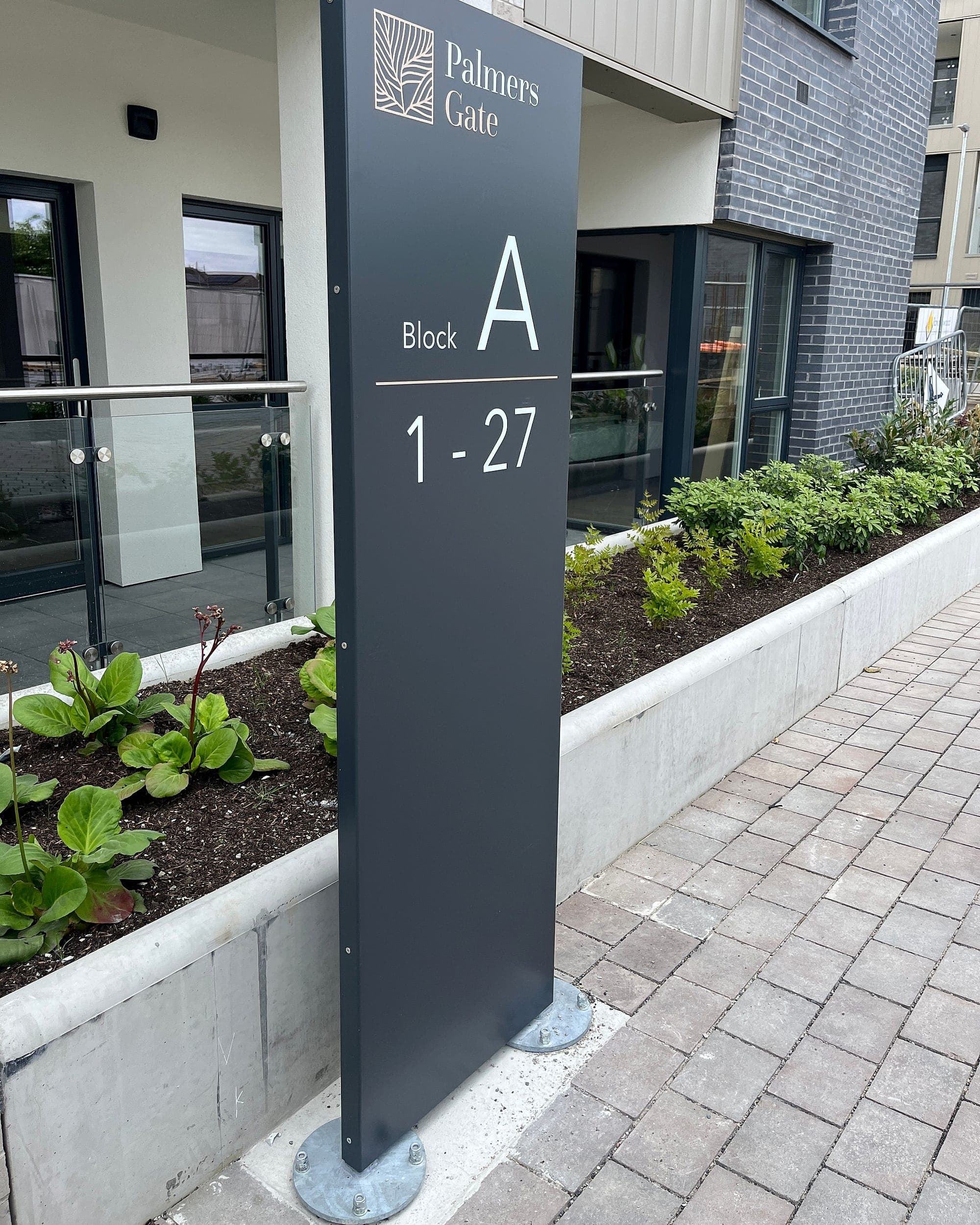
A freestanding sign is a small structure, and it fails the way small structures fail: at the connection. There are two honest routes into the ground. A root-fixed post sits directly in a concrete pad, which is cheap, very strong and permanent. A baseplated post bolts onto a pad cast below the finished surface, which costs more, survives a lift-and-relocate, and lets you replace a damaged post without breaking up the paving. The choice is a maintenance decision disguised as an installation detail, and it has to be made early, because the pad belongs to somebody else's programme. Once the groundworks crew has moved off site, a baseplate becomes a much harder conversation.
Either way, the ground has to be known before the sign is drawn. Services, drainage runs, tree root protection zones and made ground all move sign positions, and finding them on the day of installation is the most expensive way to find them. That is why the site survey does more for durability than any specification clause. Then the detailing: stainless fasteners into aluminium with isolating washers, because a mild-steel bolt in an aluminium post is a battery waiting for rain; drainage holes at the bottom of hollow sections; cappings that shed water off the top; and no single fixing left to resist the wind on its own. Installation is where a durable design either happens or doesn't.
Designing out the vandal
Vandalism is opportunistic, and opportunity is a design output. A proud edge invites a lever; a flush panel doesn't. A face that lifts with a coin invites a coin, whereas security fixings (pin-hex, clutch-head, concealed clamping) mean the tool has to be brought deliberately. Most of the external damage we get called back to is boredom, and boredom gives up when the first attempt fails.
- Anti-graffiti laminate or a sacrificial coating on any panel below about two metres. Graffiti removed within days rarely returns; graffiti left for a month attracts more.
- Replaceable faces. If the panel comes out independently of the frame and the foundation, the worst thing that can happen to you is a new panel.
- No leverage. Flush edges, no unsupported overhangs, no gap wide enough for a screwdriver.
- Impact glazing where it's needed. Polycarbonate over notice cases and lit faces in exposed public locations; glass only where it will be supervised.
- Keep spares from the original batch. Powder-coat and print colour drift slightly between runs, and a mismatched replacement panel is its own kind of damage.
The public realm is the hardest test
Signage on a private campus has a caretaker. Signage in a park, on a greenway or at a civic building has weather, footfall and nobody in particular. So local authority work is the sternest test of an external signage specification. On rollouts like Donegal County Council, the detail that matters most is the one that lets a crew make a fifteen-minute repair five years later instead of ordering a new sign.
Compliance doesn't stop at the front door
External signage carries the same statutory weight as anything inside. Part M begins at the site boundary. The approach route, the setting-down point and the accessible parking bays all sit inside it, and BS 8300-1 deals specifically with the external environment. Contrast, letter height and mounting position matter more outdoors, not less, because the viewing distances are longer and the light is worse. The Part M principles apply the moment someone gets out of a car.
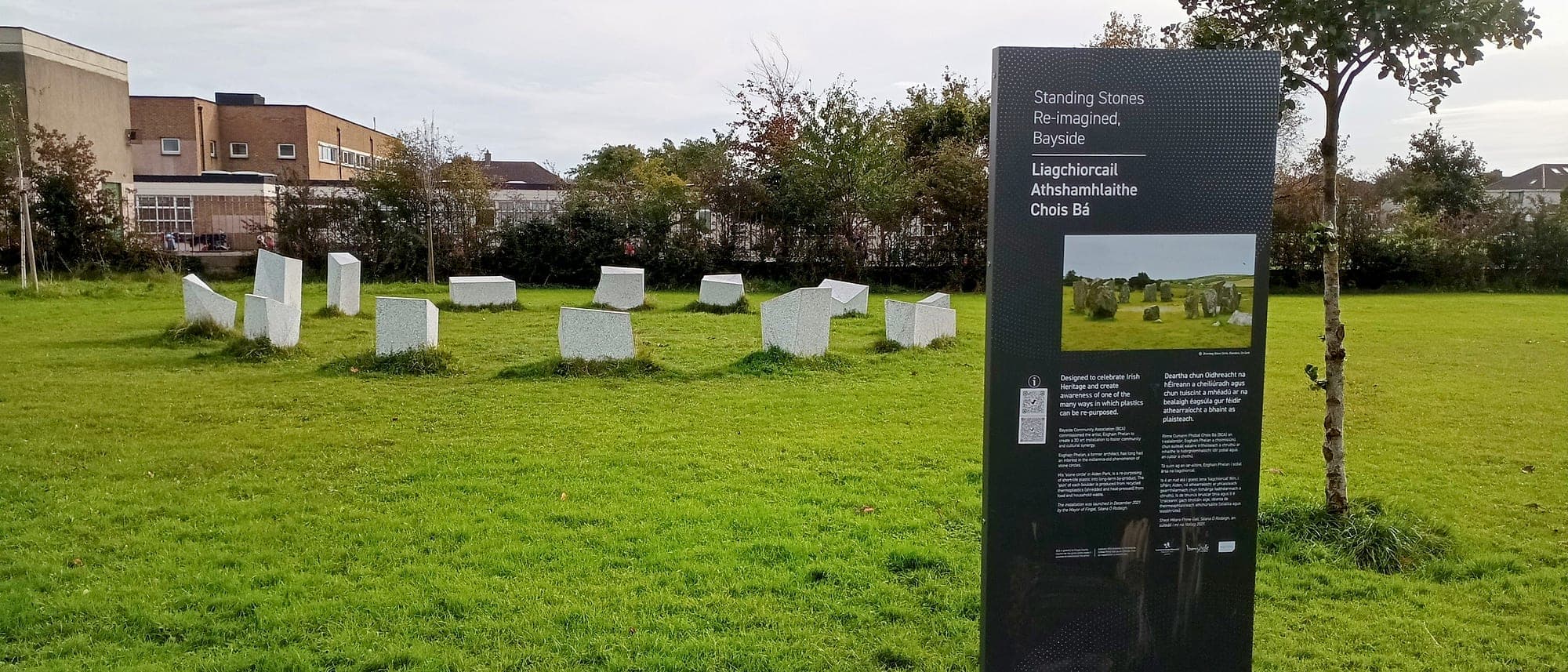
For any public body the Official Languages Act reaches outdoors too. The 2008 regulations made under the Act set out that Irish text appears first, above or to the left of the English, in lettering no smaller and no less prominent. In planning terms, most freestanding signage is an advertisement structure: certain classes are exempted development, anything beyond them needs permission, and on a protected structure or within an architectural conservation area the exemptions narrow sharply. All of it is cheaper to resolve at design stage than at handover.
- 10 yr
- warranty on signage we design, supply and install
- ~20%
- less than fragmented procurement, with one supplier from design to installation
- ×2
- languages at equal prominence, required on a public body's outdoor signage as well as its indoor
Maintenance is a design decision, not an afterthought
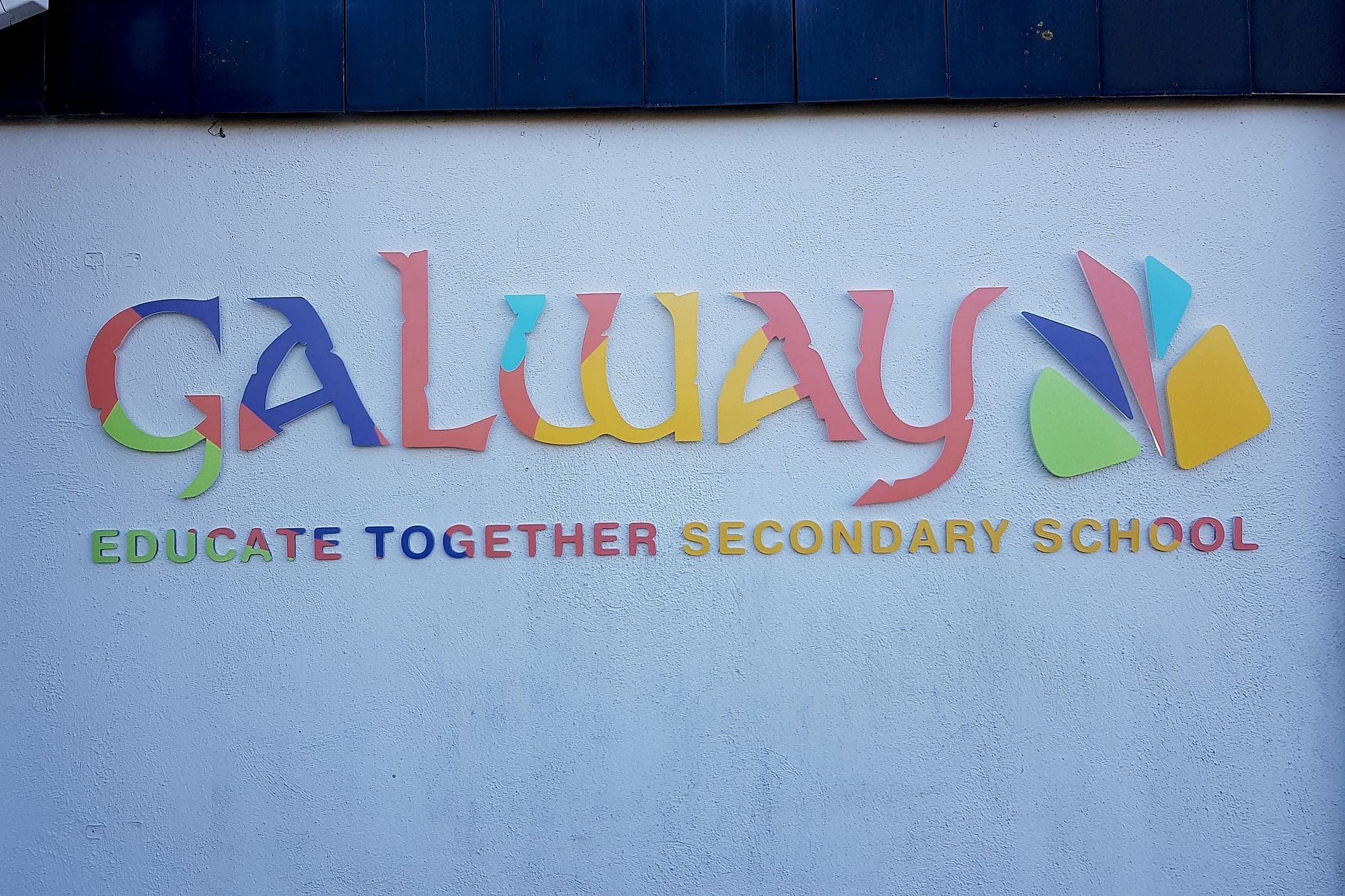
The best predictor of how an external sign looks in year eight is whether anyone thought about year eight. Can a van reach it? Does it need a platform, and is there hardstanding to put one on? Do the fixings undo, or were they riveted shut? Is the exact coating reference, print profile and panel size written down, so a replacement matches? A sign schedule that carries materials and finishes as well as text is worth more, a decade on, than the sign it describes. That is the argument we make at length in thinking in decades, not defects.
None of it is exotic. It's the ordinary discipline of building a small outdoor structure properly: know the ground, size for the wind, isolate the metals, shed the water, make the face replaceable, and write down what you used. Do that and the signage drops off the maintenance budget for a decade.
Design for year eight, or someone else will pay for it.
Specifying signage for an exposed site, a civic project or a campus that has to look the same in ten years? See our public-sector work, or talk to us while the foundations are still on paper.
Planning a wayfinding project? Talk early, while the big decisions are still cheap.