
Smart building signage: when the building talks back
Room panels, queue calls, occupancy counts: signage written by a live feed. What it genuinely fixes, and what it should never be asked to carry.
Smart building signage is signage whose content gets written in real time by another system: a room-booking calendar, a patient administration system, a queue manager, a car park counter. A designer drew the panel once. Everything on its face now arrives from somewhere else, which changes who is answerable when the words are wrong. Used narrowly, a live feed carries information static signage was never good at holding. Used widely, it publishes a building's internal inconsistencies on the wall, in public, at the speed of the feed.
We draw and supply the permanent layer, and we sit in the meetings where the live layer gets specified, which is usually after the displays have been bought. The questions that decide whether any of it works are almost never about the hardware.
What actually counts as smart building signage
Four feeds account for nearly everything on the market. Room booking and calendar data at the door of a meeting or consulting room. Appointment and queue data, where a patient administration or ticketing system calls the next number and names the room. Occupancy and access data: counts of people, desks or parking spaces. And exception data, meaning the lift that's out and the entrance that moved this morning. Everything else a display shows, from the brand film to the weather, isn't wayfinding and shouldn't come out of the signage budget.
All four answer a question a permanent sign can't answer honestly. A panel tells you where a place is. A feed can tell you whether you should be standing at it right now, which is the line separating digital wayfinding from static.
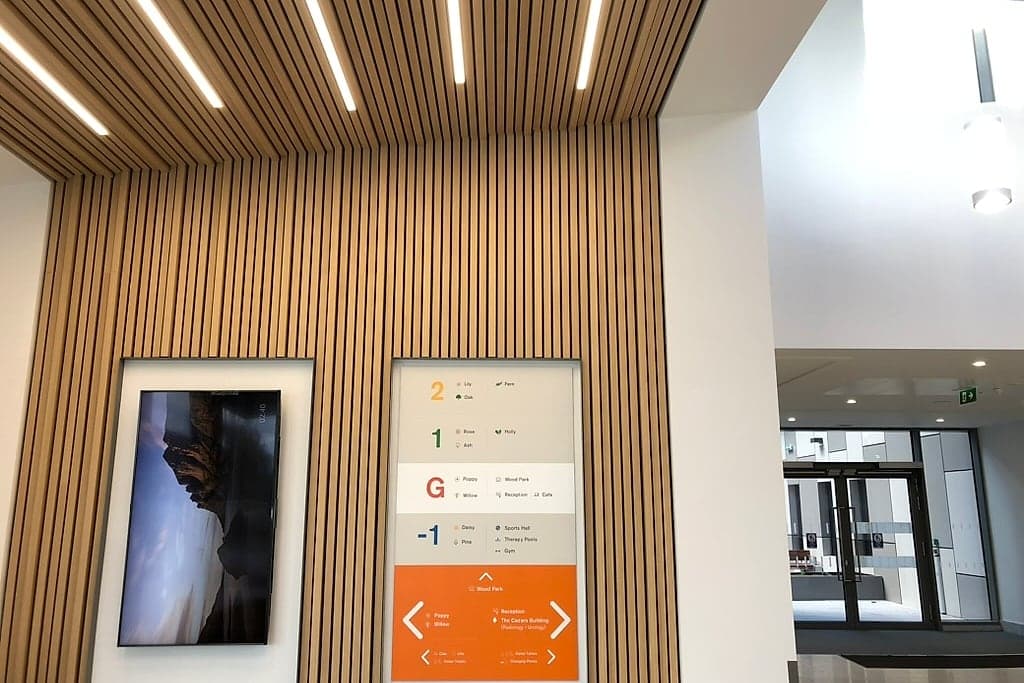
The feed is the product; the screen is the packaging
A room-booking panel is a piece of integration work with a bezel around it. Four questions settle the specification and none of them concern the display. Which system is authoritative. What identifier joins it to this physical room. How quickly a change has to appear. And who, by name, in the building, is accountable at eight in the morning when the panel is wrong.
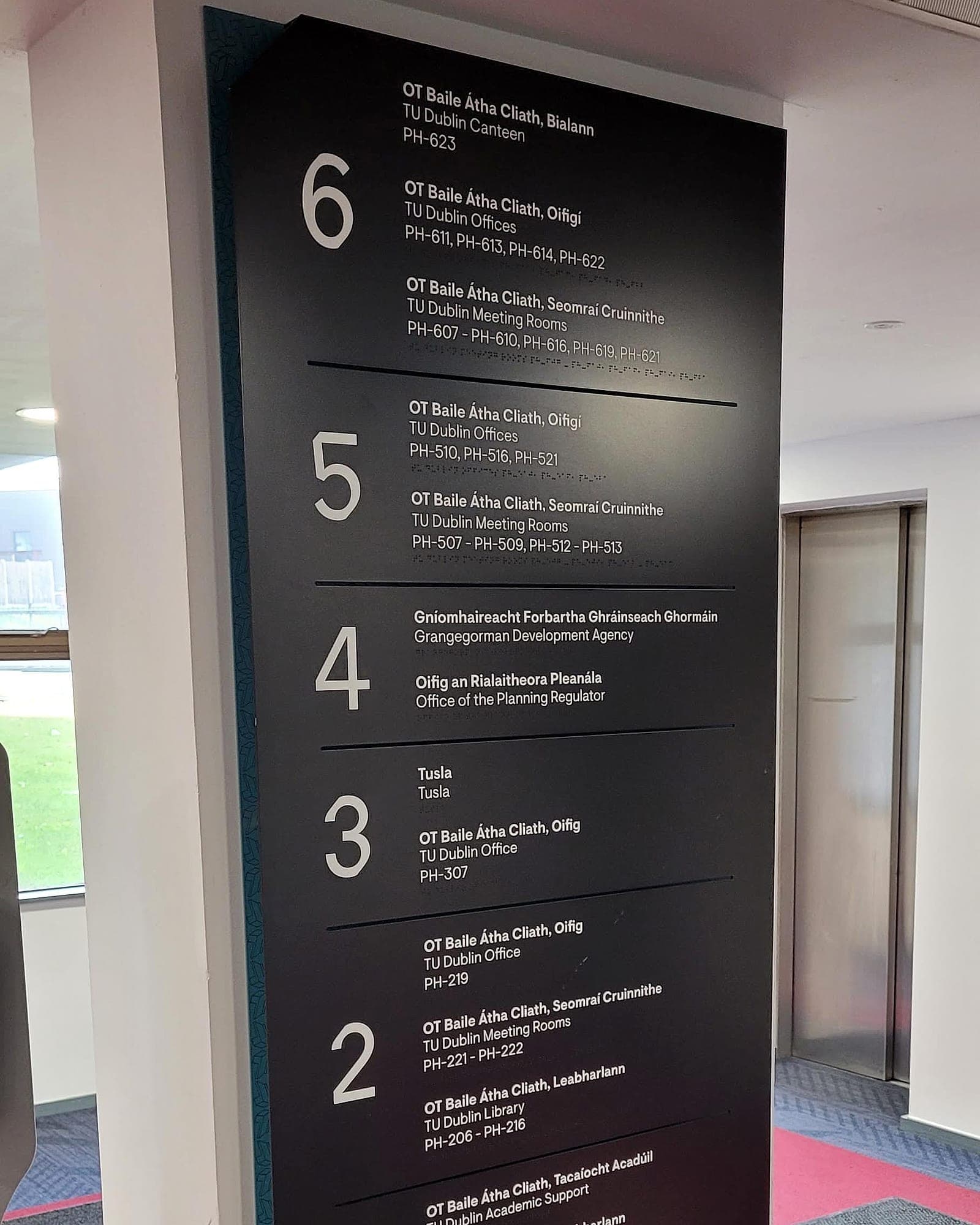
The second question is the one that fails without anybody noticing. A display is joined to a room by a key: a room code, a resource mailbox, an asset ID. If the calendar knows the room as "Boardroom", the estates system knows it as PH-607 and the door says "Seomra Cruinnithe / Meeting Room", then the integration is really a mapping table somebody maintains by hand, and mapping tables rot. That makes room naming a prerequisite for live data: one name and one code per place, carried identically by the booking system, the destination schedule, the screen and the door.
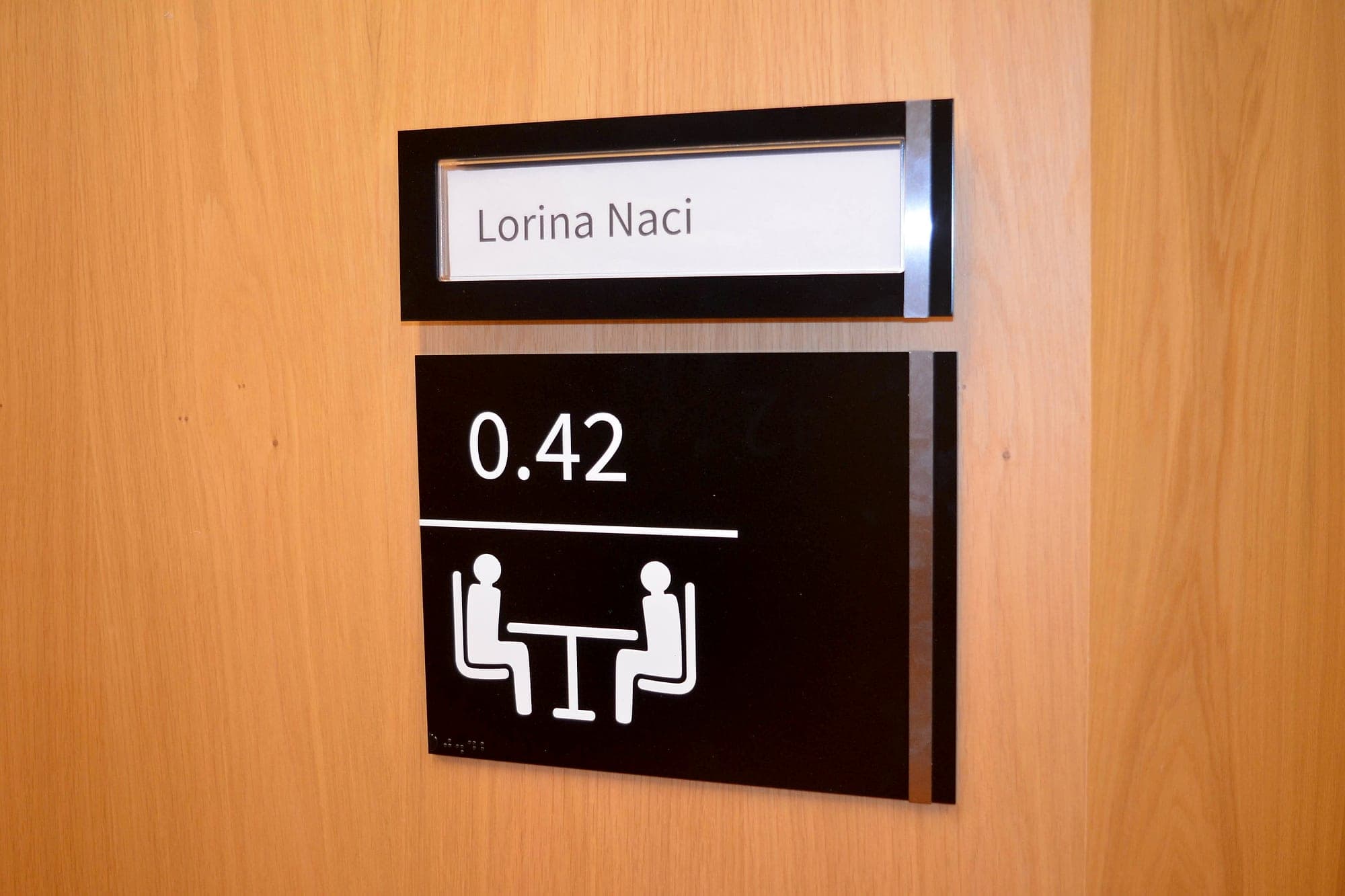
Design the failure state before the feature
Every live sign has three states, and most specifications describe one. The feed is current. The feed has stopped and the panel still shows Tuesday's value. The feed has stopped and the panel says so. Only the third is safe.
Hence the rule we hold to: fail to identity, never to stale. A booking panel that loses its feed should fall back to what is permanently true, which is that this is room 0.42 and it seats eight, and say nothing at all about availability. A blank field reads as "no information" and people cope with that. They knock. A confident "Free until 11:00" frozen since Tuesday reads as fact, and it walks somebody into an occupied consulting room. The same holds for a digital directory: a lit screen carries far more authority than its contents deserve.
Fail to identity, never to stale. Old data still reads as fact.
- Appointment and queue calling. Healthcare is the clearest case there is: which clinic is in which suite today, which number is being seen now, and where. No fabricated panel follows a list rewritten each morning.
- Room booking at the door, where rooms are genuinely shared: bookable clinical rooms, hot-desked floors, teaching spaces on a timetable. Where a room has one occupant, a panel is an expensive nameplate.
- Exception messages. Lift out of service, entrance moved for a fortnight, ward closed. One display at arrival is the right home for these, which keeps them off the permanent signage.
- The arrival end. Spaces free in the car park, shuttle times, which entrance is open at this hour. All of it generated elsewhere and merely displayed here.
One test unites them: the information did not exist yesterday and will not matter tomorrow. If a fact about your building will still be true in five years, it belongs on a panel. We are sceptical of screens as a category and we say so in meetings, so it's worth admitting that outpatients queue calling changes our mind every time.
Where a live feed is not allowed on the sign face
Identity and direction aren't live data. A department name, a floor number, the arrow at a junction: these get read at a glance by somebody who wasn't looking for them, and they're needed when nothing in the building is powered. Beyond that preference sits a compliance floor no display can reach.
TGD M sets the access requirements for buildings in Ireland, and the practice behind it expects key location information in tactile form as well as visual: raised characters and braille, where a hand can find them. Glass offers neither. Escape-route signage has to stay legible when the mains are gone, which is why TGD B provision is permanent, and photoluminescent or emergency-lit. In a power cut a screen is the darkest object on the wall. In England, regulation 8 of the Fire Safety (England) Regulations 2022 requires floor and flat identification in high-rise residential stairways to be readable in low light or by torch, a duty no display discharges. And in a public body, Irish and English appear together with equal prominence under the Official Languages Act. That obligation attaches to the information, not to the material it sits on, so a screen's templates carry it too, fallback included.
The honest version of a smart building
The buildings where this works aren't the ones with the most screens. They're the ones where somebody named a source of truth for each feed, joined it to the room list the signage was drawn from, wrote down what the panel says when that feed dies, and sited a display only where the answer changes faster than a person can walk. Usually that means one or two positions in a building, not forty.
Smart building signage works best as a thin layer over a complete permanent system: tactile, bilingual where the law requires it, certified on completion, and still correct in a power cut. Nobody is compromising between old and new by doing it that way. Each technology just does what it happens to be good at.
If you're specifying a digital wayfinding layer over a signage package, or you've inherited one that stopped telling the truth some time ago, talk to us while the room list is still a decision somebody can make.
Planning a wayfinding project? Talk early, while the big decisions are still cheap.