
Value-engineering signage without destroying it
The VE email always arrives. Here's what can safely come out of a signage package, and the four cuts that break the whole system.
Value engineering signage means buying the same wayfinding performance for less money. It does not mean the same drawings with cheaper things in them. Done well, it takes cost out of substrates, sign counts and installation sequence while the system still reads exactly as designed. Done badly, it removes the parts people navigate by, and the building pays for that over a decade in printed A4 taped to doors.
The email always arrives at the same moment. The package is priced, the number is over, and somebody has been asked to find a percentage. Signage sits near the end of the programme and reads like a shopping list, so it's an easy place to look. We've priced a lot of these exercises, with design, supply and installation in one contract, and the pattern holds. The savings that survive come out of how a package is made and sequenced. The ones that hurt come off the face of the sign.
Why signage is an easy target, and a bad one
A signage package is usually a fraction of one per cent of a construction budget. It's also the only trade every visitor uses on their first day in the building, and the only one whose compromises are legible from two metres away. Cut the mechanical spec and nobody sees it. Cut the contrast on a door sign and a partially sighted patient meets that decision every week for ten years.
Signage is the last trade priced and the first thing everybody reads.
Good value engineering: where the money actually is
These moves take real cost out of a package without changing what a person sees on the wall.
- Change the substrate, not the design. Locations drawn as folded aluminium trays often perform identically in a flat composite panel: same artwork, same contrast, same expected life. The saving comes out of fabrication hours. Nothing on the face changes. Start from what each material is actually for.
- Rationalise the sign count from the schedule, not the drawing. Much of most packages is repetition: two directionals inside one sightline, a directory on a wall nobody stops at. Work from the destination schedule and delete duplication, never information.
- Standardise into families. Three panel sizes made in a run of four hundred cost less each than eleven sizes made in runs of thirty. Size rationalisation is invisible to the user and dramatic on the quotation.
- Buy the system, not the pieces. Splitting design, fabrication and fitting across three companies buys three margins, three sets of site visits and a fourth conversation about who owns the mistake. Kept end to end, the same specification lands up to 20% cheaper.
- Sequence the installation with the programme. One mobilisation after decoration and before handover costs a fraction of six return visits chasing snags, late room names and doors that were never hung.
- Design for change instead of paying for it twice. Slatted totems and carrier systems with replaceable inserts mean the next department move costs a printed panel, not a new sign.
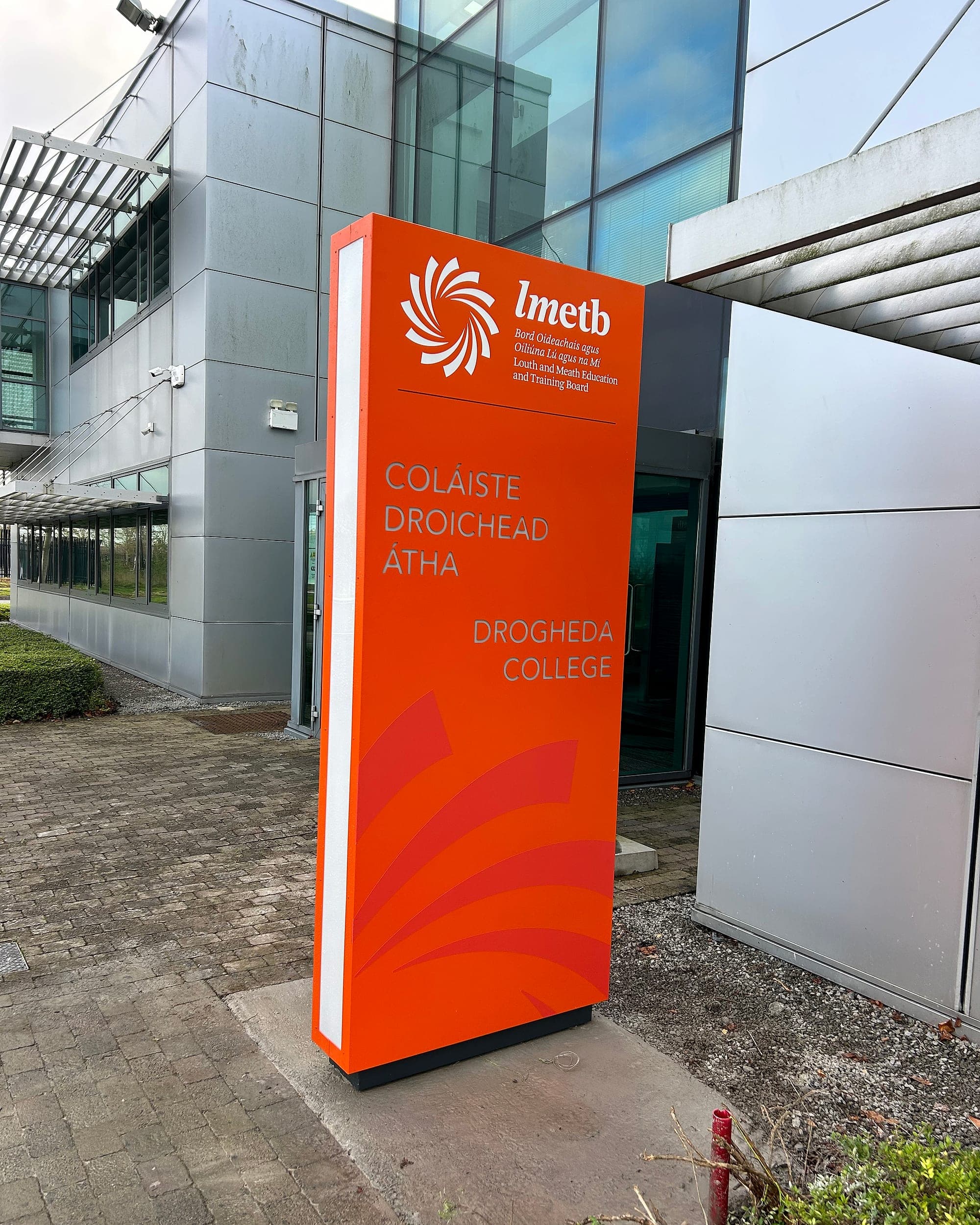
- Question illumination honestly. An internally illuminated totem is often the largest line in an external package; where the approach is already lit, a plain high-contrast panel can do the same work. A judgement per location, not a blanket cut.
Bad value engineering: the four cuts that break the system
Each of these reads like a line item on a spreadsheet. Each of them is load-bearing.
- Cutting contrast. A softer house colour is the cheapest change anyone can make to a signage package, and the one most likely to drop it below the accessibility baseline. Part M sets the duty and BS 8300 supplies the detail Irish specifications adopt: around 30 points of light reflectance value between text and background, and again between sign and wall. Contrast is a measured quantity, not a matter of taste.
- Deleting tactile and braille from the "non-essential" rooms. Raised characters and braille are how a blind or severely sight-impaired person reads a door; keep them on the toilets, strip them everywhere else, and the building is navigable only if you can see it. Tactile provision is also what a certifier looks for on completion.
- Deleting a whole sign type. Projecting and suspended signs go first: more cost per unit, and a fixing survey with them. They are also the only signs readable along a corridor rather than across it. Swap them for flat wall panels and the replacement stays invisible until you're past the turn.
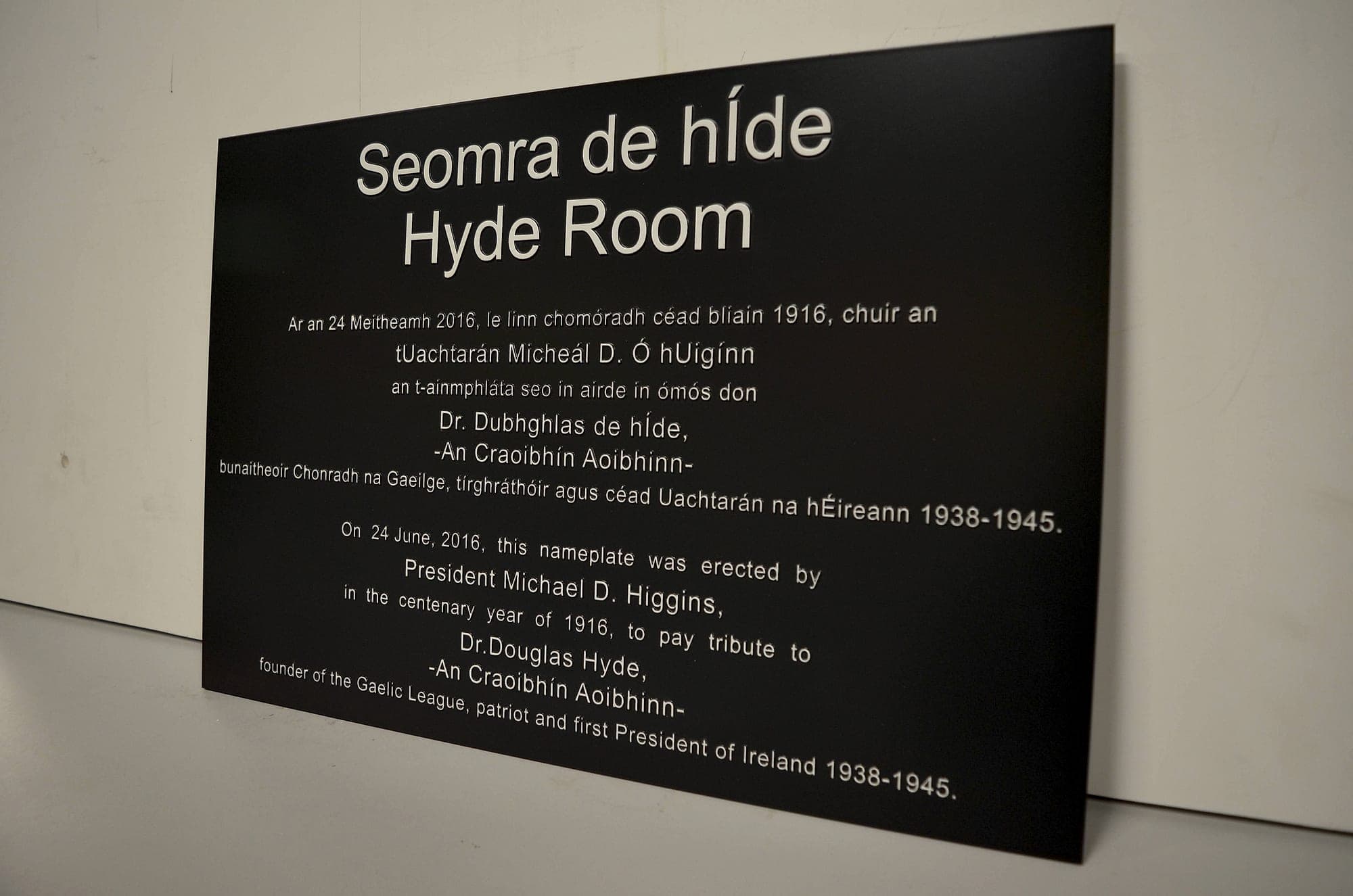
- Cutting statutory signage. Escape route signage under TGD B and the ISO 7010 graphics, floor identification in tall residential buildings, bilingual provision for public bodies under the Official Languages Act: none of these are design decisions. In England, wayfinding signage giving floor and flat numbers, visible in low light, is required in the stairwells of buildings with a storey above 11 metres. That is a duty on the responsible person. A saving there is a liability moved sideways.
One variant deserves its own warning: restyling standardised safety symbols to match a brand. ISO 7010 pictograms are specified graphics, not artwork. A redrawn running man is a non-compliant running man, however elegant.
Three questions before you accept a saving
- Does it change what the user sees, or only what it is made of? Method, substrate, fixing and finish are fair game. Message, contrast, character height and position are not.
- Does it change the compliance position? If the alternate touches contrast, tactile provision, statutory signage or bilingual text, it goes back to the design team priced and flagged. What it must never do is disappear into a revised schedule where nobody sees it.
- What does it cost in year seven? An internal-grade panel moved onto a south-facing wall is a saving that expires with the third Irish winter. Whole-life cost is the only number worth comparing.
- ~20%
- saved end to end against fragmented procurement, with one supplier from design to installation
- 30
- points of light reflectance value, the contrast baseline a colour saving must never cross
- 10 yr
- warranty we carry on what we supply and install, the honest test of any material swap
How we price a value engineering signage round
Send us the schedule, not the drawings, and we return three columns: the saving, the consequence, and a compliance flag. Anything touching Part M, TGD B or the Official Languages Act comes back marked, with the cost of putting it right later set beside the cost of doing it properly now. Most packages carry genuine slack in sizes, substrates and sequence, and we'd far rather find it than watch a good scheme get thinned. Some of that slack is ours to begin with. A drawing full of folded trays because they photograph well is our mistake before it's anybody's saving.
Past a certain point you stop saving money and start buying a worse building.
The best value engineering signage rounds we've run ended with a smaller, better package: fewer signs, fewer sizes, the same contrast, the same tactile provision, a certificate at the end. The Irish guidance is published as Technical Guidance Document M; the UK residential duties sit in the Fire Safety (England) Regulations 2022. If you're holding a package that has to come down in price, talk to us before the alternates are agreed. It costs far less than putting a system back together afterwards.
Planning a wayfinding project? Talk early, while the big decisions are still cheap.