
Signage package cost: what actually drives the price
Six things move the number: sign count, materials, illumination, access, compliance and programme. Here's how each behaves, and how to brief for a real price.
A signage package cost is driven by six things: how many signs there are, what each is made of and how it is built, whether it is illuminated, how difficult it is to reach, how much compliance content it carries, and how the programme lets you work. Everything else on a quotation follows from those six, and changing any one of them moves the number more than people expect.
Pricing feels opaque because clients ask for a rate per sign, and there's no such thing: a door sign and a five-metre illuminated totem are both "a sign". The useful question is which of the six drivers your building loads up. You can answer that from a drawing set, before anybody quotes.
What a signage package cost is actually made of
Before the drivers, the anatomy. A properly built price shows the same components whoever issues it.
- Design and the destination schedule, largely fixed and independent of quantity.
- Materials and fabrication, which scale with quantity but not linearly.
- Compliance content: tactile, braille and bilingual setting, priced per item and per language.
- Illumination, meaning the light engine, the power supply, containment and certification.
- Installation, access and preliminaries: labour, plant, fixings, and how many visits at what hours.
- Handover, covering the as-built schedule, warranties and the compliance record the building keeps.
Driver one: sign count is the cost model, not sign area
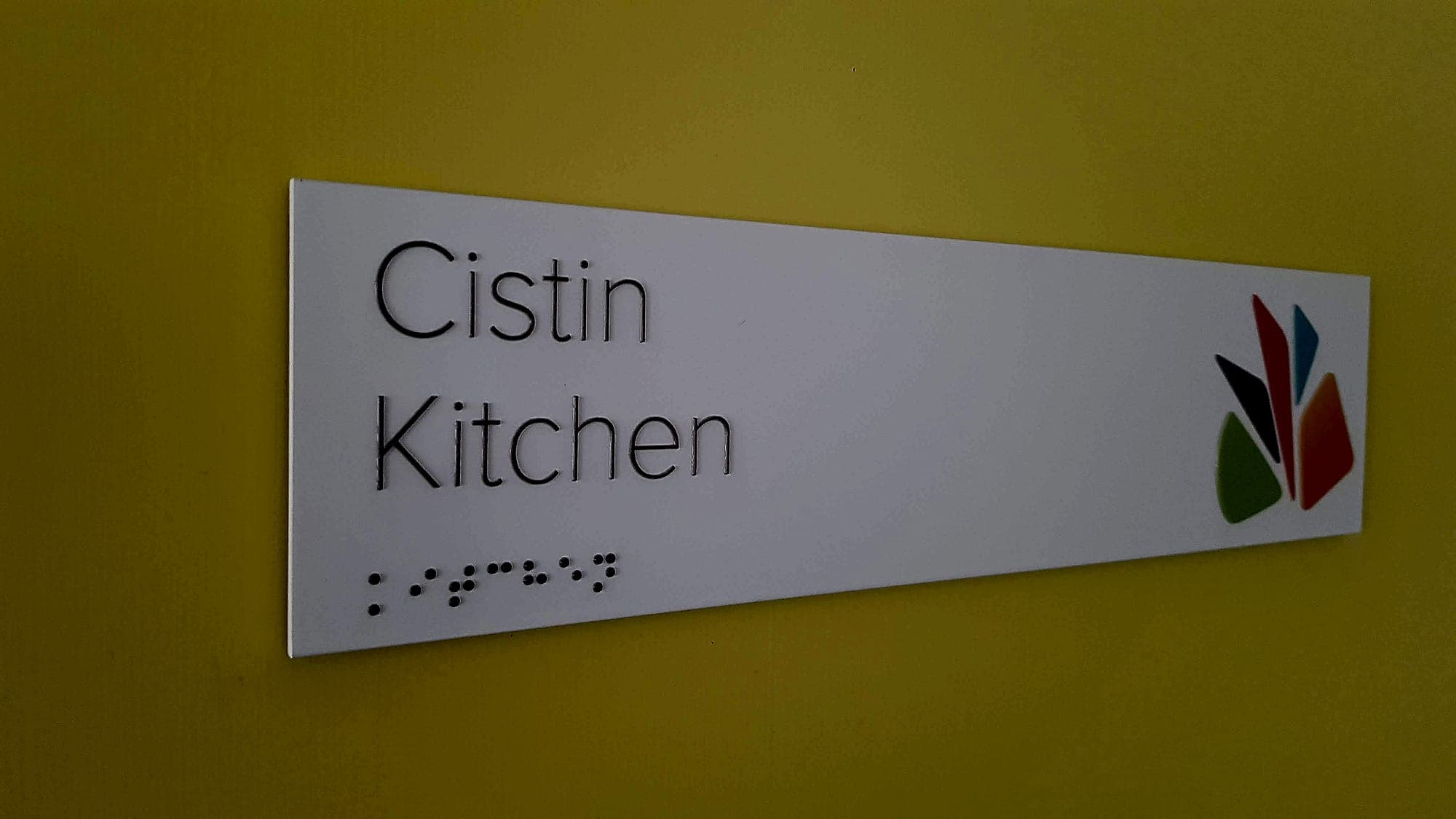
Quantity surveyors instinctively price signage by area. Sign makers price it by item, because almost all the cost of a small sign is setup. The substrate is pennies. A 200 × 150 mm panel and a 400 × 300 mm panel take the same machine time, the same handling, and the same trip down the corridor with a drill.
So the first number to establish is how many discrete items the building needs, and only the schedule answers that. How many doors need naming? How many decision points need a directional, and does every apartment get a numeral? Fix the count and you've fixed most of the signage package cost.
Driver two: materials and how the sign is built
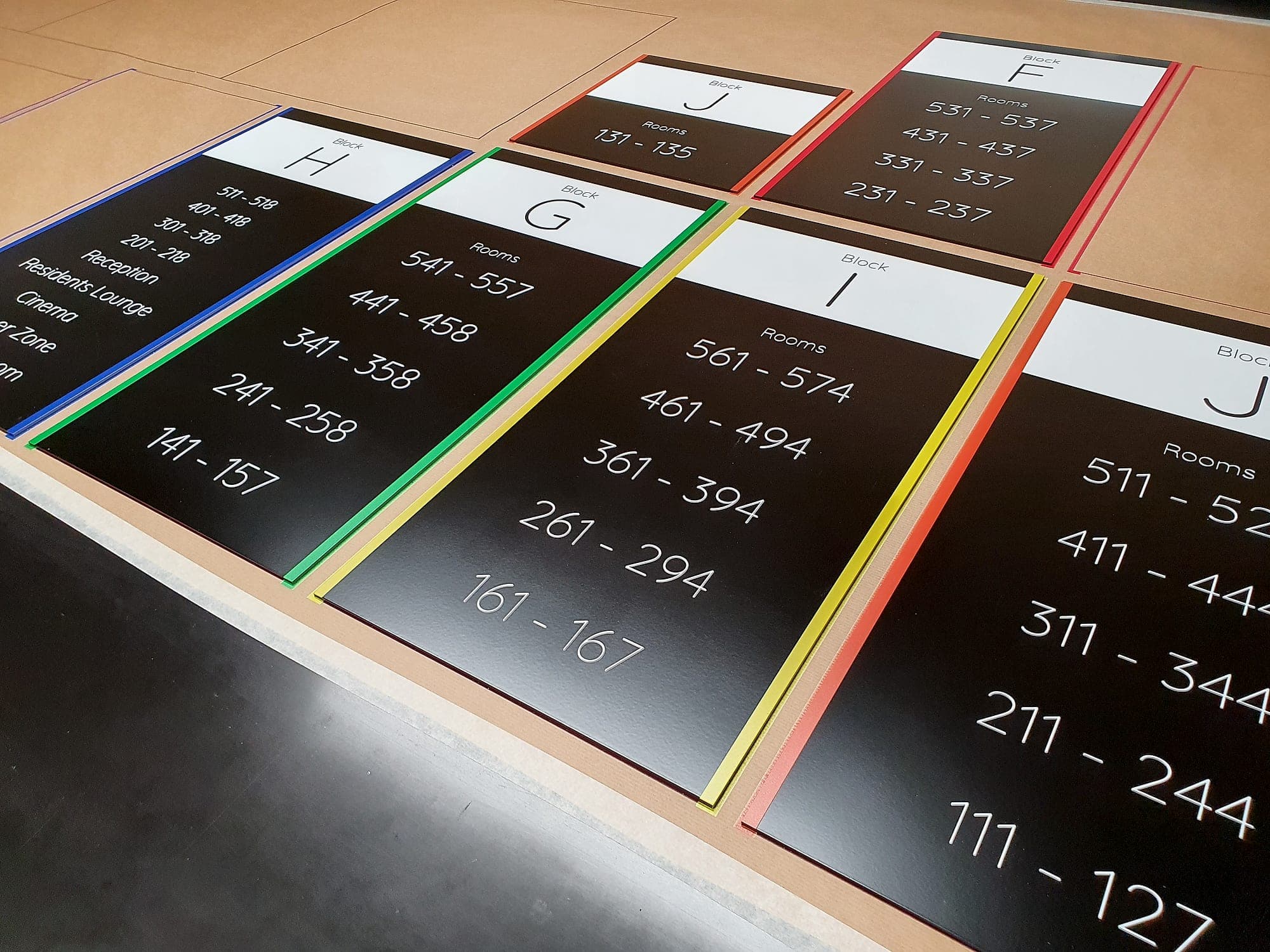
Substrate matters less than construction. A flat 3 mm aluminium composite panel with a printed face is the economical baseline. Fold that same aluminium into a tray with returned edges and you've added press time, welding, filling and paint, often doubling the item before a letter goes on it. Move to stainless or bronze and the material costs more, though the finishing labour costs more still.
Built-up letters price per character, per depth and per fixing method: face-fixed with adhesive is one price, stud-fixed and packed off a wall another, pin-and-locate on stone another again. Our materials guide covers what each buys you in durability. The money goes into how the sign is built.
Driver three: illumination
Illumination is a step change. Light an item and you're buying a small electrical installation: an LED engine and driver, a diffuser that spreads evenly at the depth available, an IP-rated enclosure outdoors, containment and cabling back to a supply, an electrician, a test certificate, and a maintenance liability for the next decade.
It's worth that on the two or three items that identify the building after dark, and rarely anywhere else. A useful discipline is to illuminate whatever a driver has to read at 40 km/h in November and let daylight handle the rest.
Driver four: access, height and programme
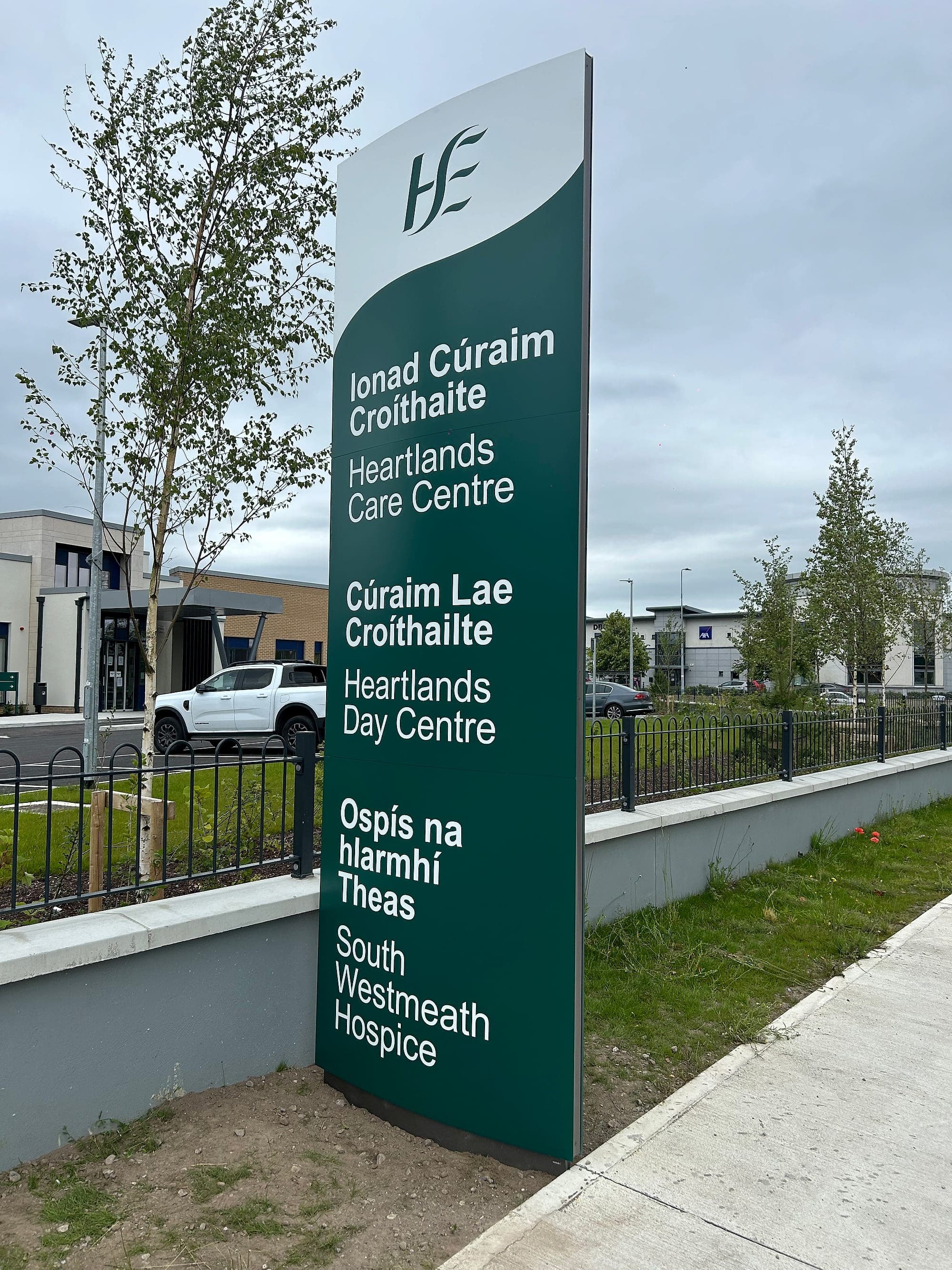
Installation is priced from the ground up, literally. A sign at 1,500 mm on plasterboard is one person with a laser level; the same sign at nine metres on a rendered facade is a mobile elevating work platform, a permit, hard standing to put it on, and two people. Anything over a footpath adds pedestrian management; anything over a road adds a traffic plan and often a night shift.
Programme does the same thing less visibly. A package installed in one continuous visit is the cheapest version of itself. Split it across four phases, at the main contractor's convenience, and it costs four mobilisations and four sets of setting-out, with an out-of-hours premium on every item in a live building. All of that is foreseeable: see installation done right.
Driver five: compliance scope is a cost, not an add-on
Compliance content is priced per item and per language, so it multiplies against the sign count. In Ireland, Part M of the Building Regulations is the accessibility requirement, with Technical Guidance Document M giving the guidance most specifications follow and BS 8300-2 carrying much of the detail design teams lean on: visual contrast, mixed-case lettering, mounting heights that work seated and standing, tactile and braille at key locations. Safety and escape signage is a separate scope, generally specified to ISO 7010 symbols and coordinated with the fire strategy under TGD B.
A compliant sign made once is cheaper than a non-compliant sign made twice.
For public bodies, regulations made under the Official Languages Act govern how Irish and English appear together, with Irish first and no less prominent, and that affects panel size as well as artwork. In England, the Fire Safety (England) Regulations 2022 require responsible persons for high-rise residential buildings to provide wayfinding signage visible in low light identifying floor and flat numbers. Scope all of it at brief stage. Retrofitting tactile characters or a second language onto approved artwork means remaking the panel.
Ballpark: how the items actually rank
A rate without a specification is a trap for both sides, so we publish relative bands instead. They hold across almost every package we price.
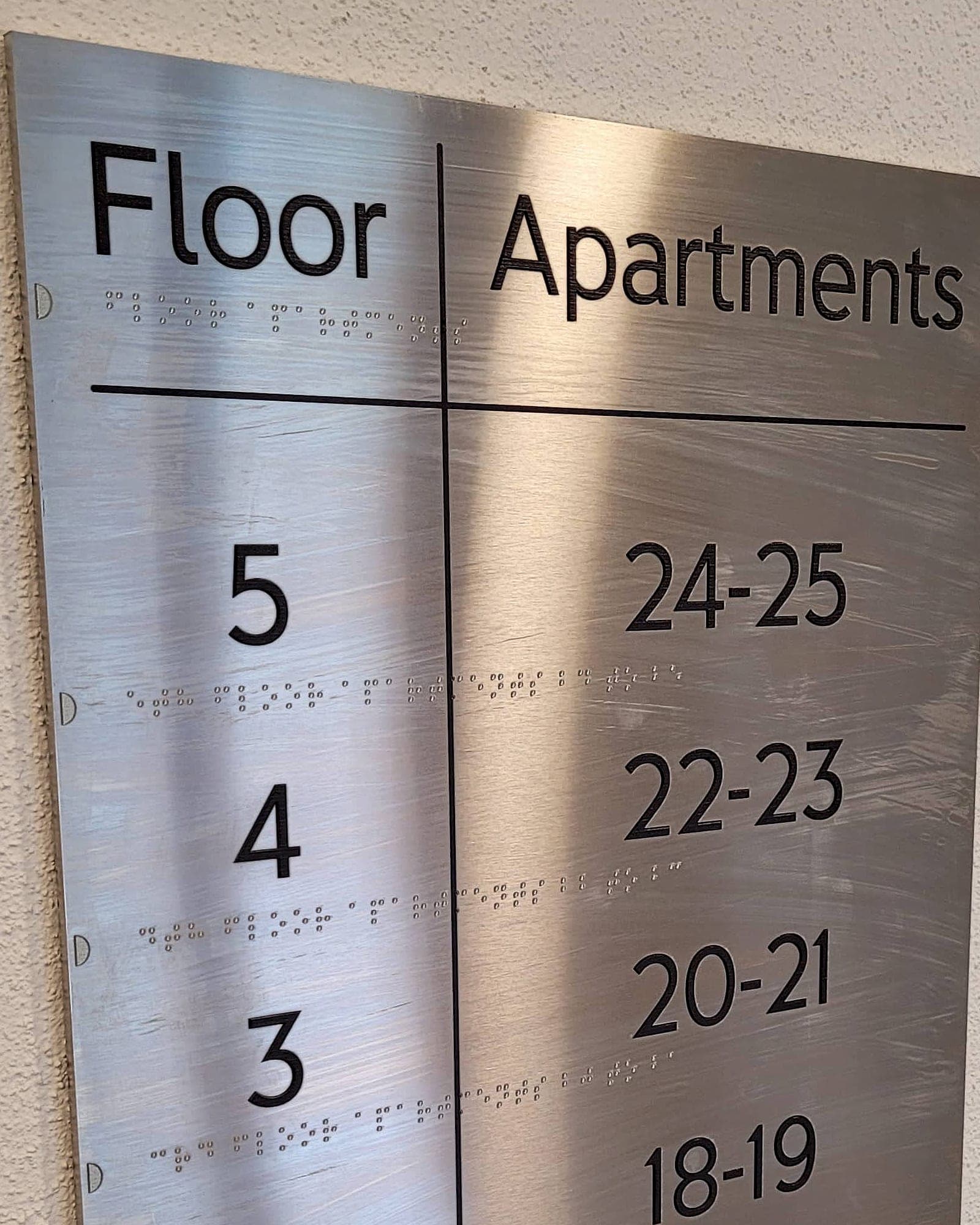
- A flat internal wall or door panel is the baseline: the cheapest item, and the one you have most of.
- A tactile and braille door sign is a multiple of that baseline: raised characters are machining and hand labour, not material.
- A slatted or changeable directory is dearer again, being a mechanism as well as a panel, and priced per line of content.
- Built-up external lettering prices per character and per fixing. A long building name is a long invoice.
- A non-illuminated external totem with a foundation is typically the largest single item on a mid-sized package.
- Illuminate that totem and it moves into a band of its own.
The shape is consistent: many low-value internal items, a handful of high-value external ones, and a total far more sensitive to the handful than the count suggests. Which is why crude value engineering, the kind that shaves the door signs, saves almost nothing.
- ~20%
- lower delivered cost when one supplier carries the scheme from design to installation
- Days
- not months, for approvals when sign-off runs through one shared record rather than emailed PDF revisions
- 10 yr
- warranty we can offer because we own the specification, the supply and the installation
How to brief for a signage package cost you can rely on
When quotations come back wildly apart, it's nearly always the assumptions that differ. Seven lines in a brief will close most of the gap, whichever procurement route you take. Ask for:
- A schedule, or a floor plan with sign positions marked. Not "signage as required".
- Which items are illuminated, and who brings power to within a metre of them.
- Wall build-ups at each fixing position: plasterboard, blockwork, curtain wall, stone.
- Mounting heights above three metres, and what plant can physically stand where.
- Compliance scope in writing (tactile, braille, bilingual, safety signage), and who certifies it.
- The programme, including phasing and any out-of-hours restriction.
- Who owns the survey, and whose dimensions the warranty is written against.
Ask three suppliers the same vague question and you'll get three different scopes back, priced.
Common questions
Appendix- Q.How much does a signage package cost for a typical building?
- There's no meaningful per-square-metre or per-sign rate, because the six drivers vary so widely. The shape is reliable, though: internal items are numerous and cheap, external items few and expensive, and illumination and access are what usually surprise a budget. A marked-up floor plan will get you a real number faster than any benchmark.
- Q.What is usually the most expensive item in a signage package?
- A large external totem, or a building identification letter set, particularly if it's illuminated, needs a foundation or sits above three metres. Those few items regularly outweigh hundreds of internal signs, which is where the cost conversation should start.
- Q.Does accessible signage cost more?
- Tactile characters, braille and bilingual setting carry a real per-item cost, and because they apply across the door signage they multiply. Adding them later costs far more, because the panel has to be remade. Everything we supply is made to Part M and BS 8300 by default, and we certify on completion for that reason.
- Q.Why do signage quotations vary so much between suppliers?
- Usually because they are pricing different scopes: one has assumed flat panels, another folded trays; one priced installation from a ladder, another from a platform; one included tactile and braille, another did not. Compare specification lines before totals.
The worst signage package cost is the one discovered late, after the artwork is approved and the crane is off site. Drawings and a rough room list are enough for us to price it properly. A vague brief only ever gets a defensive number back. See how we handle manufacture, or talk to us while the drawings are still cheap to change.
Planning a wayfinding project? Talk early, while the big decisions are still cheap.