
NHS hospital wayfinding signage: strategy first, identity second, access throughout
NHS hospital wayfinding signage answers to the NHS Estates wayfinding method, the NHS identity and access law. How the three fit on one sign family.
NHS hospital wayfinding signage answers to three sets of rules at once. The method comes from the NHS Estates guidance Wayfinding, which says to plan the whole journey before specifying a single sign. The look comes from the NHS Identity Guidelines: NHS Blue and white, Frutiger or Arial, and the organisational logo in its fixed place. And the dimensions, contrast and tactile detail come from Approved Document M, BS 8300-2:2018 and the Equality Act 2010.
Get those three in the right order and a hospital is easier to use, from the car park to the clinic door. Get them in the wrong order, usually identity first, and you end up with a beautifully branded set of signs that sends people the wrong way. A porter can tell you the cost of that. So can the outpatient list.
The method: NHS Estates' Wayfinding guidance
The national guidance on wayfinding in NHS healthcare buildings was written for NHS Estates and published in a second edition in 2005. It replaced HTM 65 "Signs", and no newer national edition has been issued. Health Building Note 00-04, on circulation and communication spaces, still refers to it for signage.
Its central argument has aged well: wayfinding is not just signs. The guidance treats the journey in stages, and expects each one to be planned:
- Before the visit: appointment letters, maps and phone directions, using the same names as the signs on site.
- Arriving at the site, and finding parking or drop-off.
- Finding the right building and the right entrance.
- Following routes inside, through junctions, lifts and corridors.
- Recognising the destination when you reach it.
It also warns that replacing old signs one for one rarely fixes a wayfinding problem. We'd go further. On an existing hospital estate, the cheapest improvement is almost always naming: the department on the appointment letter should be the one on the wall, spelled the same way. Better wayfinding reduces missed and late appointments and the staff time spent redirecting people, and most of that comes from consistency before it comes from new signs.
Read the 2005 document with its age in mind. Its legal references, such as the Disability Discrimination Act 1995, are out of date, and current access guidance takes precedence on dimensions and contrast. The method is the part to use.
The look: NHS Identity Guidelines for signage
The NHS Identity Guidelines are NHS England's rules for the logo, colours, typefaces and naming, and they include worked examples for exterior and interior signage. They're a brand standard, not a wayfinding method. For signs, the essentials are:
- NHS Blue and white are the dominant colours. NHS Blue is Pantone 300.
- Frutiger is the core typeface and Arial the secondary one. No other typeface is permitted on signs, children's services included.
- Exterior signs carry the organisational logo top right. Where several NHS bodies share a building, a single NHS logo is used.
- Emergency Services Red is used for urgent and emergency care.
- Straplines and decorative graphic devices stay off signs, which should be as clear and simple as possible.
- The NHS logo is a registered trade mark. Logo artwork comes from the trust and is never redrawn.
Since December 2024, NHS England has held a national licence for the main Frutiger weights on behalf of NHS organisations in England, which they access as sub-licence holders. Ask the trust early how font files will be supplied for sign production. It's a small question that can hold up artwork for weeks if nobody owns it.
Access: Approved Document M, BS 8300 and the Equality Act
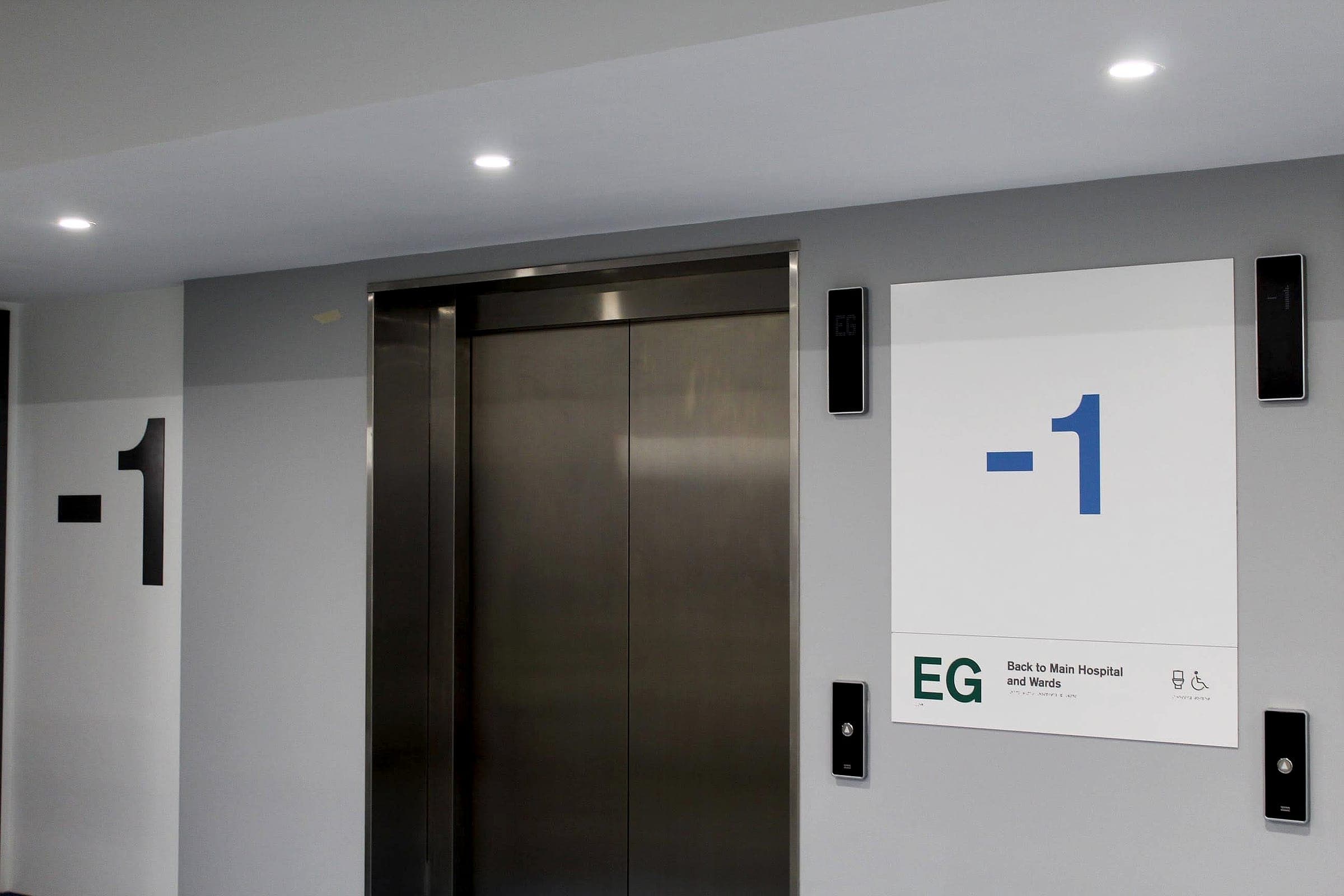
The identity tells you what an NHS sign looks like. It doesn't tell you how big the letters are, how high the sign is fixed or how much contrast it needs. Those come from access guidance, and in a hospital they matter more than almost anywhere: many visitors are older, anxious, unwell, or reading in a second language.
- Approved Document M Volume 2 sets the baseline in England: signposted accessible entrances, floor identification visible from the lift, and LRV contrast of more than 30 points between surfaces. Our guide to Approved Document M signage covers it in full.
- BS 8300-2:2018 provides the detail on letter size, positioning, tactile text and braille.
- HBN 00-04 asks for signs on or beside doors to sit between 800mm and 1500mm and to be tactile.
- The NHS identity guidelines point to the Accessible Information Standard and ask designers to consider text size, contrast, braille, symbols and pictures.
- The Equality Act 2010 makes reasonable adjustments an anticipatory duty for service providers, and signs count as physical features. It applies across Great Britain, while Northern Ireland still relies on the Disability Discrimination Act 1995.
Dementia and low vision deserve their own attention on wards and in outpatient areas. Strong contrast, clear pictograms, landmarks and consistent placement help everyone, and our notes on dementia-friendly signage go through what changes on a care of older people ward.
Wales, Scotland and Northern Ireland
NHS hospital wayfinding signage isn't one specification across the UK. Each nation runs its own health service identity, and the language duties differ.
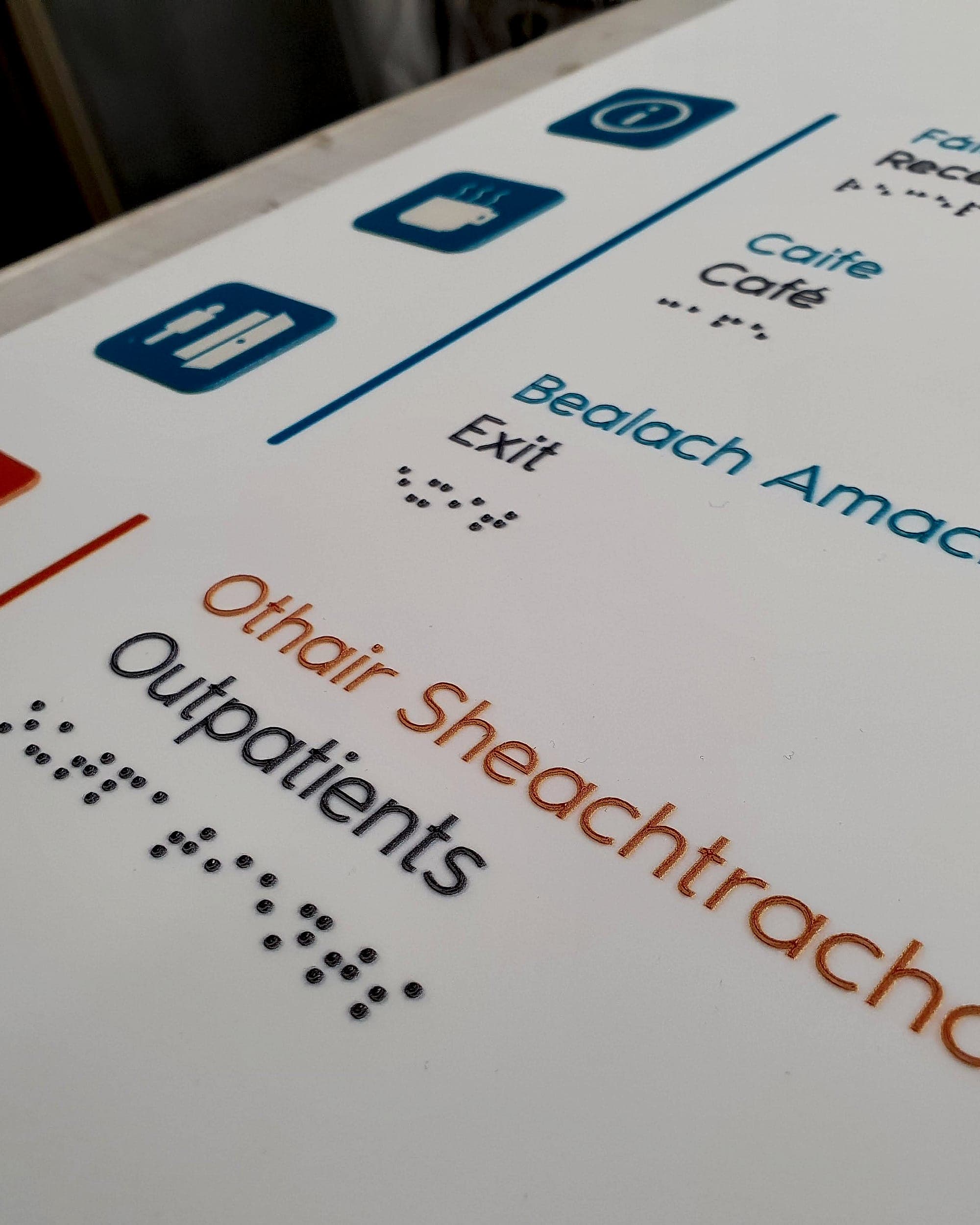
- In Wales, the Welsh Language Standards require signs in public areas, and in internal operational areas where staff have access, to be in Welsh and English, permanent or temporary. NHS Wales Shared Services Partnership restated this for estates teams in Publication Notice 20/01. Each health board has its own compliance notice, which settles questions such as whether Welsh must be read first. See the NHS Wales identity guidance.
- In Scotland, NHSScotland has its own identity and signage guidelines, and reissued the national Wayfinding guidance as best practice with a status note updating its legal references.
- In Northern Ireland, health and social care trusts sit outside the NHS England identity guidelines, and the Equality Act does not extend there.
For a portfolio that crosses borders, that means one wayfinding method and a separate brand and language specification for each nation. Bilingual signage is familiar ground for us: Irish public bodies have required it for more than twenty years, and we've designed it for hospitals, councils and universities. The craft of setting two languages without crowding a sign face transfers directly to Welsh.
New hospitals and the Building Safety Act
One more regime is worth knowing. During design and construction, a hospital in England that is at least 18 metres or seven storeys high falls within the higher-risk building regime under the Building Safety Act 2022, with building control from the Building Safety Regulator. Fire-related signage then forms part of the design approved before work starts, and its information belongs in the golden thread. We cover that in our essay on the Building Safety Act and wayfinding.
How we deliver NHS hospital wayfinding
We've worked with more than 260 healthcare institutions, and we're the only dedicated wayfinding company in the UK and Ireland. On a hospital we write the destination schedule first, agree it with the estates team and clinical leads, then apply the identity and access standards to every sign on one live schedule. Approvals come down from months to days, which matters when every department head wants to see their own signs. Our own teams install around clinical activity, and we sign off the certificates at handover.
- 260+
- healthcare institutions
- 1.8
- design rounds to approval, on average
- 10-year
- warranty on every system we install
Common questions
Appendix- Q.What guidance covers NHS hospital wayfinding signage?
- Three layers. The NHS Estates guidance Wayfinding (2005) sets the planning method. The NHS Identity Guidelines set colours, typefaces and logo placement. Approved Document M, BS 8300-2:2018 and the Equality Act 2010 set accessibility requirements such as contrast, tactile text and mounting heights.
- Q.What font and colours do NHS signs use?
- In England, NHS Blue and white as the dominant colours, set in Frutiger or Arial, with Emergency Services Red for urgent and emergency care. NHS Wales and NHSScotland run separate identities, so check the right guidelines for each nation.
- Q.Do NHS signs in Wales have to be bilingual?
- Yes. Under the Welsh Language Standards, NHS signage in public areas, and in internal operational areas where staff have access, must be in Welsh and English, whether permanent or temporary. Each health board's compliance notice sets the detailed rules.
- Q.Is HTM 65 still current?
- HTM 65 "Signs" was replaced by the NHS Estates guidance Wayfinding, published in a second edition in 2005. That document is still the national reference, and HBN 00-04 refers to it for signage.
- Q.Can you install signage while the hospital stays open?
- Yes. Our own install teams phase the work with the estates team, around clinical activity and emergency routes, so patients never follow a half-changed system.
For hospital projects in Britain, see how we work on UK projects and our health expertise. Or send us the drawings and we'll tell you what the scheme needs.
Building in health? Talk early, while the naming decisions are still cheap.