Skip to content
Wayfinders

School and university wayfinding in the UK

For main contractors, academy trusts, local authorities and university estates teams in England, Scotland, Wales and Northern Ireland.

In short

School and university wayfinding in the UK is set by the client's design standards and the access rules where the building is. For schools in England that means the DfE Technical Manual, which asks for a door sign on every space and a 15-year life for signage, read with Approved Document M and BS 8300-2:2018. We design, install and certify it from one schedule of names.

We have delivered 18+ full university campus rollouts. They are in Ireland, as are all our published education case studies, so the projects on this page are Irish. The approach is the same on a UK estate: one schedule of names, one sign family, with the UK standards in place of the Irish ones.

For campuses, read university and campus wayfinding, which has a UK section. For our education work as a whole, see campus, college and school wayfinding.

01Where it goes wrong

Where UK education schemes go wrong

The system is the same on both sides of the Irish Sea. These are the points where the UK rules catch projects out.

01

Short clauses, long references

The DfE Technical Manual's signage clauses are brief because they lean on British Standards: BS 559, BS ISO 23601, the BS 8300 series and BS 5499. The detail you build to isn't in the contract document, and it gets missed when nobody reads the references.
02

Which version does the contract name?

The January 2026 Technical Manual is part of the employer's requirements for the School buildings construction framework 2025. Earlier programmes used the Generic Design Brief and their own output specifications. Check which one your contract names before you price the signs.

03

Pupils who find unclear routes hard

The DfE's Inclusive education estates guidance explains that confusing circulation and unclear signage can raise anxiety for some pupils with SEND. It makes navigation and wayfinding one of its ten core elements of inclusive design.

04

Campuses that grew a building at a time

Each new building on a university estate tends to arrive with its own signs and its own room numbering. Without one schedule held for the whole estate, students meet a different system at every door, and the Equality Act 2010 keeps accessibility a duty as the estate changes.

05

Student housing brings the fire rules with it

Residential blocks on a campus in England with a top storey over 11 metres need floor identification and flat indicator signs under Approved Document B, and the taller ones fall under the Building Safety Act.

02UK rules

The regulations and standards that apply

Each card opens our plain-English summary in the Standards library, with what it means for signage and a link to the official text.

Schools · England

DfE Technical Manual

Door signs for every space with its name or purpose and agreed number, consistent and durable directional signs, external wayfinding to BS 559, BS ISO 23601, BS 8300 and BS 5499, and a 15-year minimum life.

Read the summary →
Schools · England

Inclusive education estates

June 2026, non-statutory. High-contrast text, consistent symbols, tactile text, a pictorial system such as Makaton, and outdoor signs at child height at decision points.

Read the summary →
Access · England

Approved Document M Vol 2

The access baseline for schools and university buildings in England, including floor identification visible from the lift and an LRV difference of more than 30 points.

Read the summary →
Access · UK

BS 8300-2:2018

The working detail on contrast, viewing heights and touch-legible signs. BSI lists educational buildings within its scope.

Read the summary →
Fire · England

ADB Volume 2

Fire safety in schools and other non-domestic buildings: exit signs to BS ISO 3864-1 and BS 5499-4, refuge signs, and fire door signs.

Read the summary →
Access · Great Britain

Equality Act 2010

The continuing reasonable adjustment duty, plus accessibility plans for schools. Great Britain only.

Read the summary →
Schools · Scotland

Sensory-inclusive Learning Environments

Scotland, March 2026: consistent signs, confirmatory directional signs at decision points on long routes, and contrast between sign and wall.

Read the summary →
Language · Wales

Welsh Language Standards

Bilingual Welsh and English signage for public bodies in Wales.

Read the summary →

03Four nations

England, Scotland, Wales and Northern Ireland

We design to the version of the rules that applies where the building is, and check each nation separately.

England
The DfE Technical Manual for schools and colleges built through its framework, the Inclusive education estates guidance for SEND, and Approved Document M Volume 2 with BS 8300-2:2018 for access.
Scotland
The building standards technical handbooks for access and fire, and the Scottish Government's Sensory-inclusive Learning Environments guidance for nurseries and schools.
Wales
Approved Document M (Wales) for access, and the Welsh Language Standards for public bodies, which put Welsh and English on the signs.
Northern Ireland
Technical Booklet R for access, and the Department of Education's Building Handbook for nursery schools, which since 2024 asks for visual cues, symbols and consistent signage.

04How we deliver

How we deliver it in the UK

Design, project management and installation by our own teams, from our offices in Belfast and London. See how a project runs.

One schedule of names for the estate

Buildings, entrances, departments and rooms named once and numbered so the number tells you where you are. At the National College of Ireland the room numbers ran from S1.01 to S6.18, and the number itself told students which floor they were on.

A door sign for every space

We build the door sign schedule from the schedule of accommodation, so every space carries its name or purpose and its agreed number, as the Technical Manual asks, before any artwork is drawn.

Inclusive from the start

Contrast, mixed-case lettering, tactile text and braille where they're needed, consistent symbols, and heights that work for children, adults and wheelchair users, to Approved Document M, BS 8300-2:2018 and the DfE's inclusive design guidance.

Built to last

Long-life materials such as stove-enamelled aluminium, with fixings chosen for a building used hard every day, specified against the Technical Manual's 15-year minimum.

Installed around the timetable

Our own install teams work around timetables, exams and buildings that stay open, and phase the work so entrances and teaching spaces are never left half-signed.

Approved and certified

Every sign is approved individually on our platform, which cuts approvals from months to days. We sign off the certificates ourselves at handover, and every system carries a 10-year warranty.

Belfast

20 Bridge Road, Moira, Co. Down, BT67 0PF

Our base just outside Belfast, serving projects across Northern Ireland.

London

23 Clerkenwell Green, Clerkenwell, London, EC1R 0NA

Our London office, serving projects across Britain.

05Track record

Our track record, from Ireland

These projects are in Ireland, where all our published case studies are. Each note says what carries across to a UK scheme.

All education work →
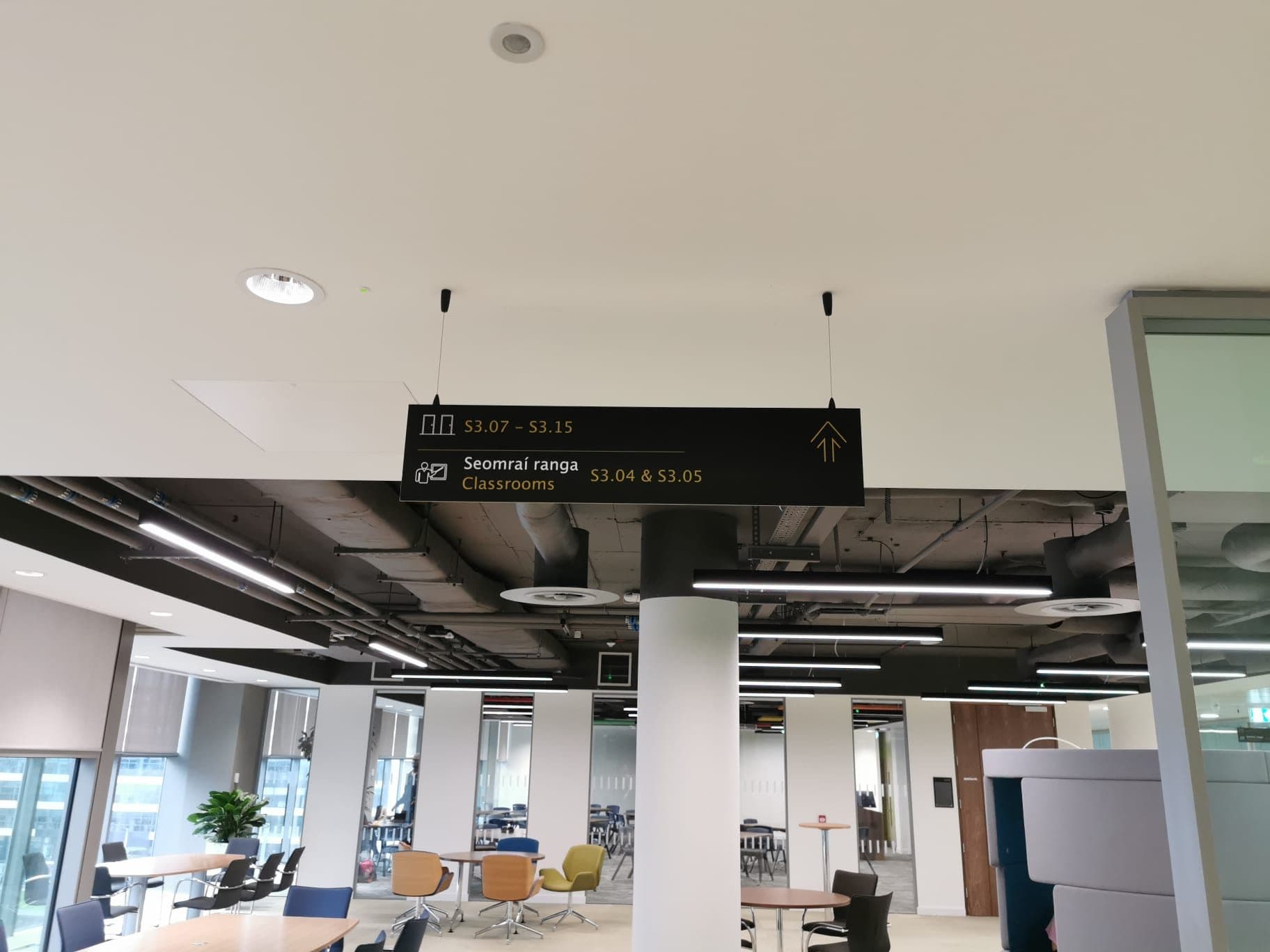
Suspended directional sign to classrooms over the open study floor at National College of Ireland

Education

National College of Ireland, Spencer Dock

An office block became a college in a single academic year. The room numbering did the work of telling students which floor they were on.

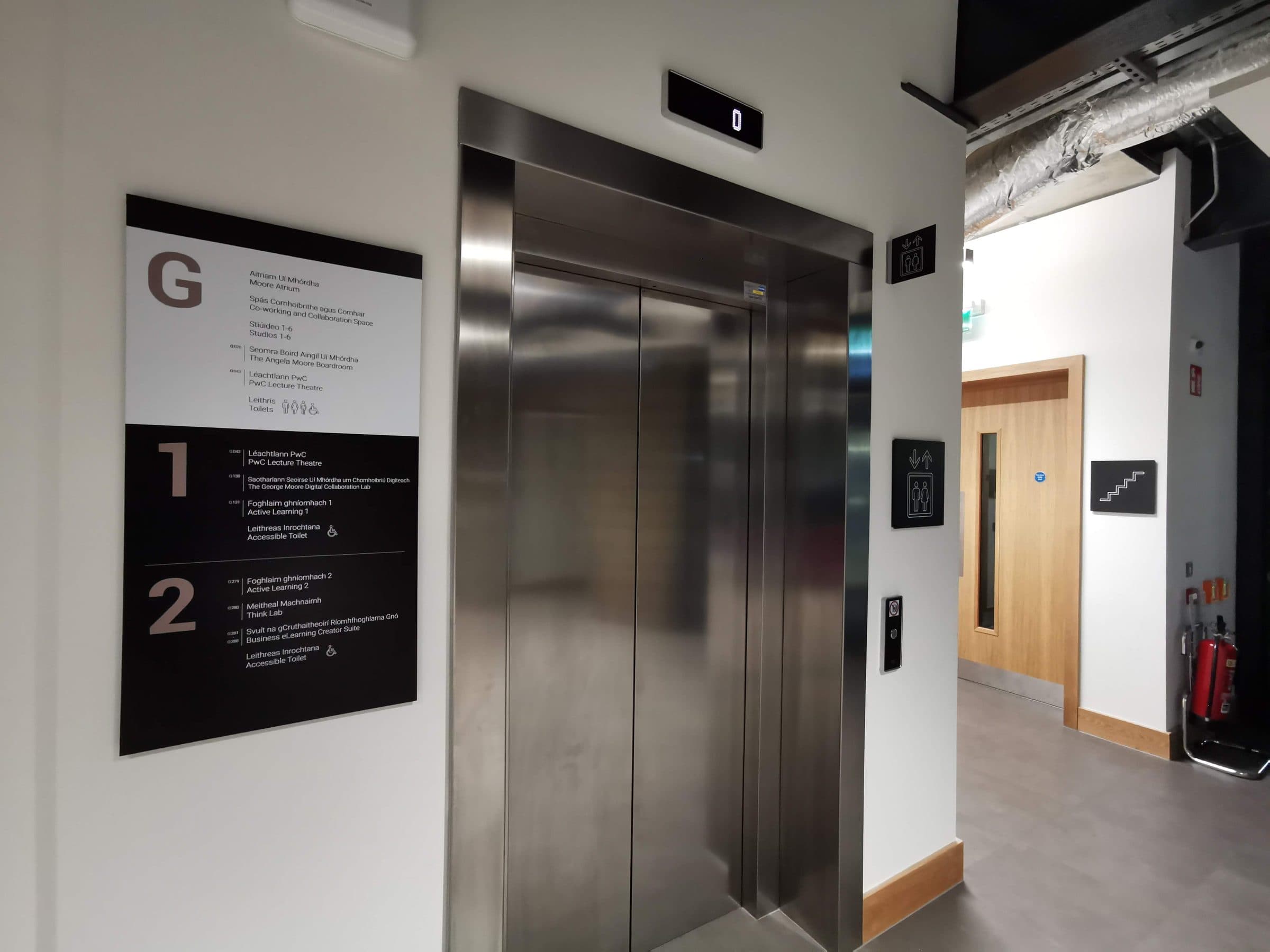
Bilingual floor directory and lift signs in the lift lobby of UCD Moore Centre for Business, Belfield

Education

UCD Moore Centre for Business

Donor and sponsor-named rooms that had to exist in Irish before they could be signed, with the wayfinding ours from strategy to completion.

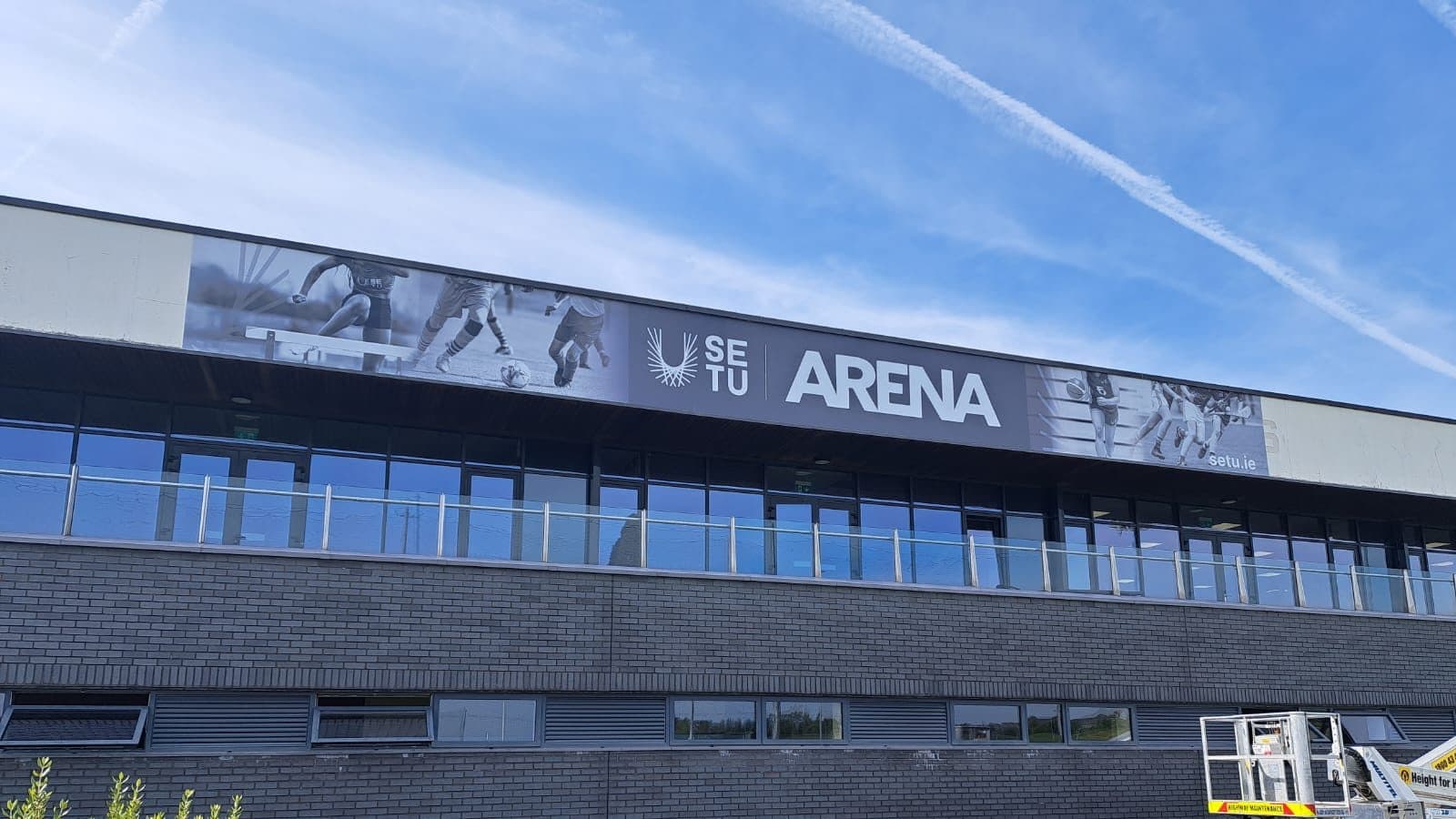
SETU Arena facade lettering on the South East Technological University campus

Education

SETU External Branding Programme

A new university's name on buildings across three counties, in two languages at equal size. The same layout problem as Welsh and English.

06Essays

The detail, in depth

Written by the people who design, install and certify the signs.

All compliance essays →
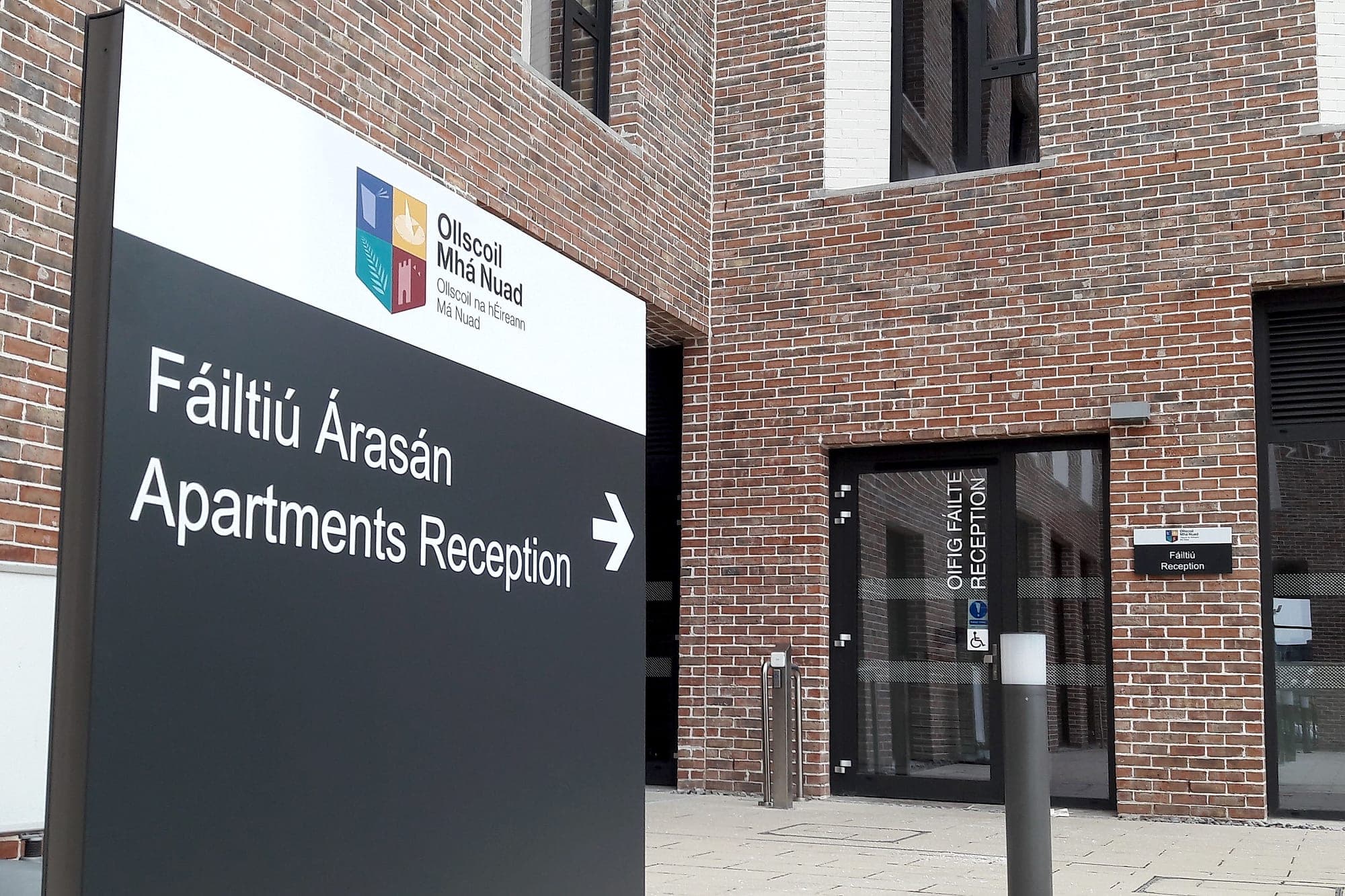
Bilingual campus directional monolith at Maynooth University pointing to apartments reception, with a matching identification plate beside the entrance door it leads to
Wayfinding by Environment · 8 min read

Campus and university wayfinding

Campus and university wayfinding gives a whole estate one system, from the gate to the door plate. Naming, bilingual signs, accessibility and change.

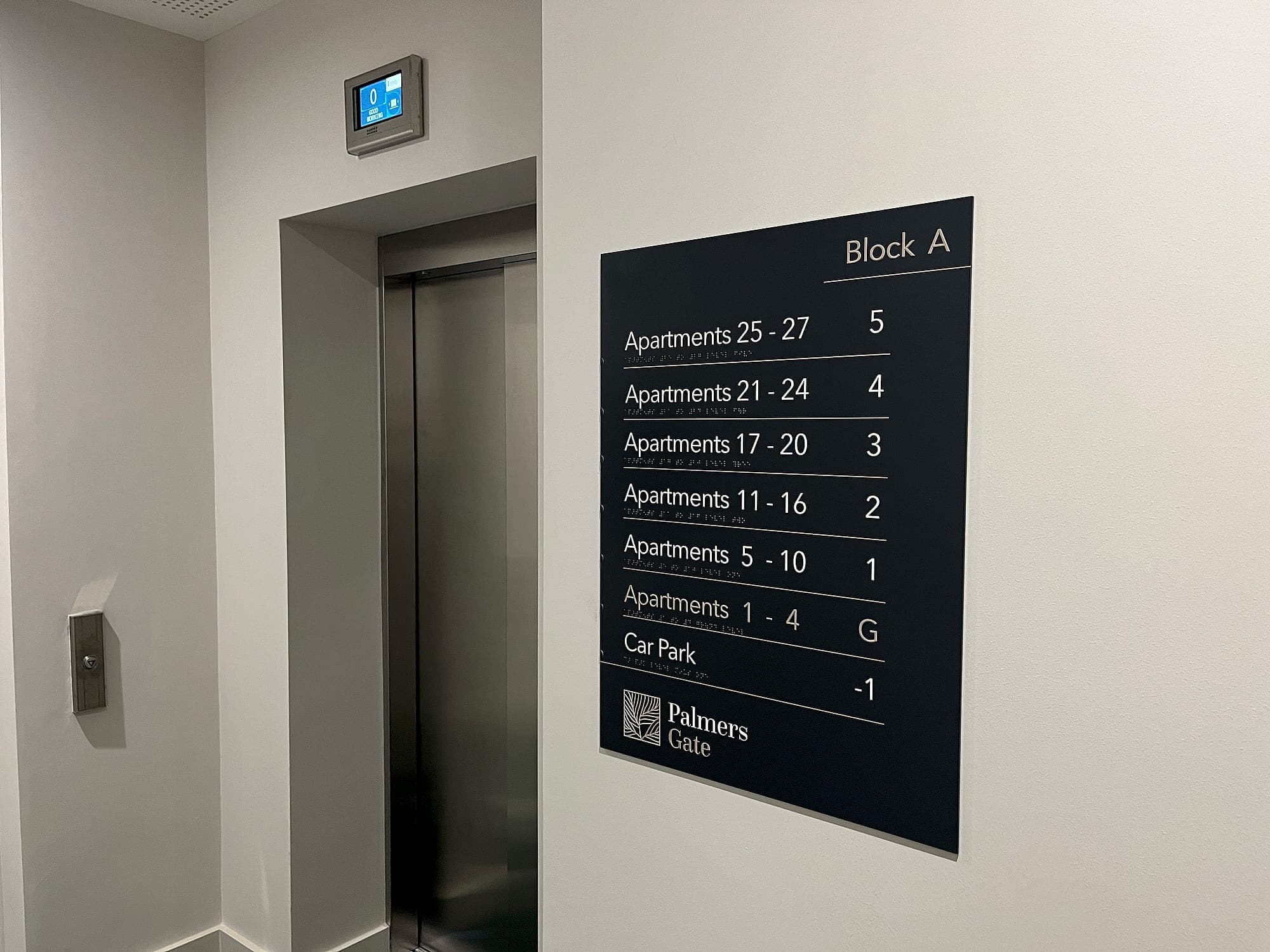
Approved Document M signage principles at a residential lift lobby: a tactile level directory with braille beneath every line, listing apartment ranges by floor beside the lift doors
Compliance & the Law · 8 min read

Approved Document M and accessible wayfinding: what England's guidance asks of a sign

Approved Document M signage in England means contrast, tactile and floor identification to ADM, detail to BS 8300-2:2018, and the Equality Act behind both.

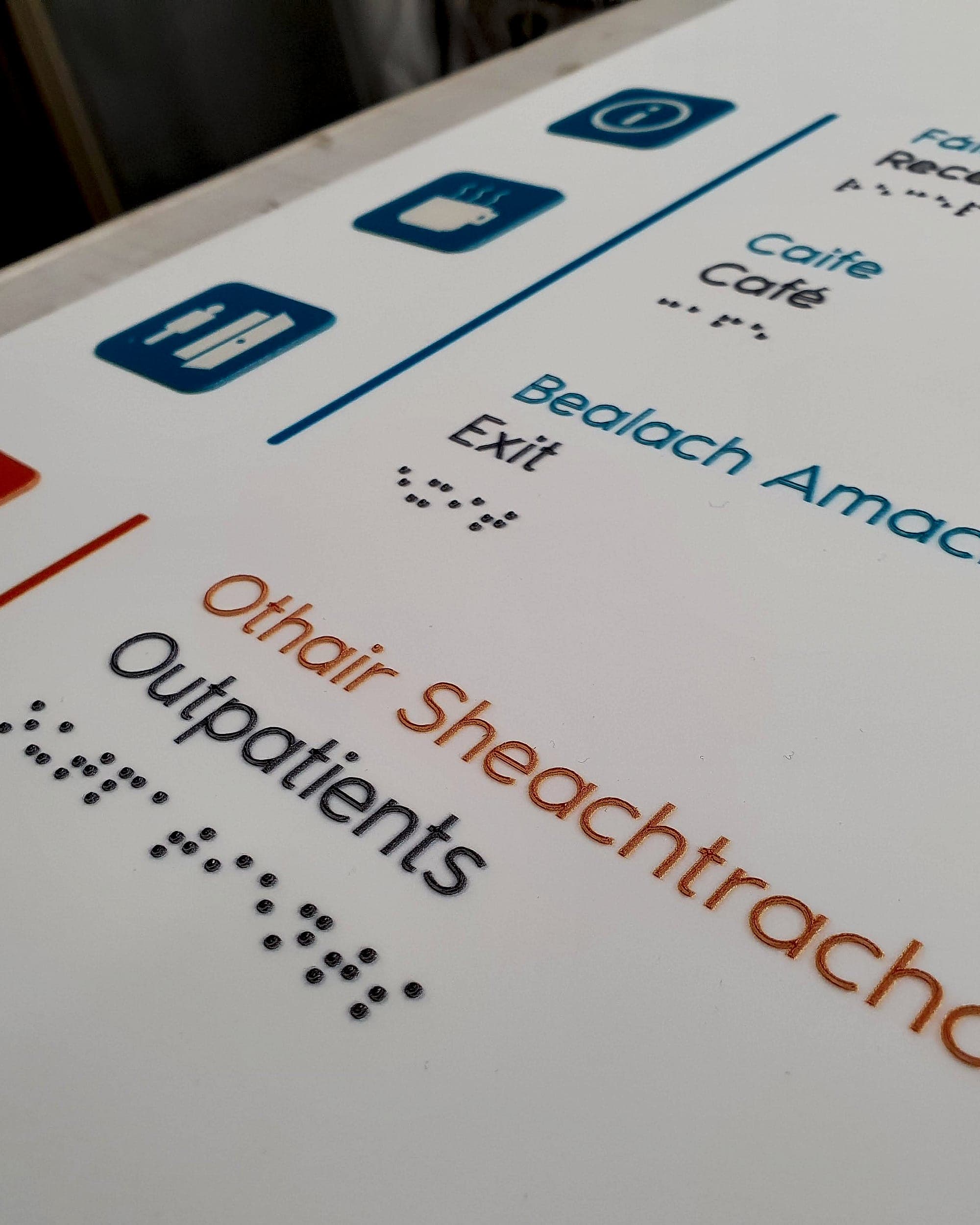
The Rotunda Hospital (BS 8300 compliant signage detail): bilingual tactile wayfinding panel with raised mixed-case lettering, tactile pictograms and braille beneath each line
Accessible by Design · 6 min read

BS 8300 explained: the standard behind accessible wayfinding

The British Standard behind accessible signage: what BS 8300 covers, how it pairs with Part M, and the clauses that decide whether a sign works.

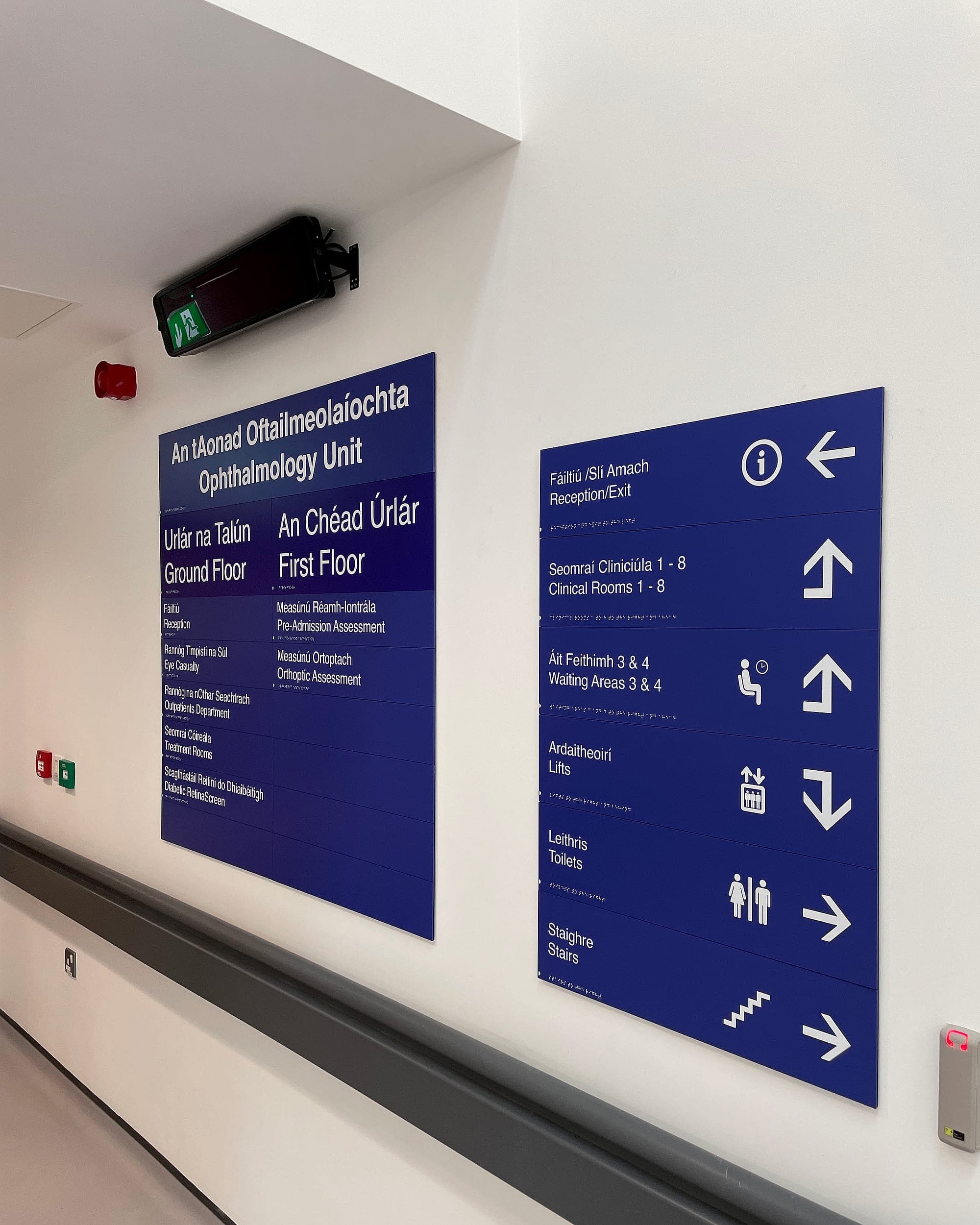
South Infirmary Victoria University Hospital: bilingual hospital directional signs in an ophthalmology unit, every destination anchored by a pictogram and braille, in one repeated format
Accessible by Design · 6 min read

Wayfinding for neurodiversity: autism-friendly signs and calmer, clearer buildings

The busiest buildings are also the loudest. For autistic and neurodivergent visitors, calm, predictable signage is the difference between coping and leaving.

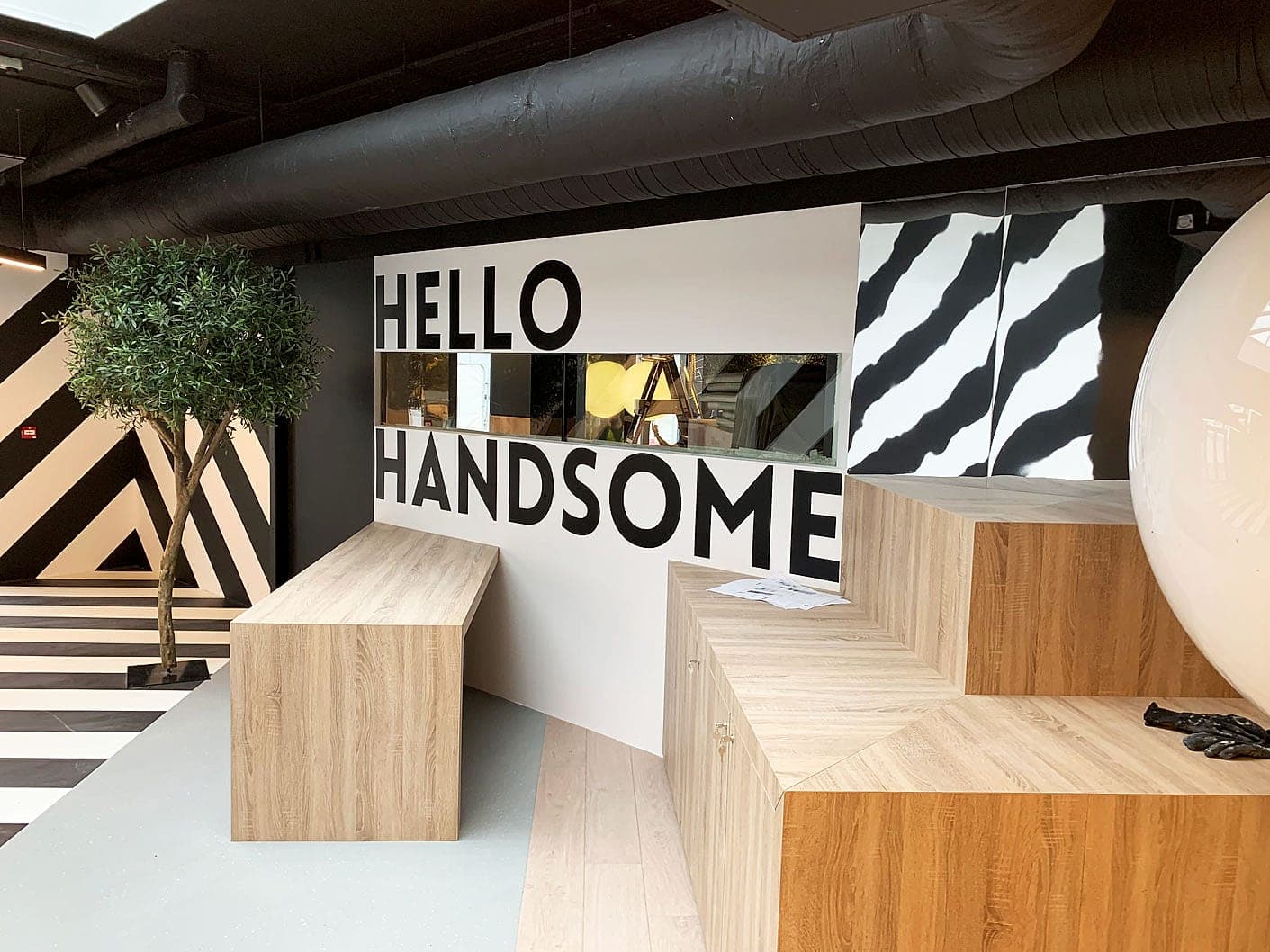
Student accommodation signage at Hatch: oversized HELLO HANDSOME wall lettering above the reception bench, with black and white chevron floor and wall graphics
Wayfinding by Environment · 5 min read

Student accommodation signage: branded living, clear navigation

Purpose-built student housing empties and refills every September, and takes a decade of ordinary wear in about three years. What the signage has to survive.

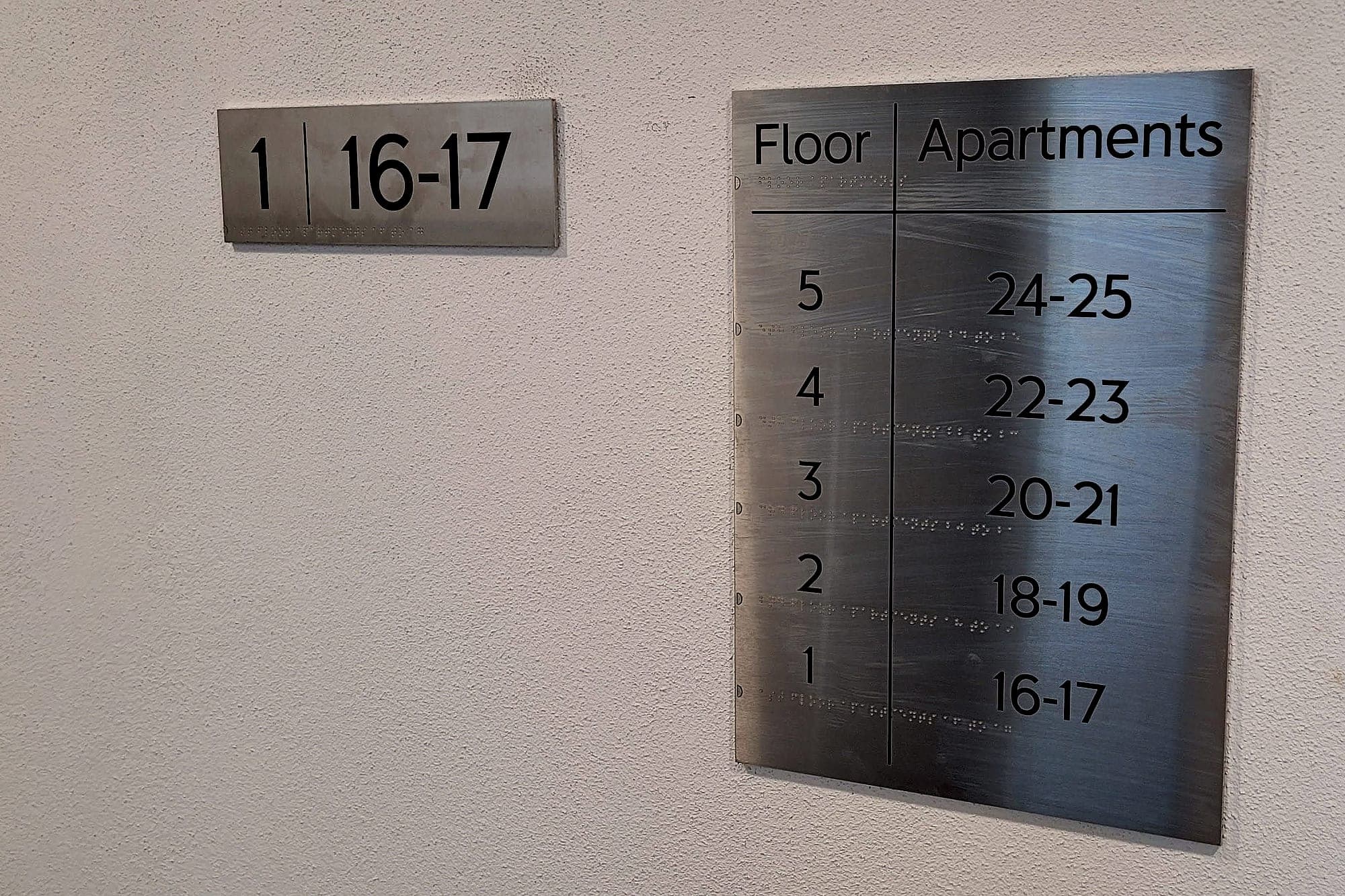
Floor identification and flat indicator signs in an apartment block lift lobby: a brushed stainless plate reading 1 | 16-17 beside a Floor / Apartments board listing floors one to five against apartment ranges
Compliance & the Law · 7 min read

The post-Grenfell wayfinding signage regulations: floor and flat identification above 11 metres

The UK's wayfinding signage regulations turn on two numbers: 11 and 18 metres. What they require, from sizes to heights to wording, and where they get missed.

07FAQs

UK questions

Something else? Call +44 2030 260034 or ask us directly.

Do you deliver school and university wayfinding in the UK?

Yes. Our London office serves education projects across Britain and our base just outside Belfast serves Northern Ireland. Our own teams design the wayfinding, manage the project and install the signs, and we sign off the certificates at handover.

What does the DfE Technical Manual ask for on school signage?

It asks for internal door signage for every space, giving its name or purpose and its agreed number, plus consistent, durable directional signs and external wayfinding signs. Fire safety signs follow BS ISO 3864-1 and BS 5499-4, hazard signs follow the Safety Signs and Signals Regulations 1996, and signage has a minimum life expectancy of 15 years.

Is the DfE Generic Design Brief still the one to design to?

Check your contract first. The current DfE design standards, including the January 2026 Technical Manual, are the employer's requirements for the School buildings construction framework 2025. The Generic Design Brief and earlier output specifications were issued for previous programmes, and a contract may still name one of them.

How do you design school wayfinding for pupils with SEND?

By planning clear routes from the gate to the classroom and signing them consistently. The DfE's Inclusive education estates guidance asks for high-contrast text, consistent symbols, tactile text where appropriate, a pictorial system such as Makaton, and durable outdoor signs at child height at decision points.

Which regulations apply to university signage in the UK?

The building regulations where the campus is set the access baseline: Approved Document M Volume 2 in England, Technical Booklet R in Northern Ireland and Section 4 of the Scottish Technical Handbook. BS 8300-2:2018 supplies the detail, the Equality Act 2010 makes it a continuing duty in Great Britain, and universities in Wales sign in Welsh and English.

Do you have UK school or university case studies?

Our published education case studies are in Ireland, including the National College of Ireland, the UCD Moore Centre for Business and SETU's branding programme across three counties. We have delivered 18+ full university campus rollouts, and a UK estate gets the same approach, designed to the UK standards.

Can you install during term time?

Yes. Our own install teams work around timetables, exams and buildings that stay open, and phase the work so entrances and teaching spaces are never left half-signed. Large changes are usually planned for the summer works window.

Start a UK project

Send the floorplans and the schedule of accommodation.

We'll come back with the wayfinding the school or campus needs under UK rules, the programme and a price.